Most Amazon sellers do not fail because of bad products. They fail because they chose the wrong niche, one that looked promising on the surface but was structurally impossible to compete in at their stage.
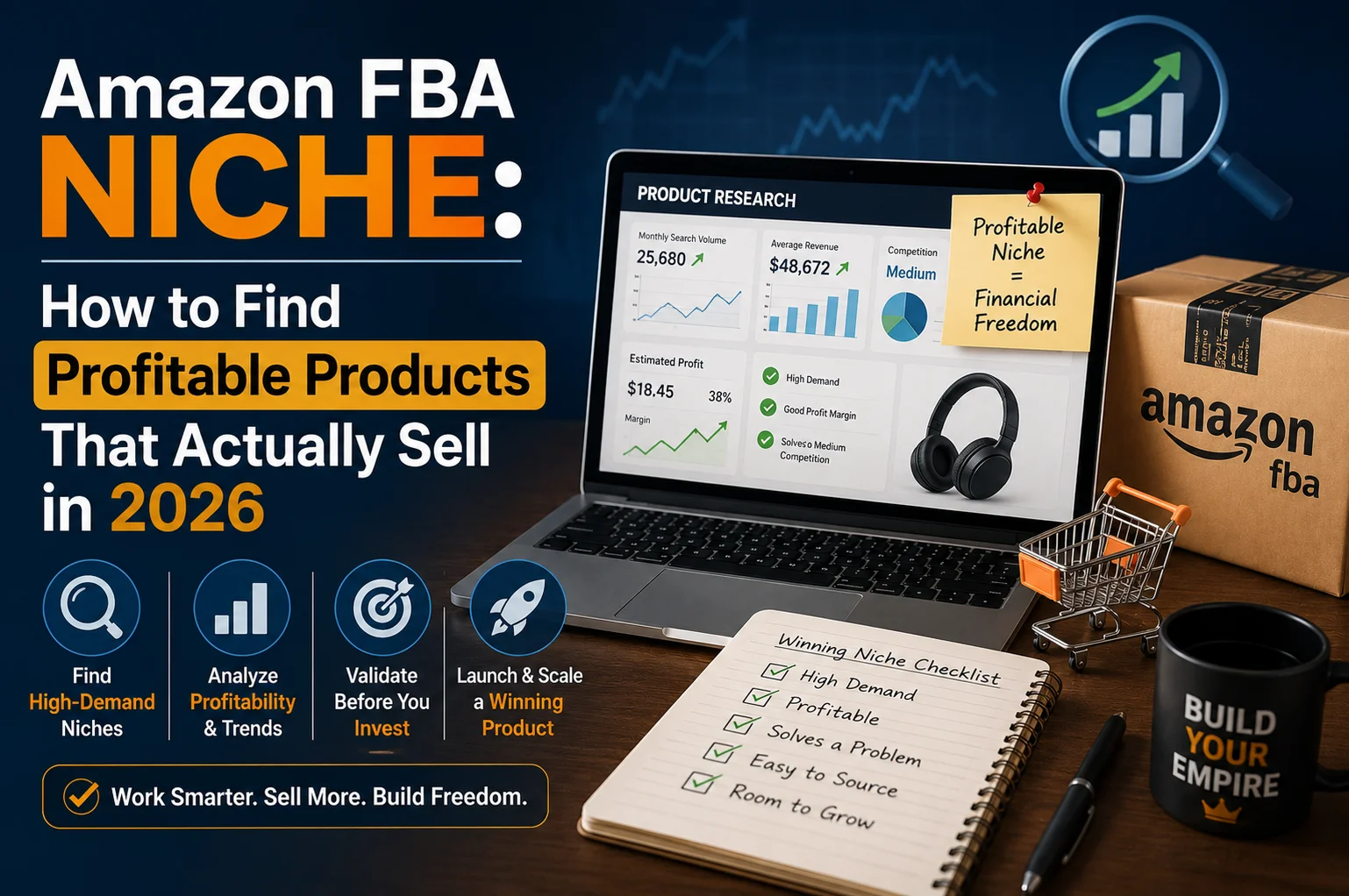
Finding a profitable Amazon FBA niche in 2026 is not about following trends or copying what worked for someone else last year. It is about applying a repeatable validation framework to identify where genuine demand exists, where competition is manageable, and where your margin structure survives the full cost of getting to page one.
This guide covers exactly how that process works, the criteria, the tools, the category signals, and the mistakes that eliminate most sellers before they make their first sale.
For the complete product launch framework this blog supports, read our Amazon Product Launch Strategy: The Ultimate Step-by-Step Guide for 2026.
Why Niche Selection Is the Highest-Leverage Decision in Amazon FBA
Every downstream decision in your Amazon business, your listing strategy, your PPC budget, your inventory commitment, your brand positioning, is shaped by the niche you choose. A structurally strong niche makes every subsequent step easier. A weak niche makes every subsequent step a cost with diminishing return.
The Most Common Niche Selection Mistakes Sellers Make
Sellers who struggle with niche selection almost always fall into one of these patterns:
Choosing saturated categories without a differentiation angle. Entering a niche where the top five listings each have over 5,000 reviews and are backed by established brands means you are buying traffic at premium CPC rates to compete against sellers who have years of review velocity and ranking history working for them.
Selecting products with insufficient margin for PPC. A product with a 15% net margin cannot sustain the launch-phase ACoS required to generate the sales velocity needed for organic ranking. The economics collapse before the product has a chance to succeed.
Validating demand without validating competition depth. High search volume does not mean accessible market share. Some of the highest-volume keywords on Amazon are owned by three or four dominant sellers who will never be displaced by a new entrant without an extraordinary differentiation advantage.
Following seasonal demand without understanding the off-season cliff. Products with extreme seasonality generate strong Q4 numbers and collapse in Q1–Q3. For sellers building year-round businesses, seasonality exposure is a structural risk that undermines unit economics.
What Makes a Profitable Amazon FBA Niche in 2026
The Three-Dimension Validation Framework
A profitable Amazon FBA niche must satisfy three criteria simultaneously. Passing two out of three is not sufficient.
Dimension 1: Proven, Stable Demand
The niche must show consistent monthly search volume, not a spike driven by a trend or a viral moment, but sustained demand that indicates buyers return to this category repeatedly.
Signals of stable demand:
- Primary keyword generating 5,000+ monthly searches with year-round consistency
- Multiple keyword variations showing demand (not a single keyword carrying all volume)
- Category best-seller rank stability among top listings, not dramatic swings that indicate fragile demand
Dimension 2: Manageable Competitive Intensity
The best Amazon FBA niches in 2026 share one consistent characteristic: the top positions are not impenetrable. Specific signals that indicate manageable competition:
- Top 10 organic listings averaging fewer than 500 reviews
- Recent reviews in top positions (active sellers) mixed with stale review accumulation (sellers not investing in growth)
- No single brand holding more than three of the top 10 positions
- Pricing that is not suppressed to the point where margin disappears
Dimension 3: Margin Structure That Survives Launch
This is the criterion most sellers skip, and it is the one that most commonly destroys otherwise sound niche choices. Before committing to a product, the margin calculation must account for:
- FBA fulfillment fees (size tier and weight-based)
- Inbound shipping and prep costs
- Launch-phase PPC spend (which will run at above-target ACoS for the first 30–60 days)
- Refund and return rate for the category
- Platform fees and storage costs
A niche that delivers 25–35% net margin after all of these costs is structurally viable. A niche that delivers 10–15% margin is one where a single bad PPC month erases the entire period’s profit.
The Most Profitable Amazon FBA Niches in 2026
Categories Worth Serious Research Attention
The following categories consistently surface profitable Amazon FBA niches in 2026 when evaluated against the three-dimension framework above. These are starting points for research, not guaranteed wins. The niche is in the sub-category, not the category.
Home & Kitchen – Sub-Niche Specificity Wins
The Home & Kitchen category is large enough to contain hundreds of accessible sub-niches. The sellers who succeed here are not selling “kitchen tools”, they are selling a specific solution to a specific problem for a specific type of buyer. Organization products, space-saving solutions, and specialty prep tools consistently surface viable sub-niches with manageable review counts and strong year-round demand.
Pet Accessories – High Repeat Purchase, Strong Loyalty
Pet owners are among the most loyal repeat purchasers on Amazon. Sub-niches within pet accessories, particularly those targeting specific breeds, life stages, or activity types, show strong demand with less competition than the broad category implies. The key is specificity: “dog leash” is saturated; “hands-free running leash for medium dogs” is a sub-niche.
Health & Personal Care – Intent-Rich, Margin-Positive
Health and personal care products attract buyers with high purchase intent and tolerance for premium pricing when claims are credibly supported. Low competition Amazon FBA niches in 2026 within this category tend to be found at the intersection of a specific health concern and a product format that existing sellers have not fully optimized.
Office & Work-From-Home Supplies – Durable Structural Demand
The permanent shift toward hybrid work has created durable, year-round demand in office and WFH supply sub-niches. Ergonomic accessories, cable management, monitor solutions, and desk organization categories continue to surface high demand, low competition Amazon FBA niches when researched at the sub-category level.
A Note on “Trending” Niches
Trending Amazon FBA niches in 2026 attract attention, and competition, fast. A niche that is trending today will often have 50–100 new sellers entering it within 60–90 days of the trend becoming visible in research tools. Trend-chasing works for sellers who can source and launch within 30 days. For most FBA sellers with standard lead times, entering a trend niche means arriving after the first-mover advantage is gone.
Tools for Finding Profitable Amazon FBA Niches in 2026
The Research Stack That Actually Works
Professional niche research uses tools in sequence, each answering a specific question rather than all tools answering the same question redundantly.
Helium 10 (Black Box + Cerebro): Product database filtering for demand volume, review count, price point, and estimated revenue. The starting point for generating a candidate list of sub-niches worth deeper evaluation.
Jungle Scout (Product Database + Opportunity Finder): Revenue estimation and demand trend analysis. Most useful for cross-referencing Helium 10 findings and assessing niche scoring across multiple variables simultaneously.
Amazon Brand Analytics: For sellers with brand-registered accounts, Brand Analytics provides actual buyer search and purchase behavior data, the most accurate demand signal available because it comes directly from Amazon’s own data. No third-party estimation error.
Manual Search Term Report Analysis: Running auto campaigns on existing products (or a test product) generates real search term data that no third-party tool can replicate. For sellers with any existing inventory, this is the highest-value data source for niche expansion research.
For a complete breakdown of how each tool fits into the research workflow, read our guide on best tools for Amazon product research in 2026.
The Pre-Launch Validation Checklist
Before Committing to Any Niche – Run This Check
Every Amazon FBA niche that passes initial screening should be validated against this checklist before inventory is sourced:
The 7-Point Niche Validation Checklist
- Review count check: Do the top 10 organic results average fewer than 500 reviews? If yes, the niche has entry points. If no, identify whether any position in the top 10 is held by a listing with under 200 reviews, that is your opening.
- Price point stability: Are the top listings priced consistently within a 20–30% range? Wide price dispersion signals a category without established value anchors, which can mean opportunity or commodity pricing risk.
- Keyword variation depth: Does the primary keyword have meaningful supporting keyword variation? A niche with one high-volume keyword and no supporting terms is fragile, one ranking change eliminates most of your traffic.
- Review recency: Are the top listings accumulating reviews consistently, or are review counts stale? Stale review accumulation in top positions can indicate low category engagement, either an opportunity or a signal that conversion rates are poor.
- Margin viability calculation: Has the full landed cost been calculated, including FBA fees, inbound shipping, PPC allowance, and return rate, and does the resulting net margin reach 25%+?
- Seasonal demand assessment: Does the product’s search volume hold at 60%+ of peak volume during its weakest months? If not, the business model requires seasonal inventory management and cash flow planning.
- Differentiation pathway: Is there a specific, executable way to make your version of this product meaningfully better than the current top sellers, through design, materials, bundling, or positioning, rather than just cheaper?
A niche that passes all seven points is worth sourcing. A niche that fails on margin or differentiation is worth dropping regardless of how strong the demand signals look.
How EcomManagers Approaches Niche Research for Clients
Research That Connects to the Full Launch Process
Niche research at EcomManagers is not a standalone deliverable. Every niche we identify for a client is evaluated in the context of their full Amazon product launch strategy, including listing optimization requirements, realistic launch-phase PPC budgets, and the timeline to organic rank that the competitive landscape implies.
This integration is what separates research that produces a list of products from research that produces a launchable business plan.
Whether you are operating through Amazon Services USA, Amazon Services UK, Amazon Services UAE, or Amazon Services Germany, niche dynamics differ by marketplace. A sub-niche that is saturated in the US may be significantly more accessible in the UK or Germany. Our regional research accounts for marketplace-specific review counts, CPC levels, and buyer behavior patterns.
Explore our Amazon Product Research Services to see how we build niche research into a complete launch readiness assessment.
Frequently Asked Questions
What are the most profitable Amazon FBA niches in 2026?
The most consistently profitable niches are found within Home & Kitchen, Pet Accessories, Health & Personal Care, and Office & WFH Supplies, specifically at the sub-niche level where demand is proven and competition has not yet consolidated around dominant brands. The specific sub-niche matters far more than the broad category.
How do I find low competition Amazon FBA niches in 2026?
Filter by review count first. In any product database tool, set a maximum average review count for the top 10 results, typically under 300–500 depending on your launch budget. Then cross-reference against demand volume and margin viability. Low competition Amazon FBA niches in 2026 exist across categories; they require granular filtering to surface.
What is the minimum budget to enter an Amazon FBA niche?
Most viable niche launches require $2,000–$5,000 for initial inventory plus $1,500–$3,000 for launch-phase PPC. Total launch readiness typically falls in the $4,000–$8,000 range depending on category competitiveness and price point. Underfunding the PPC phase is one of the most common reasons structurally sound niche choices fail to build ranking momentum.
Are there untapped Amazon niches in 2026?
Completely untapped niches, categories with high demand and zero competition, are rare. More realistically, untapped Amazon niches in 2026 are sub-niches within established categories where competition exists but has not yet optimized: weak listings, poor images, thin A+ Content, or limited keyword coverage that a well-executed launch can outperform.
Should I choose trending or evergreen Amazon FBA niches?
Evergreen niches, products with year-round, stable demand, are structurally preferable for most sellers. Trending Amazon FBA niches can generate fast early sales but attract rapid competition and often collapse once the trend cycle peaks. Unless you can source and launch within 30 days of identifying a trend, evergreen sub-niches deliver more predictable long-term economics.
Can EcomManagers help me find a profitable niche for my Amazon launch?
Yes. Our Amazon Product Research Services include niche identification, competitive analysis, margin modeling, and full launch readiness assessment, available for sellers across the USA, UK, UAE, and Germany.
Conclusion
Finding a profitable Amazon FBA niche in 2026 does not guarantee success, but choosing the wrong one makes success structurally impossible regardless of how well everything else is executed. The validation framework in this guide exists to eliminate structurally weak choices before a dollar of inventory spend is committed.
If you want EcomManagers to run this process for your next product, explore our Amazon Product Research Services and book a free strategy consultation today.