Amazon advertising has always had a data problem. Not a shortage of data, if anything, there is too much of it. The real problem has been timing. For years, Amazon sellers and agencies were making bidding decisions based on data that was already 12 to 24 hours old. By the time you saw what happened with your campaigns yesterday, the opportunity to act on it had already passed.
Amazon Marketing Stream changes that completely.
Launched as part of Amazon Ads API, Amazon Marketing Stream delivers near real-time advertising data directly to sellers and agencies giving you the ability to see what is happening in your campaigns as it happens, not the next morning. For serious Amazon advertisers, this is one of the most significant developments in the platform’s advertising infrastructure in recent years.
In this guide, we break down exactly what Amazon Marketing Stream is, how it works, what data it delivers, and how you can use it to make smarter, faster advertising decisions in 2026.

What Is Amazon Marketing Stream?
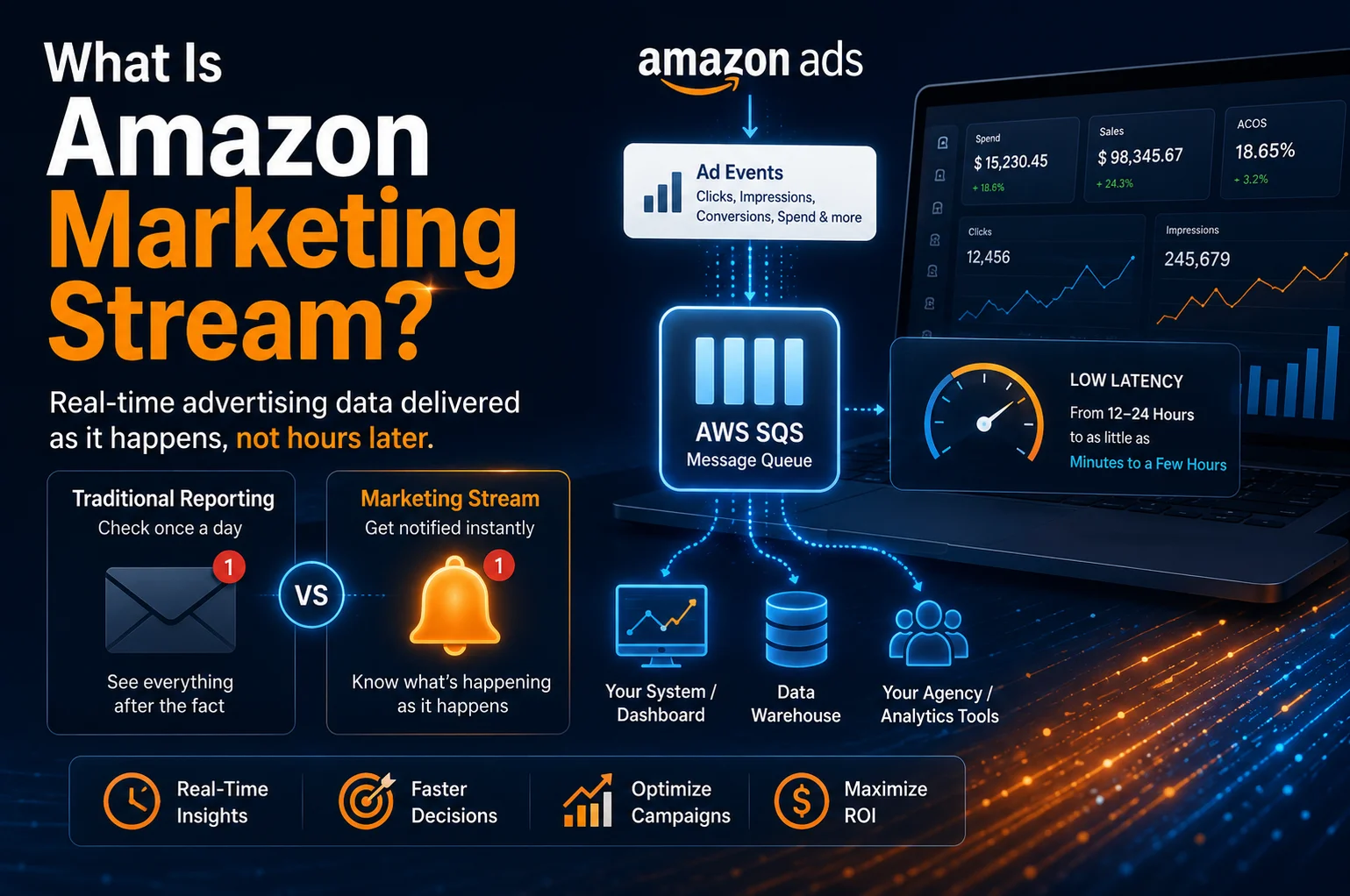
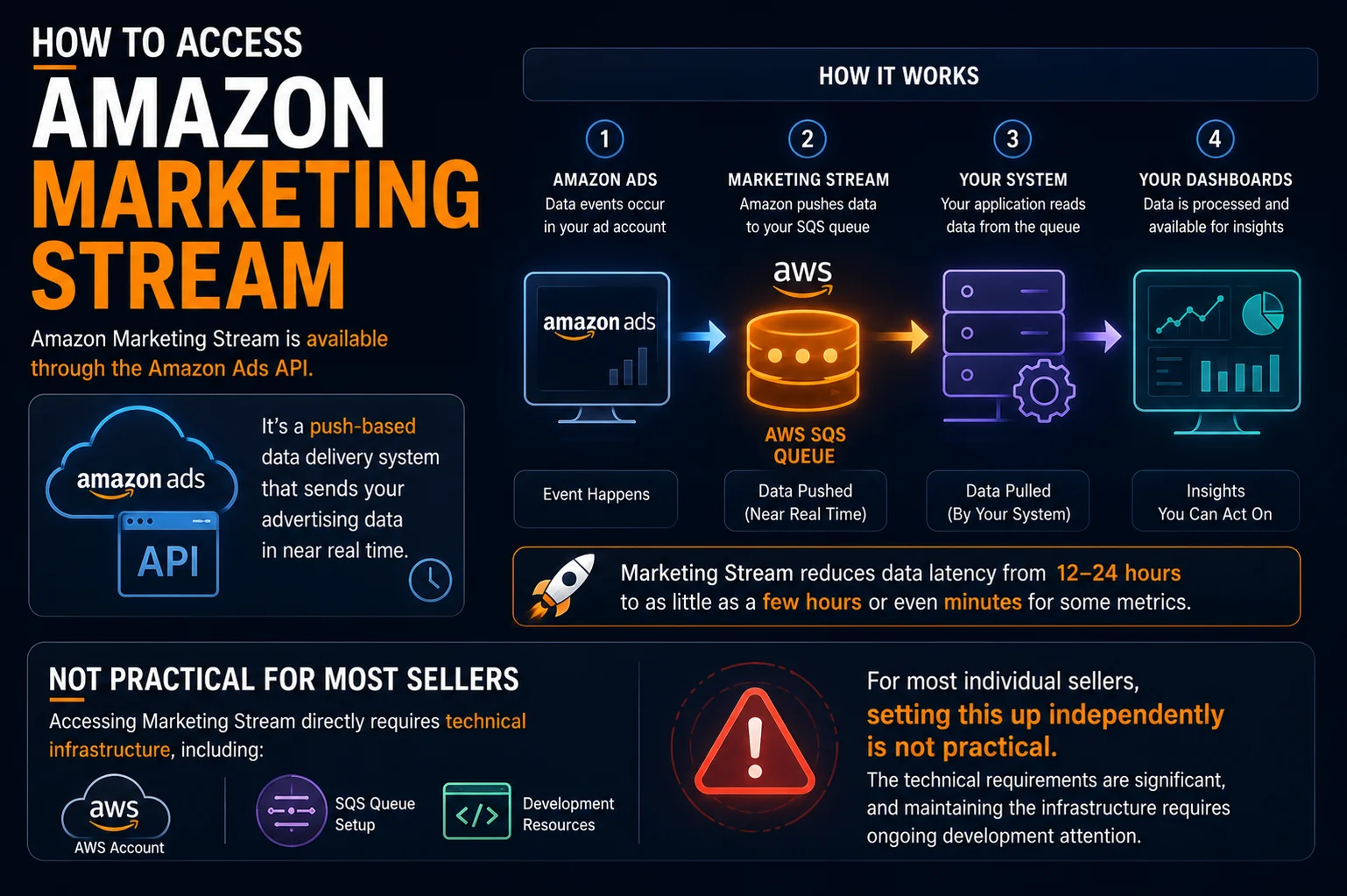
Amazon Marketing Stream is a push-based data delivery system built on top of the Amazon Ads API. Instead of requiring you to pull reports from Amazon at scheduled intervals, which is how traditional Amazon advertising reporting works, Marketing Stream pushes data to you automatically as events occur.
Think of the difference this way. Traditional Amazon advertising reporting is like checking your email once a day. You see everything that happened, but only after the fact. Amazon Marketing Stream is like receiving notifications in real time, you know what is happening as it happens.
The system uses an AWS Simple Queue Service (SQS) architecture. Amazon pushes advertising data into a message queue, and your system or your agency’s system, reads from that queue continuously. This means data latency drops from 12-24 hours to as little as a few hours for most data types, with some metrics available within minutes.
What Data Does Amazon Marketing Stream Deliver?
Amazon Marketing Stream covers a comprehensive range of advertising data across Sponsored Products, Sponsored Brands, and Sponsored Display campaigns. Understanding what data is available is key to understanding how to use it effectively.
Campaign Performance Data
Impressions, clicks, spend, and conversions broken down by hour. This hourly granularity is one of the most powerful aspects of Marketing Stream. Instead of seeing that a keyword spent $200 yesterday, you can see exactly which hours of the day drove the most spend, the best CTR, and the highest conversion rate.
Budget Consumption Data
Real-time visibility into how your campaign budgets are being consumed throughout the day. This is critical for preventing budget exhaustion during peak hours, which causes your ads to stop showing at precisely the moments when shoppers are most active.
Placement Performance Data
performance broken down by placement type, including top of search, rest of search, and product pages. Hourly placement data lets you see patterns that daily reporting completely masks.
Targeting Data
keyword and product targeting performance at hourly intervals, allowing you to identify which targets perform differently at different times of day and adjust bids accordingly.
Traffic Data
detailed impression and click data that helps you understand when your target audience is most active on Amazon and most likely to convert.
Why Hourly Data Changes Everything
Most Amazon sellers who have not used Marketing Stream do not fully appreciate why hourly data is such a significant upgrade over daily reporting, until they see it in action.
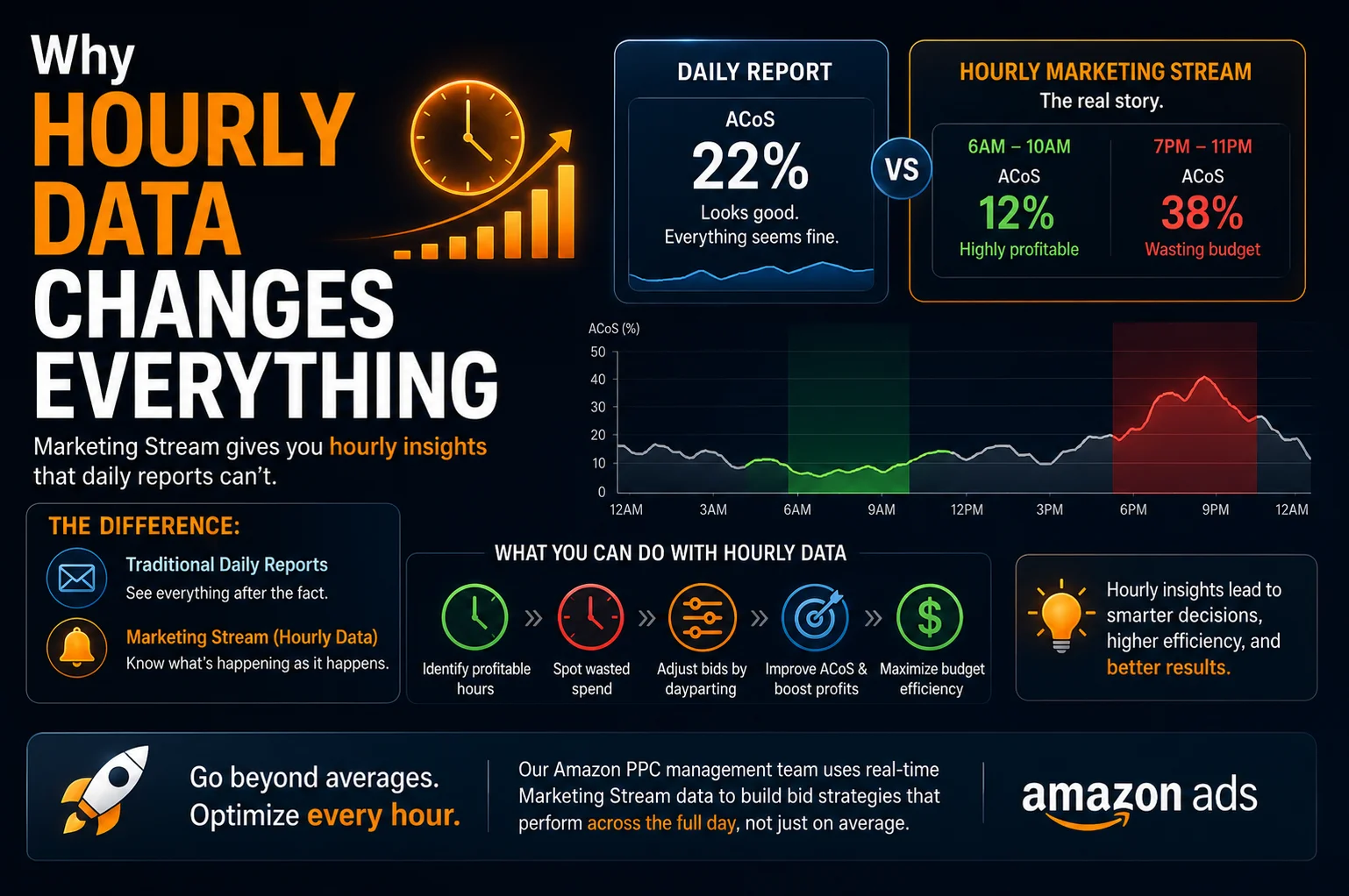
Here is a concrete example. Suppose you are running a Sponsored Products campaign for a kitchen product. Your daily report shows a respectable ACoS of 22%, well within your target range. Everything looks fine.
But your hourly Marketing Stream data tells a very different story. Between 6am and 10am, your ACoS is 12%, highly profitable. Between 7pm and 11pm, your ACoS spikes to 38%, well above break-even. The daily average of 22% was hiding the fact that you were wasting a significant budget every evening.
With Marketing Stream, you can set dayparting rules, adjusting bids up during your most profitable hours and down during your least profitable ones. This single optimization, made possible only by hourly data, can dramatically improve your overall campaign efficiency without changing a single keyword or bid strategy.
This is the kind of insight that separates sellers running average campaigns from sellers running highly optimized ones. Our Amazon PPC management team uses exactly this kind of data to build bid strategies that perform across the full day, not just on average.
How to Access Amazon Marketing Stream
Amazon Marketing Stream is available through the Amazon Ads API. This means accessing it directly requires technical infrastructure, specifically, an AWS account, an SQS queue setup, and the development resources to build and maintain the data pipeline.
For most individual sellers, setting this up independently is not practical. The technical requirements are significant, and maintaining the infrastructure requires ongoing development attention.
There are two realistic paths to accessing Marketing Stream data:
Through a PPC Management Agency or Tool
Most sophisticated Amazon PPC agencies and advanced advertising tools have already integrated Marketing Stream into their reporting and optimization workflows. When you work with an agency that uses Marketing Stream, you benefit from the real-time data without needing to build any infrastructure yourself.
Through Amazon Ads API Partners
A growing number of Amazon Ads API partners have built dashboards and optimization tools on top of Marketing Stream. Tools like Perpetua, Pacvue, and Skai have integrated Marketing Stream data into their platforms, making it accessible through a standard software interface.
If you are evaluating agencies or tools and real-time data optimization matters to you, asking whether they use Amazon Marketing Stream is a good qualifying question. Agencies that are not using it are making decisions based on yesterday’s data, which in a fast-moving advertising environment is a meaningful disadvantage.
Practical Ways to Use Amazon Marketing Stream Data
Understanding what Marketing Stream delivers is one thing. Knowing how to act on it is what drives actual results.
Dayparting optimization
As described above, use hourly performance data to identify your most and least profitable hours. Adjust bids using bid modifiers or scheduled rules to maximize spend during high-performance windows and reduce waste during low-performance ones.
Budget Pacing
Monitor budget consumption in real time to prevent your campaigns from running out of budget before the day’s peak shopping hours. If your campaigns consistently exhaust their budget by early afternoon, you are missing evening traffic when many categories see their highest conversion rates.
Rapid Response to Performance Shifts
When a keyword or campaign suddenly starts over-spending or underperforming, Marketing Stream lets you catch it within hours rather than the next morning. Early detection means smaller losses and faster corrections.
Daypart-level Bid Strategy
Rather than using a single bid across the entire day, use hourly data to build different bid strategies for different time windows. Morning commute hours, lunch hours, and evening browsing sessions often have very different conversion characteristics within the same category.
Competitive reaction
Hourly impression share data can reveal when competitors are increasing their bids or budgets in real time. Responding quickly to competitive shifts, rather than discovering them in yesterday’s report, keeps you in the game during peak traffic windows.
Amazon Marketing Stream vs Traditional Reporting
It is worth being clear about what Marketing Stream is and what it is not. It does not replace Amazon’s standard reporting suite, Search Term Reports, Campaign Performance Reports, and Placement Reports are still essential tools for strategic analysis.
What Marketing Stream does is fill the timing gap that standard reporting leaves open. Use standard reports for weekly and monthly strategic reviews, identifying long-term trends, keyword pruning, and budget allocation decisions. Use Marketing Stream for daily and intraday tactical decisions, bid adjustments, budget management, and rapid response to performance changes.
The two approaches are complementary, not competing.
Conclusion
Amazon Marketing Stream represents a genuine shift in how sophisticated advertisers manage Amazon PPC campaigns. Real-time hourly data removes the guesswork from dayparting, budget management, and performance optimization, replacing it with decisions grounded in what is actually happening in your campaigns right now, not what happened yesterday.
For sellers running significant ad budgets on Amazon, not using Marketing Stream data means leaving optimization opportunities on the table every single day.
If you want your Amazon advertising managed by a team that uses real-time data to build campaigns that consistently outperform, explore how EcomManagers‘ Amazon PPC service can help you scale profitably. And if you have questions about what to expect from a professional PPC partner, our Amazon PPC agency FAQs is a good place to start.