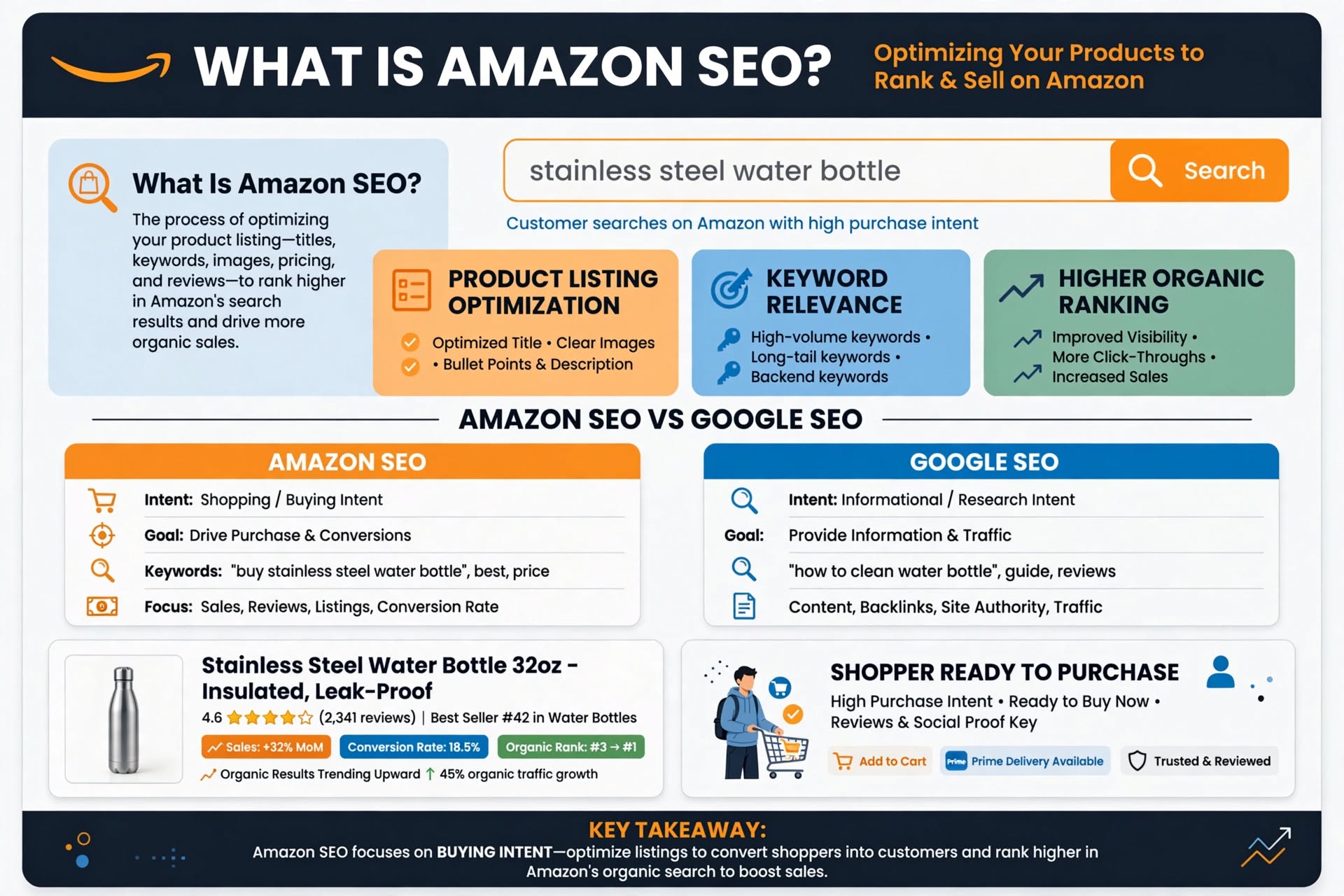
Step 1: Start With Amazon Keyword Research
Keyword research should come before you rewrite your product listing.
The first objective is to understand how shoppers search for products like yours.
Find Relevant Amazon Search Terms
Start with the phrases customers are likely to enter into Amazon’s search bar.
For example, if you sell a reusable insulated bottle, potential searches could include:
- insulated water bottle
- stainless steel water bottle
- reusable water bottle
- insulated bottle for travel
- leakproof water bottle
The important point is relevance.
Do not select a keyword simply because it has a large search volume. A highly searched term that does not accurately describe your product can attract the wrong shoppers and produce weak conversions.
Use Amazon Search Suggestions
Amazon’s search autocomplete is a useful starting point for keyword search on Amazon.
Enter a broad product term and review the suggestions Amazon provides. These suggestions can reveal variations that shoppers commonly search for.
You can also examine:
- Competitor product titles
- Bullet points
- Product descriptions
- Category terminology
- Customer reviews
- Frequently mentioned product features
Third-party free SEO keyword research tools can also help expand your initial list, but Amazon-specific search behavior should remain your priority.
Build a Keyword Map
Once you have your keyword list, organize terms according to their importance.
A simple structure is:
Keyword Type | Example |
Primary keyword | insulated water bottle |
Secondary keyword | stainless steel water bottle |
Long-tail keyword | insulated water bottle for travel |
Feature keyword | leakproof water bottle |
Use-case keyword | water bottle for hiking |
This prevents you from forcing the same phrase repeatedly throughout your listing.
Don’t Chase Every Keyword
A common mistake is trying to rank for dozens of unrelated searches.
Instead, focus on keywords that accurately represent:
- What the product is
- What problem it solves
- Who it is for
- Where or how it is used
- What makes it different
This creates a stronger foundation for listing SEO.
Step 2: Optimize Your Amazon Product Title
Your title is one of the most important elements of an Amazon listing.
It helps shoppers understand the product while giving Amazon additional information about relevance.
Create a Clear, Keyword-Relevant Title
A strong title should communicate the product naturally.
A useful structure can include:
Brand + Product Type + Key Feature + Size/Quantity + Important Use Case
For example:
Brand X Stainless Steel Water Bottle, Insulated Leakproof Travel Bottle, 32 oz
The exact title format should follow Amazon’s current category-specific requirements.
Avoid Keyword Stuffing
Repeating the same phrase several times does not make a title better.
Instead of:
Insulated Water Bottle, Insulated Bottle, Water Bottle Insulated, Insulated Stainless Steel Bottle
write naturally for the customer.
Amazon SEO should improve search relevance and shopping clarity, not make the listing difficult to read.
Step 3: Optimize Your Bullet Points
Your bullet points have two jobs:
- Explain the product’s benefits
- Help shoppers decide whether to purchase
Use them to communicate important features and outcomes.
Focus on Benefits, Not Just Features
Instead of:
Double-wall stainless steel construction.
Consider:
Keeps Drinks Cold Longer: Double-wall stainless steel insulation helps maintain a refreshing temperature during commutes, workouts, and outdoor trips.
This approach naturally incorporates relevant search language while giving shoppers a reason to buy.
Use Different Keyword Variations
Do not repeat the primary keyword in every bullet.
Instead, incorporate relevant variations and related terminology.
For example:
- insulated bottle
- stainless steel bottle
- reusable drink container
- leakproof bottle
- travel bottle
This improves topical relevance without creating unnatural copy.
Step 4: Improve Your Product Description
Your product description provides additional space to explain what makes the product useful.
Use it to answer questions shoppers may have after reading the title and bullets.
Cover areas such as:
- Product purpose
- Main features
- Materials
- Dimensions
- Compatibility
- Use cases
- Care instructions
- Key differentiators
The description should support the buying decision rather than becoming a list of keywords.
Use Natural Language
Modern marketplace optimization is increasingly about relevance and context rather than mechanical keyword repetition.
Write for a real shopper first.
If a sentence sounds unnatural because a keyword was forced into it, rewrite the sentence.
Step 5: Use Backend Search Terms Strategically
Amazon provides backend fields where sellers can provide additional search terms that may help Amazon understand the product.
These terms are not intended to be visible promotional copy.
What Should You Include?
Consider relevant terms that did not fit naturally into the visible listing, including:
- Keyword variations
- Alternative phrases
- Common abbreviations
- Relevant use cases
- Synonyms
- Search terminology
Avoid adding irrelevant terms simply because they have high search volume.
You should also avoid wasting backend space by repeatedly entering keywords already represented unnecessarily.
The goal is to expand relevant search coverage.
Step 6: Optimize Images for Better Organic Performance
Images are primarily a conversion element, but conversion matters for overall marketplace performance.
A shopper who clicks your listing but cannot understand the product quickly is less likely to buy.
Your Main Image
Your main image should clearly communicate what the customer is purchasing and follow Amazon’s image requirements for your category.
Supporting Images
Use additional images to demonstrate:
- Product dimensions
- Features
- Product-in-use scenarios
- Materials
- Packaging
- Compatibility
- Before-and-after benefits where appropriate
- Comparison information where permitted
Your images should reduce uncertainty.
The easier it is for shoppers to understand the product, the stronger the opportunity for conversion.
Step 7: Improve Your Conversion Rate
Getting visibility is only part of the challenge.
If shoppers frequently click your listing but rarely purchase, simply adding more keywords is unlikely to solve the problem.
Why Conversion Matters for Amazon SEO
Amazon wants to connect shoppers with products that satisfy their searches.
If relevant traffic consistently arrives but fails to convert, your listing may have difficulty competing against products that generate stronger purchasing behavior.
Review your:
- Product title
- Images
- Price
- Reviews
- Bullet points
- Product description
- A+ Content
- Variations
- Shipping experience
- Overall value proposition
Ask a simple question:
If I were the shopper, would this listing give me enough confidence to buy?
Step 8: Strengthen Your Reviews and Customer Experience
Reviews are important for shoppers and can influence purchasing decisions.
However, sellers should focus on earning legitimate customer feedback rather than trying to manipulate review volume or ratings.
Improve the Customer Experience
Look for recurring complaints involving:
- Product quality
- Packaging
- Instructions
- Sizing
- Product expectations
- Shipping
- Missing components
Customer reviews can become a valuable source of SEO and conversion insights because shoppers often use language that you may not have considered during keyword research.
For example, customers might repeatedly describe a product as:
“gym water bottle”
while your listing only uses “sports bottle.”
That language can reveal additional relevant terminology worth evaluating.
Step 9: Monitor Your Amazon Search Ranking
SEO optimization should not end when you publish the listing.
You need to determine whether your changes are improving visibility.
Track Your Keyword Positions
Create a tracking sheet for your most important search terms.
Record:
- Keyword
- Current position
- Previous position
- Search result page
- Date checked
- Listing changes made
This creates a basic SEO ranking check process.
Track Organic Search Ranking Changes
Suppose your product initially appears around position 45 for an important keyword.
After optimizing the listing, it moves to position 28 and later to position 15.
That progression provides evidence of SEO ranking improvement.
Do not judge performance from one day’s position alone. Amazon rankings can fluctuate based on competition, inventory, customer behavior, and other variables.
Step 10: Understand Amazon Search Frequency Rank
Amazon Search Frequency Rank can help sellers understand the relative popularity of search terms within Amazon’s search ecosystem.
A stronger search frequency position generally indicates greater shopper interest compared with lower-ranked terms.
However, search popularity should not be your only selection criterion.
A keyword with enormous demand may also have intense competition.
The better opportunity can sometimes be a more specific search term with strong relevance and meaningful purchasing intent.
Step 11: Use Amazon SEO Tools Carefully
Several SEO ranking tools and marketplace research platforms can help sellers monitor keywords, competitors, and listing performance.
They can be useful for:
- Keyword discovery
- Search-position tracking
- Competitor research
- Listing audits
- Search-volume estimates
- Ranking monitoring
But third-party tools should be treated as directional data.
Amazon does not expose every element of its search algorithm publicly, so no external tool can guarantee an exact ranking position.
A Practical SEO Ranking Workflow
A simple process is:
Research → Optimize → Publish → Track → Analyze → Improve
This is more sustainable than changing your listing every few days without measuring the outcome.
Step 12: Build an Ongoing Amazon SEO Optimization Process
Amazon SEO is not a one-time task.
Competitors launch new products, customer preferences change, search behavior evolves, and your own product performance can shift.
Review Your Listing Regularly
A monthly or quarterly review can examine:
- Keyword rankings
- Conversion performance
- Competitor listings
- Customer reviews
- Pricing
- Images
- Bullet points
- Search terms
- Inventory availability
If a keyword is losing visibility, investigate why before making major changes.
Update Based on Evidence
Do not rewrite your entire listing every time rankings move.
Instead, make controlled improvements.
For example:
Month 1: Improve keyword targeting
Month 2: Improve images
Month 3: Refine bullets based on customer feedback
Month 4: Review keyword positions and conversion data
This makes it easier to understand which changes are actually helping.
Amazon SEO Ranking Factors to Watch
There is no single formula that guarantees the top position.
However, sellers should pay attention to the broader factors that contribute to organic marketplace performance.
Relevance
Does your product genuinely satisfy the shopper’s search?
Listing Quality
Is the information clear, complete, and useful?
Conversion Performance
Do shoppers who discover your product actually purchase?
Sales Performance
Does the product consistently generate sales within its relevant category and searches?
Customer Experience
Are buyers satisfied with the product, fulfillment, and overall experience?
Availability
Can customers actually purchase the product when Amazon displays it?
Together, these elements provide a more useful framework than focusing on one isolated ranking factor.
Common Amazon SEO Mistakes to Avoid
Even well-optimized listings can lose opportunities through basic mistakes.
Keyword Stuffing
Repeating the same phrase unnecessarily makes copy harder to read and does not create a better customer experience.
Targeting Irrelevant Keywords
High-volume keywords are useless if the product does not satisfy the search.
Ignoring Conversion
Ranking traffic without purchases does not create sustainable growth.
Changing Everything at Once
Making multiple major changes simultaneously makes performance harder to analyze.
Forgetting Competitor Research
Your ranking is relative to the marketplace. Competitors are continuously improving their listings.
Neglecting Customer Feedback
Reviews and customer questions can reveal valuable information about product positioning and shopper expectations.
Amazon SEO Checklist
Before considering your listing optimized, review the following:
- Primary keyword identified
- Relevant secondary keywords researched
- Product title optimized naturally
- Bullet points focused on benefits
- Product description improved
- Backend search terms reviewed
- Images optimized
- A+ Content evaluated
- Pricing reviewed against competitors
- Customer reviews analyzed
- Conversion performance monitored
- Important keywords added to a ranking tracker
- Organic positions checked regularly
- Competitor listings reviewed
- Listing updated based on performance data