Why Amazon Organic Search Matters
Organic visibility can become one of the most valuable sources of sales because sellers do not pay Amazon for every organic click.
When a product earns strong rankings for commercially relevant terms, it can continue receiving impressions and clicks without requiring the same direct advertising spend as paid traffic.
That does not mean organic rankings are free. Research, listing optimization, content creation, testing, and ongoing management all require investment. But the economics are different from paying for each advertising click.
What Is Amazon PPC?
Amazon PPC is a paid advertising model where sellers use campaigns to promote products to shoppers.
Depending on the campaign type and eligibility, advertising can place products in search results, on product detail pages, and in other Amazon placements.
PPC gives sellers more immediate control over visibility because they can influence targeting, bids, budgets, placements, and campaign structure.
Why Sellers Use PPC
Amazon PPC can be especially useful when a seller wants to:
- Launch a new product
- Generate traffic quickly
- Test keyword demand
- Discover converting search terms
- Defend important branded keywords
- Reach competitor product audiences
- Scale profitable products
- Support seasonal promotions
This is where pay per click vs SEO becomes an important business decision. SEO is generally an investment in organic visibility, while PPC is an investment in controlled traffic.
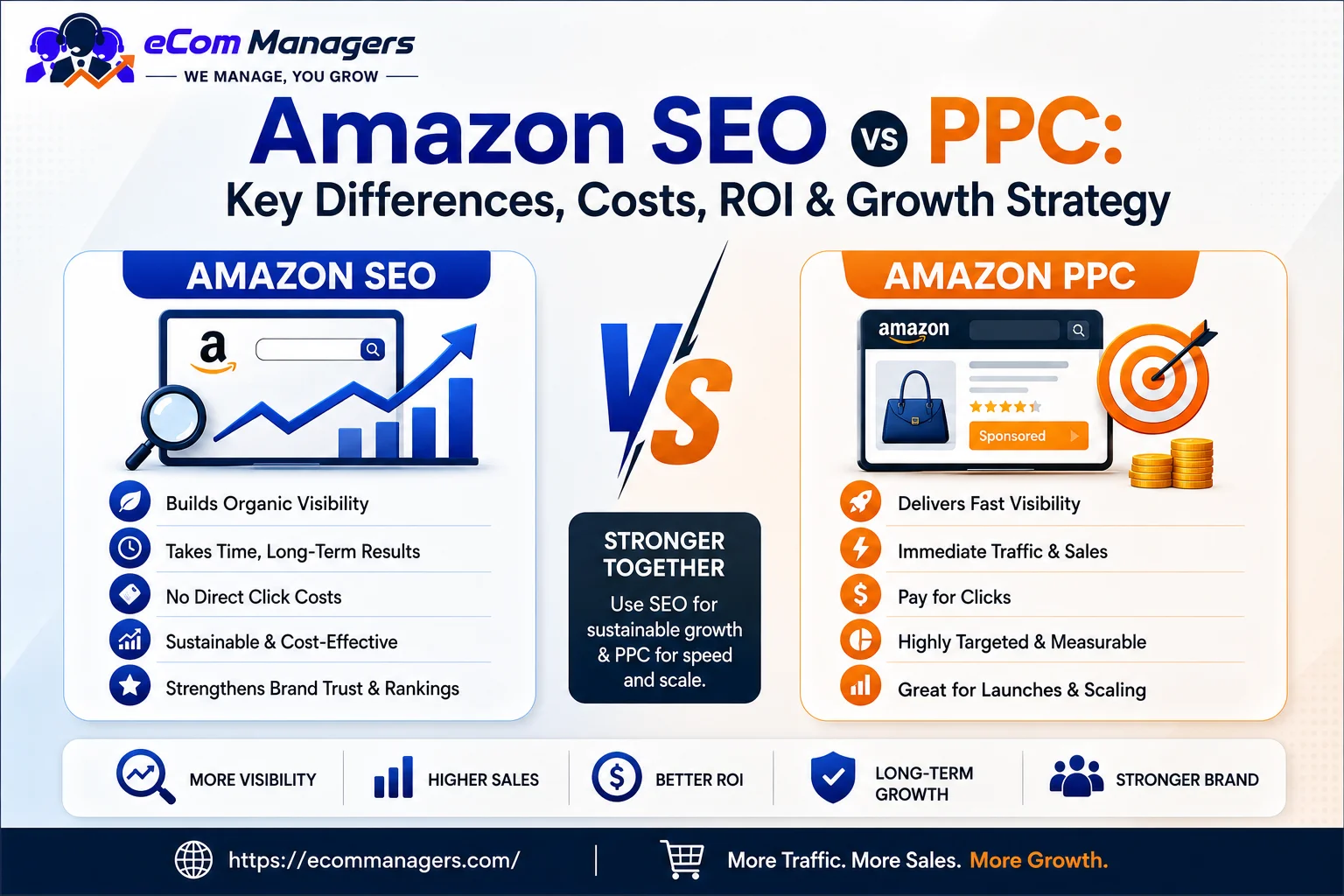
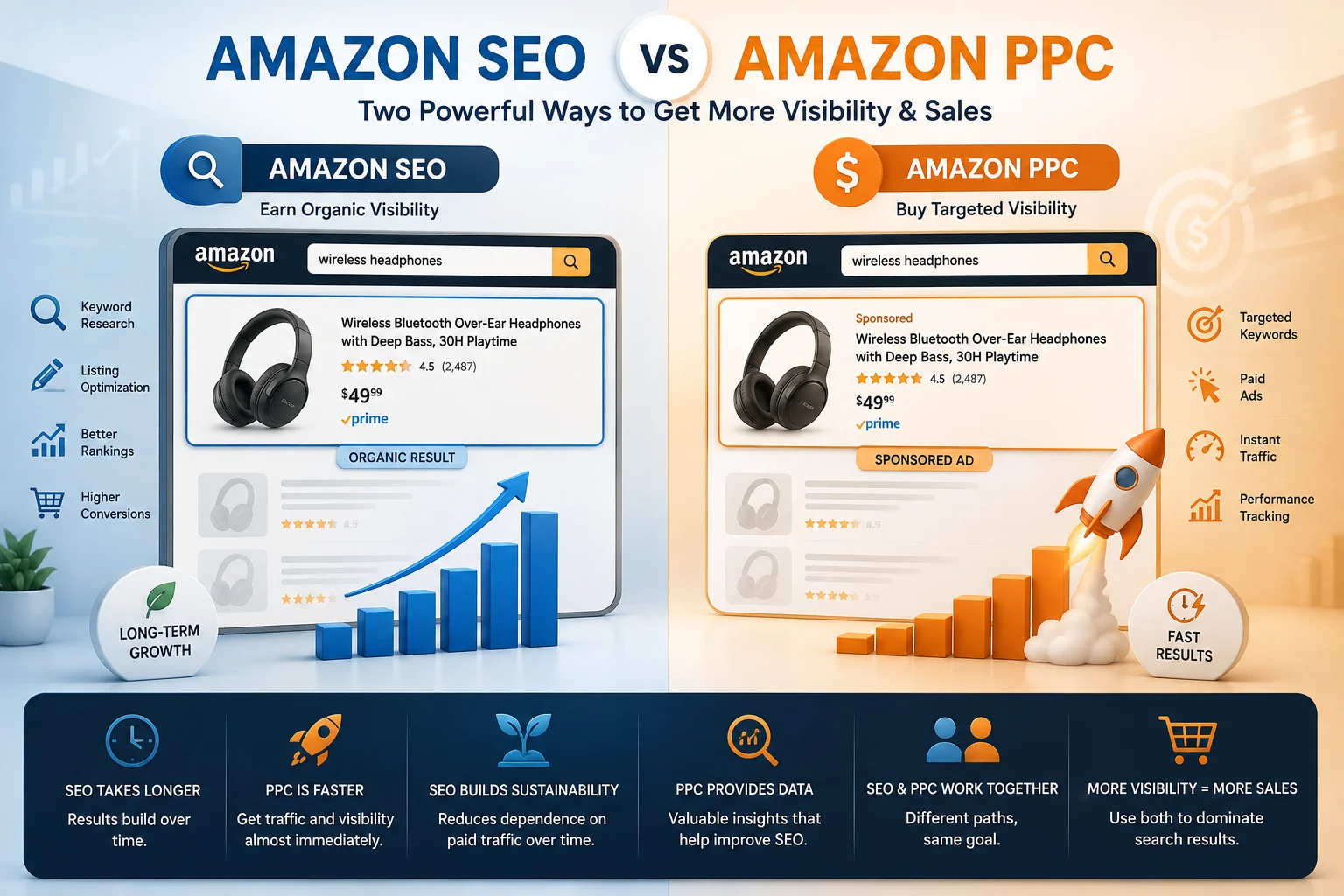
Amazon SEO vs PPC: Key Differences
The biggest difference between the two strategies is how they generate visibility.
Factor | Amazon SEO | Amazon PPC |
Visibility | Organic | Paid |
Speed | Gradual | Fast |
Direct click cost | No | Yes |
Control | Indirect | High |
Keyword data | More limited | Detailed campaign data |
Long-term value | High | Depends on continued spend |
Product launches | Foundation | Strong accelerator |
Testing | Slower | Faster |
Budget dependency | Lower after optimization | Higher |
Best use | Sustainable growth | Traffic, testing and scaling |
This SEO vs PPC comparison shows why choosing one strategy permanently is often a mistake.
SEO vs PPC Difference in Speed
PPC generally wins when speed matters.
A properly configured campaign can begin generating impressions and clicks soon after becoming active. SEO takes longer because organic visibility depends on relevance, indexing, listing quality, conversion performance, sales history, and competitive conditions.
That makes PPC particularly useful for new products.
SEO, however, becomes increasingly valuable when the goal shifts from immediate visibility to sustainable organic growth.
SEO vs PPC Difference in Cost
The cost structure is also different.
With PPC, sellers pay for advertising clicks according to the campaign’s auction dynamics. Competition, keyword demand, placement, bids, and conversion performance can influence how efficiently the budget is used.
SEO does not have a direct cost per organic click, but it still requires investment in research, optimization, content, testing, and management.
Therefore, asking whether SEO or PPC is “cheaper” without considering the business stage can produce a misleading answer.
Amazon SEO vs PPC: Which Has Better ROI?
There is no universal winner when comparing PPC vs SEO ROI.
ROI depends on product margin, average order value, competition, conversion rate, advertising efficiency, organic rankings, and the seller’s growth stage.
How SEO ROI Works
SEO can create compounding value.
Suppose a product begins ranking organically for several high-intent searches. Those rankings can continue generating visibility without a direct advertising charge for each click.
As organic sales increase, a brand may become less dependent on paid traffic for those specific searches.
That is why organic SEO vs PPC is often better viewed as a long-term versus short-term investment question rather than a simple winner-takes-all comparison.
How PPC ROI Works
PPC ROI is easier to measure at the campaign level.
Important metrics include:
- Advertising Cost of Sales (ACoS)
- Return on Ad Spend (ROAS)
- Cost per click
- Click-through rate
- Conversion rate
- Advertising sales
- Total advertising spend
A campaign with strong ROAS may look excellent at the campaign level, but sellers should also consider total business profitability and whether paid sales are contributing to sustainable organic growth.
When Amazon SEO Is the Better Priority
Amazon SEO should usually receive greater attention when your product listing has a weak organic foundation.
Focus on SEO When:
- Your listing is poorly optimized.
- Important keywords are not indexed.
- Organic rankings are weak.
- Your product receives relevant traffic but converts poorly.
- You want to reduce long-term advertising dependency.
- Your product already has reviews and sales history.
- You are building a long-term brand asset.
A product cannot be rescued by advertising forever if the listing itself does not convert.
If shoppers click but do not buy, increasing the PPC budget can simply increase the amount of money spent generating unsuccessful visits.
SEO Is Especially Important for Mature Products
Established products often have enough sales history and customer feedback to benefit from deeper optimization.
At this stage, sellers should identify which keywords already generate organic sales, which terms have ranking potential, and where competitors are outperforming the listing.
When Amazon PPC Is the Better Priority
PPC becomes particularly important when a seller needs faster visibility.
Focus on PPC When:
- You are launching a new product.
- Your listing is already conversion-ready.
- You need immediate traffic.
- You want to test keyword demand.
- Competitors dominate important organic positions.
- You need to support a seasonal promotion.
- You want additional visibility for profitable keywords.
For new products, PPC can provide the traffic and data needed to understand which search terms actually attract buyers.
PPC Is Also a Testing Tool
One of the biggest advantages of PPC is the speed of feedback.
Instead of waiting months to discover whether a keyword is commercially useful, sellers can test relevant search terms through campaigns and analyze impressions, clicks, orders, and conversion performance.
Those insights can then influence listing optimization.
How Amazon SEO and PPC Work Together
The strongest strategy is often not PPC or SEO, but a coordinated approach.
PPC can help identify valuable search terms, while SEO can incorporate those insights into the product listing and broader organic strategy.
Use PPC Data to Strengthen SEO
Suppose a campaign discovers that shoppers repeatedly convert after searching for a specific long-tail phrase.
That information can help you evaluate whether the product listing clearly communicates relevance for that search.
You can then improve appropriate elements of the listing without forcing the keyword unnaturally into every section.
Use SEO to Improve PPC Performance
The relationship works in the opposite direction too.
A well-optimized listing can help turn paid clicks into sales.
If your ad receives many clicks but the product page fails to convince shoppers, the problem may not be the campaign alone. Pricing, images, reviews, product positioning, or listing content may need attention.
This is why Amazon SEO and PPC should be managed as connected parts of the same growth system.
Amazon SEO vs PPC Keywords: How to Build a Smarter Strategy
Keywords sit at the center of both strategies, but they are used differently.
Build an SEO Keyword Foundation
For SEO, focus on identifying relevant terms that accurately describe:
- The product
- Its primary use
- Its features
- Its audience
- Its category
- Shopper problems
- Specific purchase intent
The objective is relevance first, not keyword stuffing.
Use PPC to Validate Keyword Opportunities
PPC can help reveal which search terms produce meaningful engagement and sales.
Instead of assuming that high-volume keywords are automatically valuable, sellers can compare actual performance.
A lower-volume keyword that consistently produces profitable orders may be more valuable than a high-volume keyword that generates expensive clicks without conversions.
How to Decide Between SEO and PPC
The right decision depends on four factors: product stage, listing quality, budget, and competition.
New Product
For a new product, build the SEO foundation first and then use PPC to accelerate visibility and gather data.
Established Product
For an established product, analyze the balance between organic and paid sales.
If organic visibility is strong, PPC can focus on profitable gaps, competitive keywords, product targeting, and incremental growth.
Low-Converting Product
If both organic and paid traffic are producing weak conversions, do not automatically increase ad spend.
Review the listing first.
Highly Competitive Category
Competitive categories often require both strategies.
SEO helps establish organic relevance, while PPC provides additional visibility where competitors are aggressively bidding.
A Practical Amazon SEO and PPC Growth Framework
A simple framework can help sellers avoid treating these channels as disconnected activities.
Stage 1 — Build the Foundation
Start with keyword research, listing optimization, compelling images, competitive pricing, and strong product positioning.
Check Before Advertising
Before increasing ad spend, make sure the listing can convert the traffic you are buying.
Review the Product Page
Check the title, images, bullets, description, A+ Content, reviews, pricing, and offer.
The Goal
The goal is simple: make the listing ready to convert before paying to send more shoppers to it.
Stage 2 — Launch Controlled PPC
Create campaigns around relevant keywords and product targets.
Start with controlled budgets and monitor search terms, clicks, conversions, ACoS, and ROAS.
Stage 3 — Feed Data Back Into SEO
Identify valuable search terms from advertising performance.
Use those insights to improve the organic strategy where they genuinely match the product and shopper intent.
Stage 4 — Scale What Works
Increase investment around proven opportunities instead of spreading budget equally across every keyword.
At the same time, continue improving organic visibility so growth does not depend entirely on advertising.
Common Mistakes Sellers Make With SEO and PPC
Mistake 1 — Treating PPC as a Replacement for SEO
Paid traffic cannot fix every listing problem.
If the product page has poor conversion fundamentals, more clicks may simply create more wasted spend.
Mistake 2 — Treating SEO as Completely Free
Organic clicks do not have a direct advertising charge, but effective SEO requires research, content work, optimization, testing, and ongoing management.
Mistake 3 — Looking Only at ACoS
A low ACoS is not automatically a sign of strong business performance.
Sellers should also consider total sales, organic sales, profit margin, TACoS, conversion rate, and the contribution of advertising to overall growth.
Mistake 4 — Using the Same Strategy for Every Product
A new product, mature product, premium product, and highly competitive product may require completely different SEO-to-PPC priorities.
So, Is SEO Better Than PPC on Amazon?
If the question is “is SEO better than PPC?”, the answer is not universally yes.
SEO is better when your priority is long-term organic visibility, sustainable growth, and reduced dependence on paid traffic.
PPC is better when your priority is speed, controlled visibility, keyword testing, product launches, or aggressive competitive positioning.
For most serious Amazon brands, the better question is:
How can SEO and PPC work together to produce more profitable growth?
That shift in thinking creates a much stronger strategy.