Business Model Comparison: How Amazon and Walmart Actually Work
To compare Walmart and Amazon business models and business strategies fairly, you have to look past the surface similarity (both let third parties sell alongside their own retail inventory) and look at what each company optimizes for.
Amazon’s Marketplace Model: Scale, Ads, and Search Dominance
Amazon’s model is built around search-first shopping behavior. A large share of US product searches start directly on Amazon rather than a search engine, which means ranking inside Amazon’s own search results is close to ranking on the open web. That scale is Amazon’s biggest asset and its biggest challenge for sellers: more buyers, but also far more competing listings and heavier reliance on advertising spend to stay visible.
Walmart’s Marketplace Model: Curation, Landed Cost, and Omnichannel Reach
Walmart’s marketplace business model leans on curation and its physical retail footprint. Approval is gated, seller density is a fraction of Amazon’s, and the Buy Box algorithm weighs landed cost (item price plus shipping) and delivery speed heavily. Walmart also ties its online marketplace to thousands of physical stores, which supports pickup, local delivery, and a customer base that already trusts the Walmart name for everyday value purchases.
Seller Fees Compared: Walmart vs Amazon Cost Structure
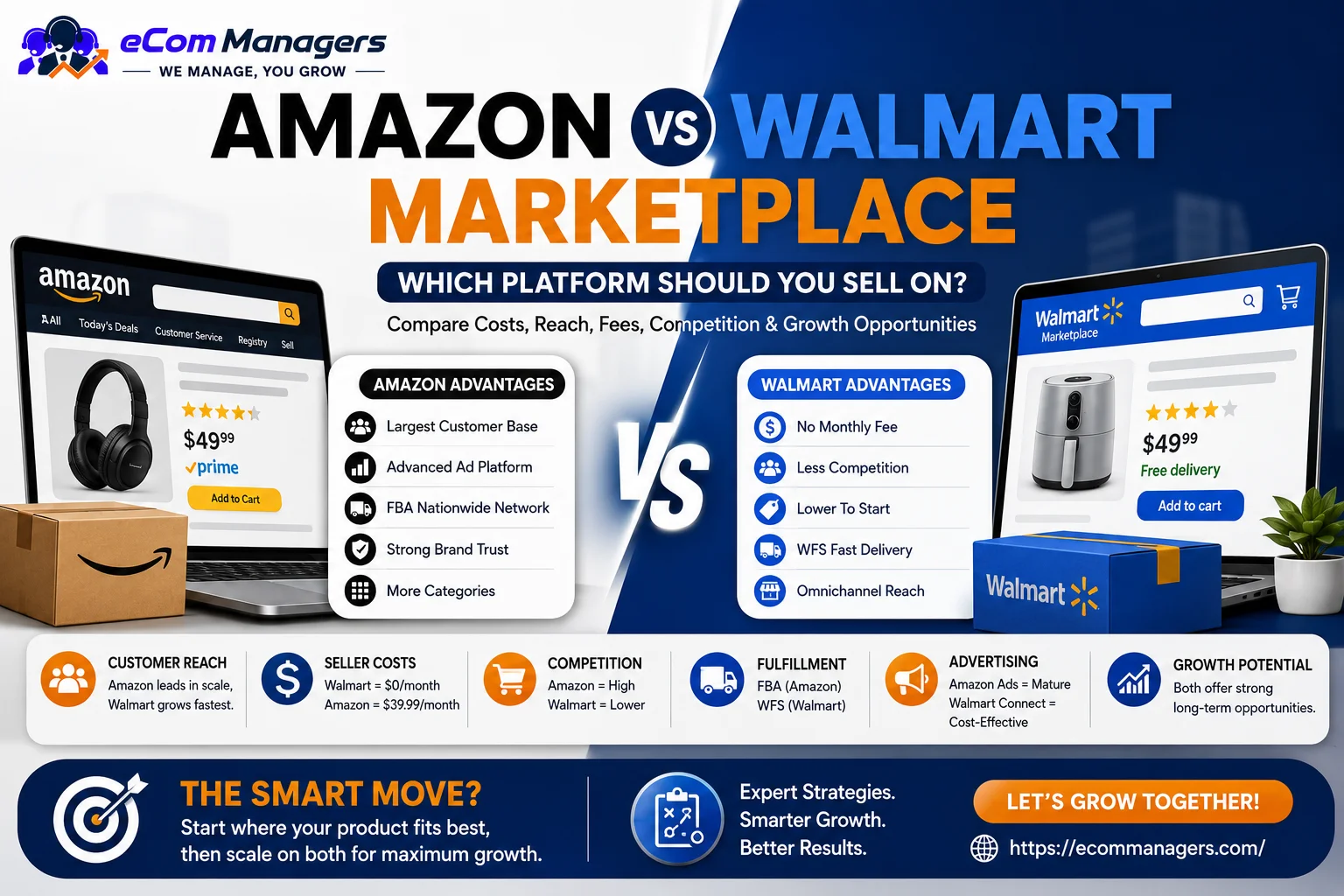
This is usually where the Walmart vs amazon business model decision gets practical. Here’s how the core costs stack up:
Cost Component | Amazon | Walmart |
Subscription | $39.99/month (Professional plan) | None |
Referral fee | 8% – 20%, category-based | 8% – 20%, category-based, similar structure |
Fulfillment | FBA: tiered by size, weight, and price point, with added surcharges for oversized or low-inventory items | WFS: priced by weight and dimension, generally more predictable |
Inbound/placement fees | Can apply unless inventory is split per Amazon’s preferred method | None currently |
Low-inventory penalties | Can apply if stock drops below Amazon’s coverage threshold | None currently |
Hidden Fees to Watch on Both Platforms
Referral fees and fulfillment fees are the headline numbers, but they aren’t the full cost picture on either platform.
Example: A $50 Item, Side by Side
On Amazon, a $50 item in a 15% referral category can carry additional inbound placement or oversize surcharges that push effective cost well above the sticker referral rate. On Walmart, the same item typically carries just the referral fee plus a flat, weight-based WFS charge, fewer variables, easier to model in advance.
Quick Takeaway
Amazon’s fee structure rewards sellers who can absorb complexity and optimize inbound logistics at scale. Walmart’s fee structure rewards sellers who want a simpler, more predictable margin model while they’re still testing a category. If you’re trying to compare Walmart and Amazon prices directly, model your landed cost (item price, shipping, and referral fee combined) on both platforms rather than comparing referral percentages alone, that’s the number that actually determines your margin. For the complete category-by-category breakdown, see our guide on how much it actually costs to sell on Walmart Marketplace.
Amazon Prime vs Walmart+: Comparing the Membership Programs
Walmart and Amazon Prime memberships shape buyer behavior more than most sellers give them credit for. Amazon Prime members are conditioned to expect two-day (often same-day) shipping and tend to shop across a huge range of categories in a single household account. Walmart+ members get free shipping, fuel discounts, and Walmart’s own fast-delivery perks, and they skew toward buyers who already shop Walmart for groceries and household essentials, then extend that habit to other categories online.
Which Membership Drives More Purchase Intent?
Neither program is objectively “better” for a seller, it depends on your product. Amazon Prime vs Walmart Plus really comes down to this: Prime members browse more broadly and compare more listings before buying, while Walmart+ members tend to have shorter consideration windows and higher trust in the Walmart brand itself, which can translate into faster conversion for well-priced, clearly presented listings.
Walmart vs Amazon Competitive Advantage by Category
Amazon and Walmart competition doesn’t play out evenly across every product type. Broadly:
- Amazon tends to win for electronics, niche/specialty products, and categories where buyers actively research and compare before purchasing.
- Walmart tends to win for everyday essentials, personal care, home goods, and categories where buyers already associate the Walmart name with value and already shop Walmart in-store or for groceries.
- Both perform well for mid-priced consumer goods with clear differentiation and strong product photography, the deciding factor there is usually execution, not platform.
If your catalog already has in-store Walmart placement, adding the marketplace is close to a formality. If it doesn’t, Walmart is still worth testing for the categories above, but expect a longer runway to meaningful volume than you had on Amazon.
Selling on Walmart vs Amazon: Operational Differences
Application & Approval
Amazon’s seller signup is largely self-service, you can often be listing within days. Walmart runs a gated application reviewed by a real underwriting team, which typically takes one to four weeks and requires a cleaner catalog and business documentation upfront.
Listing Optimization & Content
Keyword behavior differs between the two. Buyers search differently on each platform, so a listing copied word-for-word from Amazon to Walmart usually underperforms. Titles, bullet content, and backend attributes need platform-specific optimization rather than a straight copy-paste.
Fulfillment: WFS vs FBA
Both programs work the same way conceptually, you ship inventory in, the platform stores, picks, packs, and ships. FBA has more pricing tiers and more surcharge categories; WFS pricing is simpler but the network itself is smaller and still expanding.
Advertising: Walmart Connect vs Amazon Ads
Amazon Ads is the more mature, more competitive auction, which generally means higher cost-per-click but also more available data and targeting depth. Walmart Connect typically runs lower CPCs with less competition for placements, making it more capital-efficient during a launch phase, though the available targeting options are still catching up to Amazon’s. For a full breakdown of running a Walmart ad account well, see our Walmart PPC Management Services.
Can You Buy From Walmart and Sell on Amazon?
This is a different question from marketplace selling, and it’s worth answering directly since it comes up often. Buying discounted or clearance items from Walmart to resell on Amazon is a form of retail arbitrage, not marketplace selling and it carries real risk. Amazon requires proof of authenticity and, for many brands, direct authorization from the manufacturer or an approved distributor. Sourcing from Walmart retail (in-store or online) generally does not satisfy that requirement, and it can lead to listing suspensions or account-level enforcement if a brand owner files a complaint.
If your goal is a durable, scalable business rather than a short-term reselling play, the better path is building your own Walmart Marketplace seller account alongside your Amazon account selling your own catalog on both platforms under your own brand, rather than trying to buy from Walmart sell on Amazon as a resale strategy.
Which Is Better, Walmart or Amazon? A Decision Framework
There’s no single answer to which is better, Walmart or Amazon, the honest answer depends on where your business is right now.
When Amazon Wins
Choose Amazon first if you’re a brand-new seller with no existing sales history, your product fits a research-heavy category, or you need access to the largest possible audience while you’re still validating product-market fit.
When Walmart Wins
Choose Walmart first (or prioritize it alongside Amazon) if you already have retail presence at Walmart stores, your product fits everyday essentials or value-driven categories, or you’re looking for lower fixed costs while testing a new SKU. Our Walmart Product Research Services can tell you within days whether a given product has real headroom on Walmart specifically.
Why Many Sellers Choose Both
Most established multi-channel brands don’t actually pick one, they run both, sequenced deliberately. A common, low-risk pattern: build a track record on Amazon first, then use that sales history and product data to strengthen a Walmart application and launch with a head start instead of starting from zero on two platforms simultaneously.
The sellers who get the most out of running both channels tend to treat them as genuinely separate operations rather than one listing pushed to two places. That means separate keyword research, separate pricing logic that still respects Walmart’s parity checks, and separate performance tracking, so a slow week on one platform doesn’t get misread as a problem with the product itself when it’s really just a platform-specific dip.
How eComManagers Helps You Run Both Channels Without the Guesswork
Selling on Amazon vs Walmart doesn’t have to be a debate you settle once and never revisit. Product mix, seasonality, and platform policy all shift over time, and the right allocation of budget and attention between the two channels shifts with them. Our Walmart Account Management Services keep your Walmart listings healthy and competitive while you focus on whichever channel is earning the bigger share of your attention that quarter.