Why This Matters for eCommerce Brands
Google can help a brand create awareness before the shopper has decided where to purchase. However, that broader reach can also mean that not every click represents immediate buying intent.
The Key Takeaway
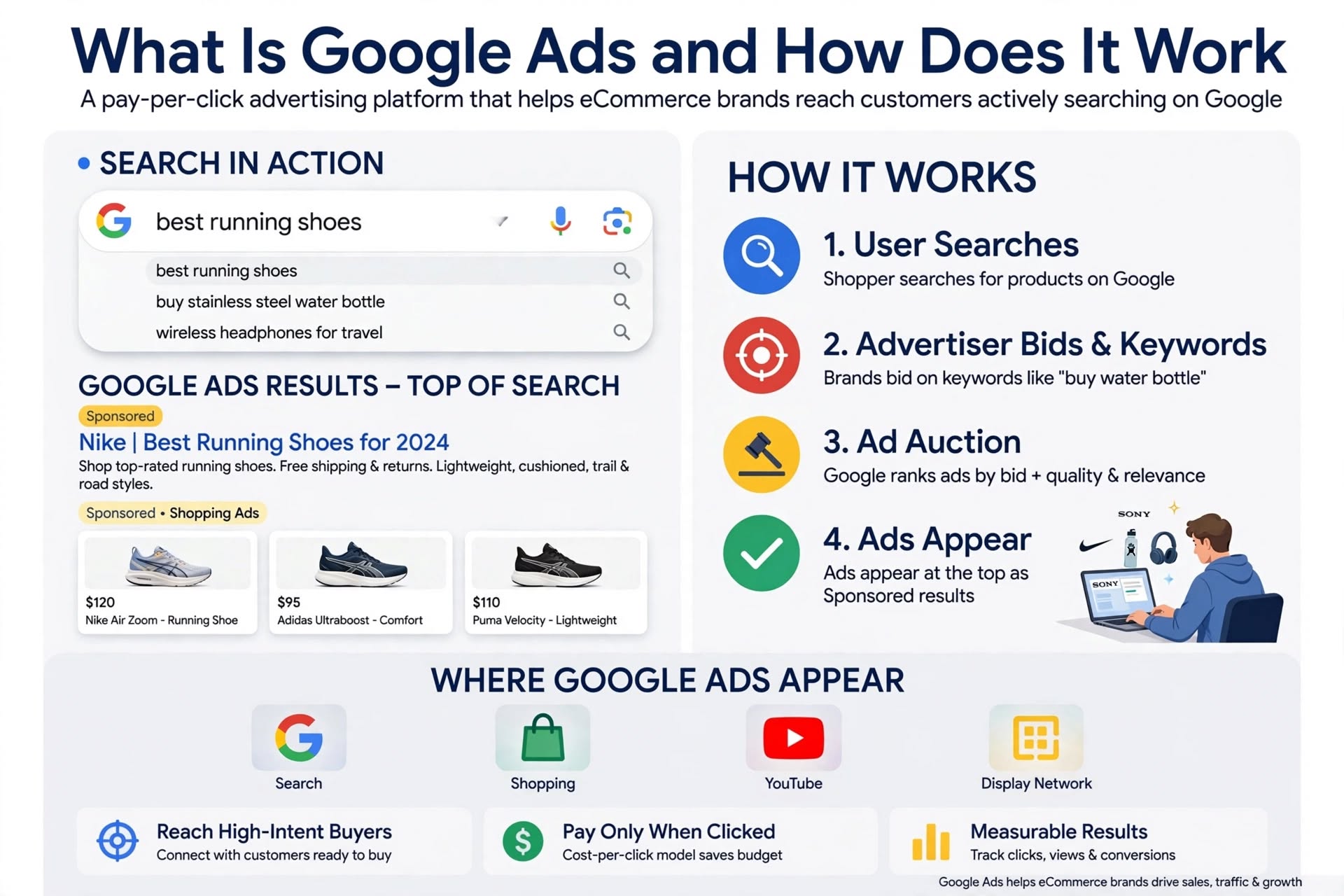
Google Ads is particularly useful when a brand wants to capture demand and create demand, rather than relying exclusively on shoppers already browsing Amazon.
What Is Amazon Ads?
Amazon Ads is Amazon’s advertising ecosystem designed primarily to help brands and sellers reach shoppers within the Amazon marketplace and across Amazon’s broader advertising environment.
Amazon Advertising vs Google Advertising: The Biggest Difference
The biggest difference is shopping intent.
Someone searching Amazon for a specific product is generally already in a shopping environment. They may be comparing prices, checking reviews, evaluating alternatives, or preparing to buy.
That makes Amazon particularly attractive for product sellers focused on direct marketplace sales.
Amazon’s advertising environment is closely connected to product discovery and purchasing behavior. This is one reason Amazon PPC can be an important part of an overall Amazon growth strategy.
Google vs Amazon Ads: Key Differences
Instead of asking which platform is universally better, sellers should ask which platform better matches their current business objective.
Factor | Google Ads | Amazon Ads |
Primary environment | Search & broader web ecosystem | Amazon marketplace |
User intent | Varies from research to purchase | Generally stronger shopping intent |
Main destination | Website or selected destination | Amazon product/store experience |
Best suited for | Discovery, traffic, demand generation | Amazon sales and marketplace visibility |
Customer journey | Multiple funnel stages | Often closer to purchase |
Data focus | Search, audience and website behavior | Shopping and product performance |
Conversion path | Often requires additional steps | Closely connected to Amazon checkout |
Best KPI focus | CPA, conversion value, ROAS | ACoS, ROAS, sales, conversion rate |
The important point is that neither platform automatically wins every category. The right choice depends on where your customers are and what you want your advertising to accomplish.
Buyer Intent: Google Ads vs Amazon Ads
Buyer intent is one of the most important differences between the two platforms.
Google Ads Reaches Customers Earlier in the Journey
Google users may be researching a problem before they know which product they want.
For example:
“How to improve sleep quality”
could eventually lead to a purchase of a sleep-related product.
At this stage, the customer may not be ready to buy.
Another search such as:
“buy cooling sleep mask”
shows considerably stronger purchase intent.
Google can capture both types of users.
Amazon Ads Starts Closer to the Purchase
Amazon shoppers are already inside an eCommerce environment.
They may search for:
“cooling sleep mask”
and immediately compare listings, prices, ratings, reviews, delivery options, and product features.
This creates an important advantage for sellers whose primary goal is marketplace revenue.
Which Platform Wins on Purchase Intent?
For an Amazon-focused seller, Amazon Ads generally has the stronger purchase-context advantage because the customer is already shopping within Amazon.
That does not mean every Amazon click converts. Product price, reviews, listing quality, inventory, competition, and offer quality still influence the final purchase.
Google Ads vs Amazon Ads: Cost Comparison
Cost is another area where sellers often make the wrong comparison.
There is no universal answer to “Which is cheaper?”
Both platforms operate through advertising auctions, and actual costs vary based on competition, keyword demand, audience, product category, relevance, and campaign performance.
Understanding Google Advertising Costs
Google costs can vary dramatically depending on the search term and industry.
A highly competitive commercial keyword may cost considerably more than an informational search.
A brand also needs to consider what happens after the click. If Google sends traffic to an external website, the seller must convert that visitor through the website experience.
Understanding Amazon Advertising Costs
Amazon advertising costs are also affected by competition and shopper demand.
For Amazon sellers, metrics such as:
- ACoS
- ROAS
- CPC
- CTR
- Conversion rate
- Advertising-attributed sales
help determine whether advertising spend is producing acceptable results.
The important distinction is that a higher CPC does not automatically mean worse performance.
If a keyword costs more but generates highly profitable sales, it may be more valuable than a cheaper keyword that produces low-quality traffic.
Amazon Ads vs Google Ads: Which Has Better Conversion Potential?
Conversion potential depends heavily on the customer’s intent.
Why Amazon Can Be Strong for Direct Product Sales
Amazon combines advertising with:
- Product listings
- Reviews
- Pricing
- Prime or delivery options
- Product comparisons
- Checkout
- Existing shopper trust
The customer does not need to leave Amazon to complete the purchase.
This shorter path can make Amazon particularly attractive for brands whose primary objective is marketplace sales.
Why Google Can Still Be Powerful
Google provides access to customers before they necessarily choose Amazon.
A brand can capture demand from users researching products, comparing brands, looking for solutions, or searching for a specific company.
For businesses with a strong DTC website, Google can therefore become an important acquisition channel.
Targeting Differences Between Google Ads and Amazon Ads
Targeting is another major difference.
Google Ads Targeting
Google offers broad targeting capabilities across search and its wider advertising ecosystem.
Brands can use signals related to:
- Search intent
- Audience behavior
- Location
- Demographics
- Interests
- Previous interactions
This makes Google flexible for businesses trying to reach people at different stages of the funnel.
Amazon Ads Targeting
Amazon’s advantage is its relationship with shopping behaviour.
Amazon advertising can connect products with relevant shopping searches and product-related intent.
For an Amazon seller, this means advertising decisions can be closely connected to actual marketplace performance.
Why Targeting Should Match Your Goal
If your objective is broad customer acquisition, Google may provide greater flexibility.
If your objective is to increase visibility and sales for products already listed on Amazon, Amazon advertising is often more directly aligned with that goal.
Google Ads vs Amazon Ads for Brand Growth
Brand growth requires more than immediate sales.
Google Is Strong for Broader Brand Discovery
Google can introduce customers to your brand when they are researching a category or problem.
This can be valuable for businesses with:
- Their own website
- Content marketing
- Multiple sales channels
- Longer customer journeys
- Higher-consideration products
Amazon Is Strong for Marketplace Brand Growth
Amazon advertising can help brands compete for visibility where shoppers are already comparing products.
For an Amazon-first brand, improving visibility on relevant shopping searches can support both paid performance and broader marketplace growth.
This is particularly important in competitive categories where organic visibility alone may not be enough.
Google Ads vs Amazon Ads for Amazon Sellers
If your main business model is selling on Amazon, the decision becomes more straightforward.
Choose Amazon Ads When Your Main Goal Is Amazon Revenue
Amazon advertising is usually the more direct choice when you want to:
- Increase Amazon product sales
- Capture high-intent shoppers
- Improve product visibility
- Defend important search terms
- Support new product launches
- Grow marketplace revenue
- Improve advertising efficiency
Amazon’s advertising system is specifically connected to the marketplace, which allows sellers to evaluate advertising alongside product sales and marketplace performance.
Use Google When You Need External Demand
Google can complement Amazon when your brand wants to reach shoppers before they arrive at the marketplace.
For example, a brand might use Google to build awareness while using Amazon PPC to capture customers who are already searching for the product on Amazon.
Can You Use Google Ads and Amazon Ads Together?
Yes. For many established brands, the strongest strategy is not Amazon Ads vs Google Ads, but using both platforms for different purposes.
A Practical Omnichannel Approach
A brand could use Google to:
- Generate awareness
- Capture broader search demand
- Drive qualified traffic
- Build brand recognition
At the same time, Amazon advertising can focus on:
- Marketplace search visibility
- Product sales
- Competitor positioning
- High-intent shopping demand
- Amazon revenue growth
This approach allows each advertising channel to perform the job it is best suited for.
Which Platform Should Your Brand Choose?
There is no single answer for every business.
Choose Amazon Ads If:
Amazon is your primary sales channel and your biggest objective is increasing marketplace sales.
It is particularly relevant when you already have:
- A competitive product
- Strong product-market fit
- An optimized listing
- Competitive pricing
- Good reviews
- Reliable inventory
Choose Google Ads If:
Your business depends heavily on your own website, lead generation, broader brand discovery, or reaching customers earlier in the buying journey.
Consider Both If:
You have sufficient budget and resources to build a multi-channel acquisition strategy.
The strongest brands often separate channel objectives rather than forcing one platform to accomplish everything.
How Amazon PPC Management Can Improve Marketplace Performance
Choosing Amazon Ads is only the first step.
Running profitable Amazon PPC requires ongoing monitoring, search-term analysis, bid adjustments, budget allocation, keyword evaluation, and performance optimization.
For sellers who do not have the time or internal expertise to manage these activities, professional Amazon PPC management services can provide a structured approach.
What Professional Amazon PPC Management Should Focus On
A strong management process should connect advertising decisions with actual business goals.
That means looking beyond clicks and impressions and evaluating:
- Sales
- ACoS
- ROAS
- Conversion rate
- Search-term performance
- Budget efficiency
- Product-level profitability
The objective should not simply be to spend more. It should be to make advertising spend work more efficiently.
How to Decide Between Google Ads and Amazon Ads
Use this simple framework:
If your customer is already shopping on Amazon → prioritize Amazon Ads.
If your customer is searching the wider web and needs education or discovery → consider Google Ads.
If your brand has both a DTC website and Amazon presence → consider using both strategically.
The most important factor is not which advertising platform is more popular. It is where your customers are most likely to convert profitably.