How to Use TikTok Ads Manager
If you’re wondering how to use TikTok Ads Manager, the overall process follows a structured workflow.
Step 1 – Create Your Business Account
Register your business account and connect it with TikTok Ads Manager.
Make sure your business information, payment method, and billing details are complete before launching campaigns.
Step 2 – Create a New Campaign
Inside the dashboard, click Create Campaign and select your advertising objective.
TikTok uses your selected objective to optimize delivery, making this one of the most important decisions during campaign setup.
Step 3 – Build Ad Groups
After creating a campaign, you’ll create one or more ad groups.
This is where you’ll configure:
- Audience
- Placements
- Budget
- Schedule
- Optimization goal
- Bidding method
Step 4 – Launch Your Ads
Finally, upload your creatives, write compelling ad copy, review your settings, and publish your campaign.
While creative quality significantly influences performance, we’ll cover that topic in our dedicated guide on How to Create High-Converting TikTok Shop Video Ads That Sell, since this article focuses specifically on campaign management.
Understanding TikTok Campaign Structure
Before launching campaigns, it’s important to understand how TikTok organizes advertising.
The platform follows a three-level hierarchy.
Campaign Level
At this level, advertisers select:
- Campaign objective
- Overall campaign budget (optional)
This is where your campaign’s primary goal is defined.
Ad Group Level
Most campaign decisions happen here.
You’ll configure:
- Audience targeting
- Placements
- Budget
- Schedule
- Optimization event
- TikTok bidding strategy
This level gives advertisers the flexibility to test different audiences under the same campaign.
Ad Level
This is where the actual advertisement lives.
You’ll upload:
- Video creative
- Primary text
- Call-to-action
- Destination
- Product selection (for TikTok Shop)
Multiple ads can run inside the same ad group to test different creative approaches.
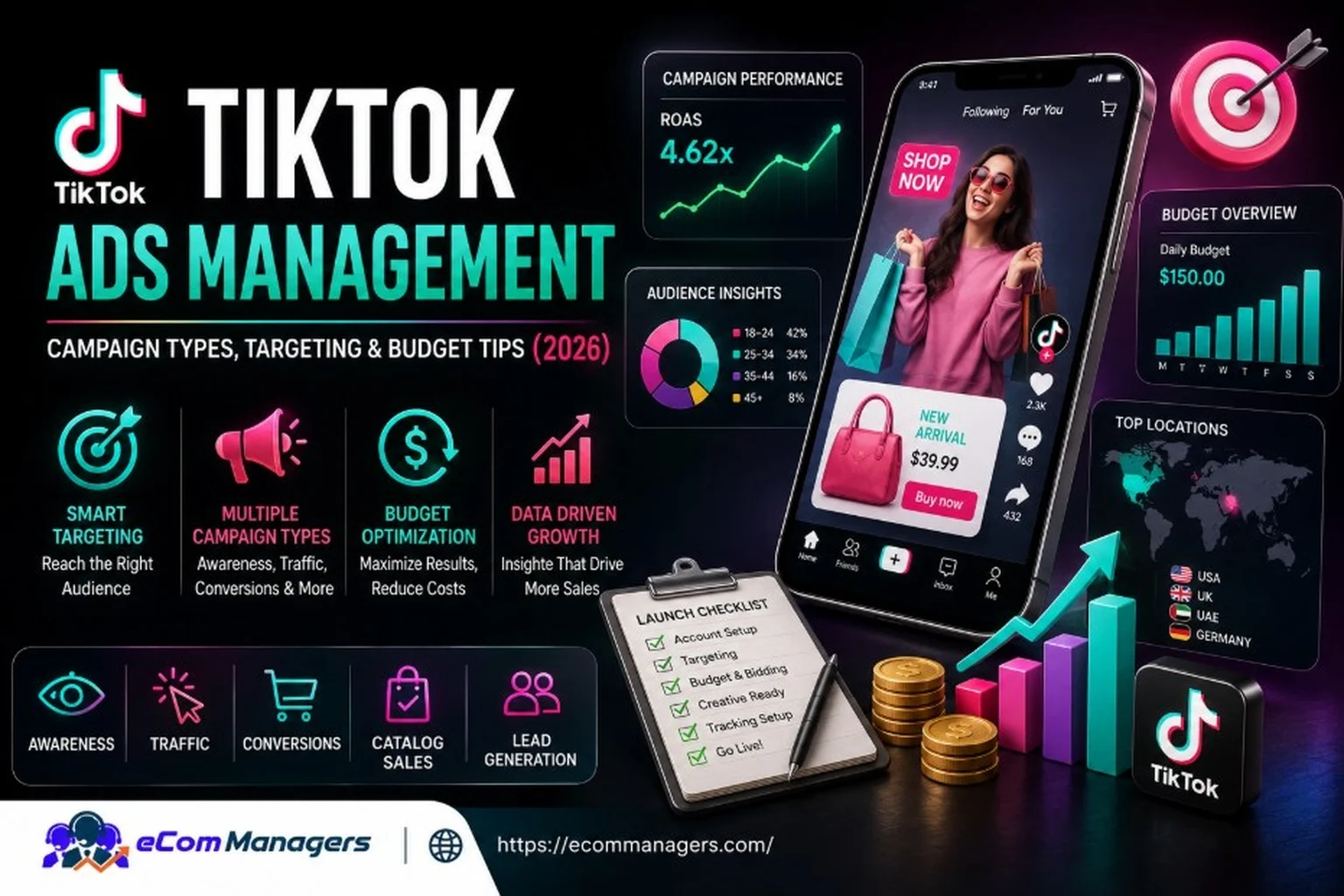
TikTok Campaign Types Explained
One of the biggest mistakes beginners make is confusing campaign objectives with ad formats.
Campaign objectives tell TikTok what result you want to achieve, while ad formats determine how your advertisement appears.
Understanding different TikTok campaign types helps advertisers spend their budget more efficiently.
Awareness Campaigns
Awareness campaigns focus on maximizing visibility.
They’re commonly used for:
- New brand launches
- Product awareness
- Seasonal promotions
- Market expansion
Instead of immediate purchases, these campaigns prioritize reaching as many relevant users as possible.
Traffic Campaigns
Traffic campaigns are designed to send users to a destination.
Depending on your business, that destination could be:
- TikTok Shop product page
- Landing page
- Ecommerce website
- Mobile application
Traffic campaigns work well when introducing new collections or driving visitors into your sales funnel.
Conversion Campaigns
Conversion campaigns focus on actions that directly generate business value.
These include:
- Purchases
- Add-to-cart actions
- Leads
- Registrations
- Checkout completion
For most ecommerce brands, conversion campaigns deliver the strongest long-term return because TikTok’s algorithm optimizes delivery toward users most likely to convert.
Catalog Sales Campaigns
Catalog campaigns automatically promote products from your TikTok Shop catalog.
These campaigns are particularly useful for businesses managing multiple SKUs, allowing the platform to match products with interested shoppers dynamically.
Choosing the Right TikTok Campaign Objectives
Selecting the correct TikTok campaign objectives is one of the most important decisions you’ll make.
Your objective determines how TikTok’s algorithm delivers your ads and which users are most likely to see them.
Common TikTok Ads Campaign Objectives
TikTok currently offers objectives such as:
- Reach
- Traffic
- Video Views
- Community Interaction
- Lead Generation
- Website Conversions
- Product Sales
- Catalog Sales
Each objective serves a different business goal, so choosing the wrong one can lead to inefficient spending even if your creativity is excellent.
For example, if your goal is generating product purchases, selecting a Video Views campaign instead of a Sales objective may result in plenty of views but very few conversions.
Mastering TikTok Ads Targeting Options
Even the best campaign will struggle if it reaches the wrong audience. One of the biggest advantages of TikTok Ads Manager is the ability to show your ads to users who are more likely to engage with your products.
Instead of targeting everyone, focus on building audiences based on buyer intent and campaign goals. As your account gathers more data, you can refine these audiences to improve performance and lower acquisition costs.
TikTok Interest Targeting
TikTok interest targeting allows advertisers to reach users based on the content they regularly engage with.
Popular interest categories include:
- Fashion
- Beauty
- Home & Kitchen
- Fitness
- Technology
- Pets
- Gaming
- Parenting
- Food & Beverage
- Business
For example, a kitchenware brand can target users interested in cooking and home organization instead of showing ads to a broad audience.
Interest targeting works especially well for new advertisers who have limited customer data.
TikTok Behavioral Targeting
While interests show what users like, TikTok behavioral targeting focuses on what they actually do.
TikTok analyzes actions such as:
- Videos watched
- Likes
- Shares
- Comments
- Purchase behavior
- Product interactions
This helps advertisers reach users with stronger buying intent rather than simply broad interests.
TikTok Location Targeting
For regional businesses or international sellers, TikTok location targeting is essential.
Brands can target audiences by:
If your business serves customers in New York, Los Angeles, Chicago, Houston, or Miami, location targeting helps allocate your budget where it matters most instead of advertising nationwide.
For brands expanding internationally, separate campaigns for the USA, UK, UAE, and Germany often deliver better optimization than combining all regions into one audience.
TikTok Custom Audiences
One of the most valuable features inside TikTok Ads Manager is TikTok custom audiences.
These audiences are built using your existing business data, including:
- Website visitors
- Customer email lists
- Previous purchasers
- App users
- Video viewers
Custom audiences are ideal for remarketing because they target people who already know your brand.
Instead of constantly searching for new customers, you can encourage previous visitors to complete their purchase.
TikTok Lookalike Audiences
Once your custom audience has enough data, you can create TikTok lookalike audiences.
TikTok identifies users with behaviors and interests similar to your existing customers.
Lookalike audiences often outperform broad targeting because the platform uses machine learning to find people with comparable purchasing patterns.
For ecommerce brands focused on scaling, this is one of the most effective audience expansion strategies.
Planning Your TikTok Ads Budget
One of the most common questions advertisers ask is:
How much should I spend on TikTok advertising?
The answer depends on your goals, competition, and product pricing.
A small testing budget is usually more effective than investing heavily before identifying winning audiences and creatives.
Your TikTok ads budget should allow enough time for the algorithm to learn before making significant adjustments.
Daily Budget vs Lifetime Budget
TikTok offers two primary budgeting methods.
Daily Budget
A daily budget sets the maximum amount TikTok can spend each day.
This option works well for:
- Testing campaigns
- New advertisers
- Continuous lead generation
- Evergreen ecommerce campaigns
Lifetime Budget
A lifetime budget distributes your spending across the campaign’s duration.
This option is often used for:
- Seasonal promotions
- Product launches
- Limited-time offers
- Holiday campaigns
Regardless of the method you choose, avoid making major budget changes every day. Sudden increases or decreases can interrupt the learning phase and reduce campaign stability.
Understanding TikTok Advertising Costs
Every advertiser wants to know the real TikTok advertising costs, but there is no fixed price.
Your TikTok ad campaign cost depends on factors such as:
- Audience competition
- Industry
- Campaign objective
- Ad quality
- Engagement rate
- Bid strategy
- Seasonality
Instead of asking how much TikTok ads cost, focus on whether they generate profitable returns.
A campaign with a higher cost per click may still produce excellent profitability if conversion rates remain strong.
Key Advertising Metrics Every Advertiser Should Understand
Although a dedicated analytics guide will explore these metrics in depth, every advertiser should understand the basics.
TikTok CPM
TikTok CPM (Cost Per Thousand Impressions) measures how much you pay for one thousand ad impressions.
Lower CPM generally means your ads are reaching people more efficiently, although it should never be evaluated without considering conversions.
TikTok CPC
TikTok CPC (Cost Per Click) measures how much you pay whenever someone clicks your advertisement.
Reducing CPC often involves:
- Better targeting
- More engaging creatives
- Improved relevance
- Higher engagement rates
TikTok CPA
TikTok CPA (Cost Per Acquisition) shows how much you spend to generate one conversion.
Most ecommerce businesses focus heavily on CPA because it directly impacts profitability.
TikTok ROAS
TikTok ROAS (Return on Ad Spend) measures revenue generated compared to advertising spend.
For example:
- Spend: $500
- Revenue: $2,500
ROAS = 5X
While a higher ROAS is desirable, acceptable benchmarks vary depending on profit margins and business goals.
Our upcoming TikTok Shop Analytics guide explains how to interpret these metrics in greater detail.
Choosing the Right TikTok Bidding Strategy
Your TikTok bidding strategy influences how efficiently your advertising budget is spent.
TikTok offers multiple bidding options depending on campaign objectives.
Rather than chasing the lowest possible costs, advertisers should choose bidding methods that align with their business goals.
Lowest Cost Bidding
This strategy allows TikTok’s algorithm to maximize results within your available budget.
It is commonly recommended for:
- Beginners
- New campaigns
- Testing audiences
- Learning campaigns
Cost Cap Strategy
Cost Cap helps maintain a more predictable average acquisition cost.
It works well for businesses with defined profitability targets and established conversion data.
Bid Cap Strategy
Bid Cap gives advertisers greater control over the maximum bid submitted during auctions.
Although it offers more manual control, it generally requires experience and continuous monitoring.
TikTok Ads Optimization Best Practices
Launching a campaign is only the beginning. Long-term success depends on continuous TikTok ads optimization.
Successful advertisers regularly review campaign performance and make gradual improvements based on data rather than assumptions.
Proven Optimization Tips
- Test multiple audience segments instead of relying on one broad audience.
- Avoid changing budgets dramatically during the learning phase.
- Pause underperforming ad groups instead of entire campaigns.
- Refresh creatives regularly to reduce ad fatigue.
- Monitor conversion trends instead of focusing only on impressions or clicks.
- Scale winning campaigns gradually rather than doubling budgets overnight.
- Review search trends and seasonal demand before increasing advertising spend.
Small improvements made consistently often produce better long-term results than frequent major campaign changes.
Quick Tip
Allow campaigns enough time to gather meaningful data before making optimization decisions. Reacting too quickly to one day’s performance can prevent TikTok’s algorithm from completing its learning process.
Remember
Advertising success comes from testing, measuring, and refining. Even experienced advertisers rarely achieve perfect performance with their first campaign.
What’s Next?
Once your campaign structure is performing well, the next step is improving the creative itself. In our upcoming guide, How to Create High-Converting TikTok Shop Video Ads That Sell, we’ll explore hooks, storytelling, UGC-style videos, and creative best practices that increase conversions without increasing your advertising budget.
Build a Complete TikTok Advertising Strategy
Running successful ads is only one part of growing a profitable TikTok Shop. Long-term success comes from combining product research, strong launches, creative advertising, ongoing optimization, and account management into one connected strategy.
Whether you’re launching your first product or scaling an established brand, each stage supports the next.
Start With the Right Product
Even the best advertising campaign cannot fix a product with little demand.
Before investing in paid campaigns, validate your product using our guide on How to Find High-Demand, Low-Competition TikTok Shop Products in 2026. Choosing the right product first gives your advertising budget a much better chance of generating profitable returns.
If you need expert research support, explore our TikTok Product Research Service, where our team identifies products with strong market potential before you invest.
Launch Before You Scale
A successful campaign starts long before your first ad goes live.
If you’re preparing a new product, our TikTok Shop Product Launch Strategy Guide explains how to build momentum before launch, while the TikTok Shop Product Launch Checklist helps ensure your listings, creatives, inventory, and account settings are fully prepared.
For businesses looking for hands-on assistance, our TikTok Product Launch Service manages everything from launch planning to execution.
Connect Paid Ads With Organic Growth
The highest-performing brands rarely rely on paid advertising alone.
Organic content builds trust, while TikTok Shop ads accelerate visibility and conversions.
As your campaigns mature, you’ll also benefit from:
- High-converting video creatives
- Influencer collaborations
- Live selling sessions
- Performance analytics
- Continuous creative testing
We’ll cover these topics in dedicated cluster guides, helping you build a complete TikTok Shop marketing strategy without overlapping content.
Why Brands Choose eComManagers for TikTok Ads Management
Managing TikTok campaigns requires much more than launching advertisements. It involves audience research, campaign planning, budget optimization, ongoing testing, and continuous performance improvements.
At eComManagers, we help ecommerce brands build profitable advertising strategies instead of relying on guesswork.
Full-Service TikTok Advertising Support
Our TikTok services include:
- TikTok campaign setup
- Audience research and targeting
- Budget planning
- Bid optimization
- Campaign scaling
- Product launch support
- Account management
- Performance monitoring
Whether you’re advertising one product or managing a large product catalog, we tailor every campaign to your business goals.
Regional Expertise
Consumer behavior differs across markets, which is why we provide localized TikTok support for businesses selling in:
By adapting campaign strategies to each region, we help brands reach more qualified buyers while improving advertising efficiency.