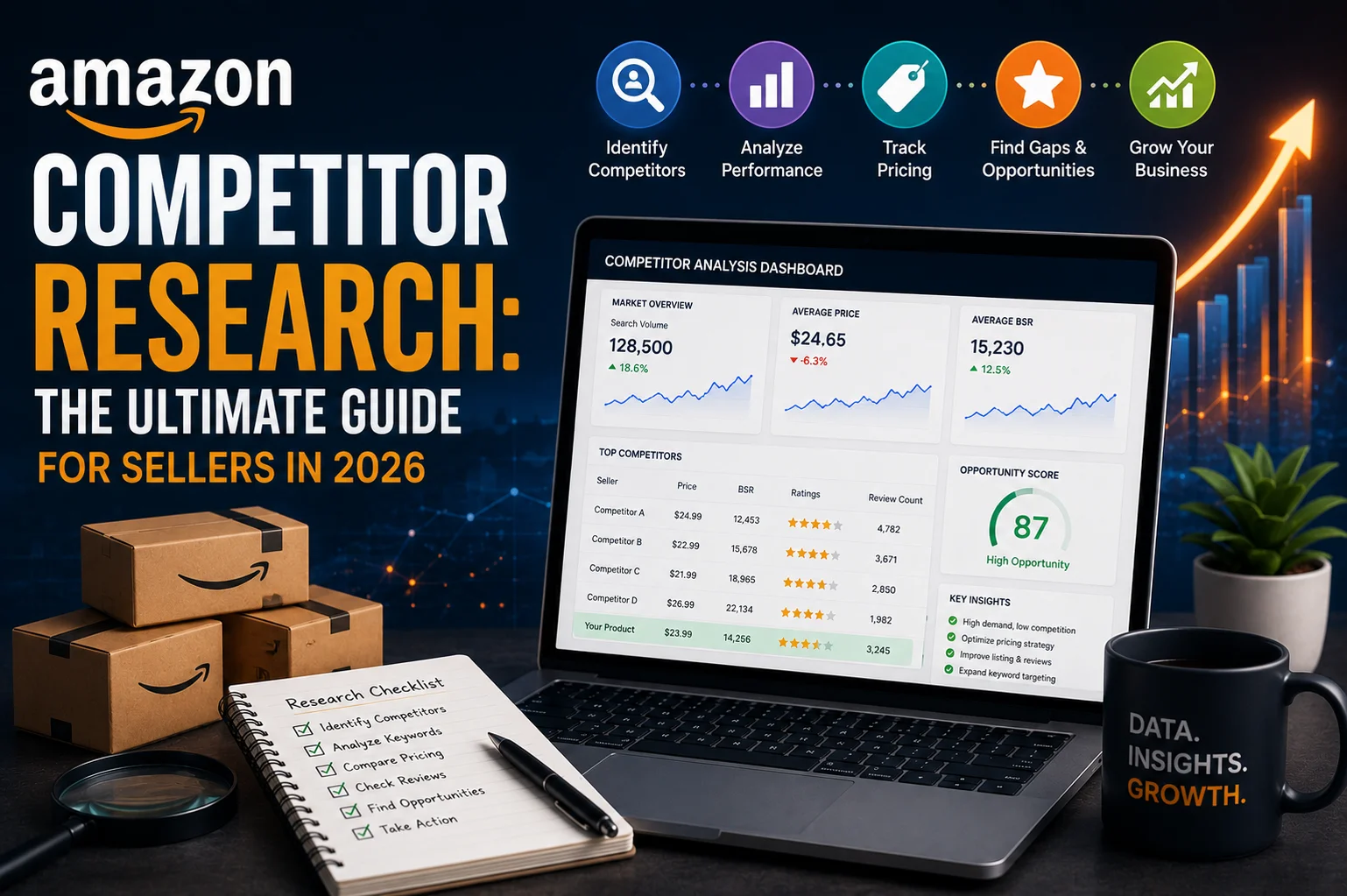
If you want to win on Amazon in 2026, you cannot afford to guess. Every product you launch, every keyword you target, and every price you set should be backed by one thing: solid competitor research.
The sellers who dominate Amazon are not necessarily the ones with the best products. They are the ones who understand their competition better than anyone else. They know what their competitors are ranking for, what customers are complaining about, and exactly where the gaps are.
This guide will show you how to do Amazon competitor research the right way in 2026, from identifying who your real competitors are to extracting insights that directly drive your sales growth.
Why Amazon Competitor Research Matters More Than Ever in 2026
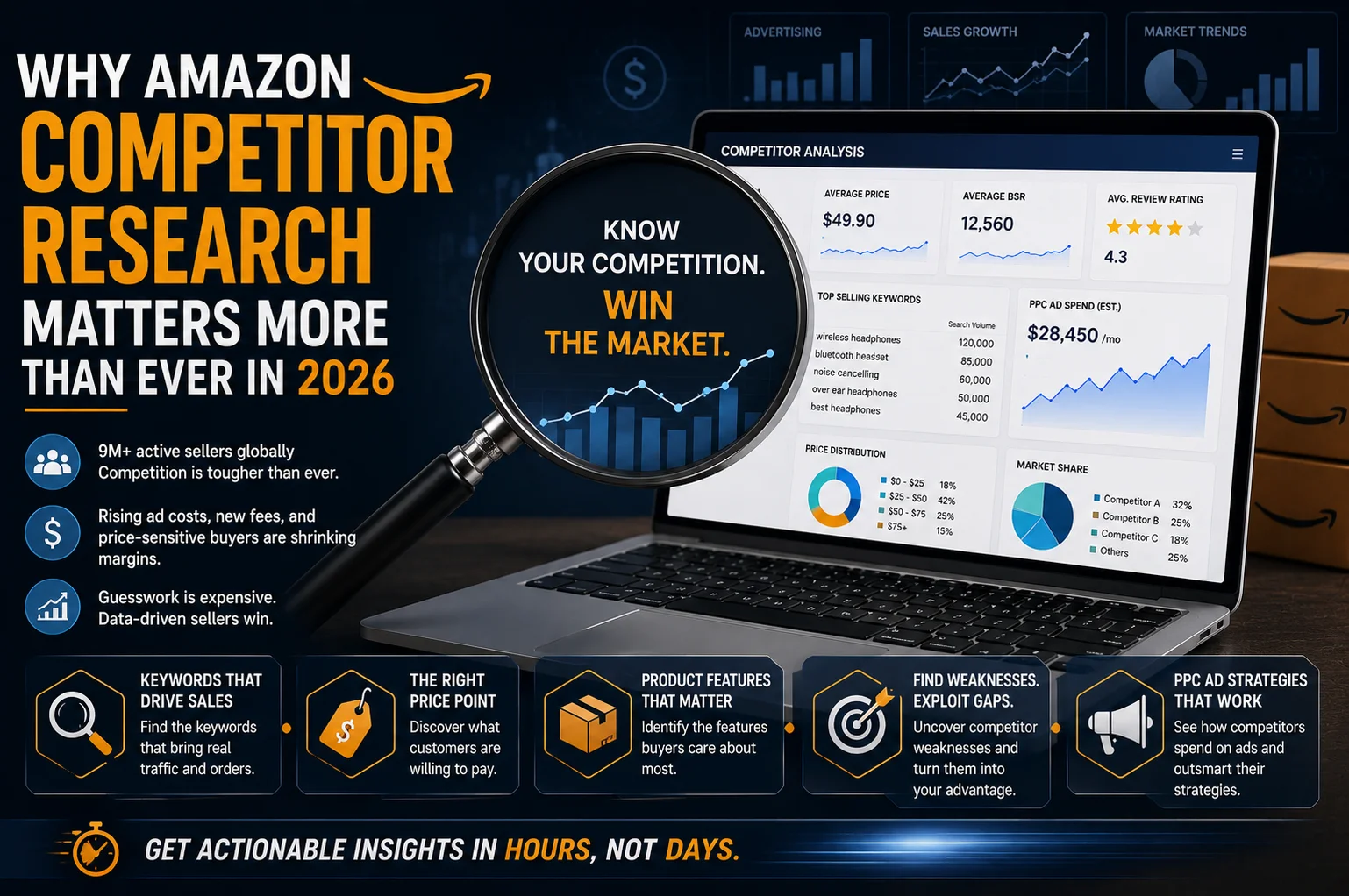
Amazon has over 9 million active sellers globally. The competition in almost every category has intensified over the last two years. Rising advertising costs, new fee structures, and an increasingly price-sensitive customer base mean that sellers who rely on guesswork are losing money every single month.
Competitor research is no longer optional, it is the foundation of every smart decision you make on Amazon. It tells you:
- Which keywords are actually driving sales in your category
- What price points customers are willing to pay
- Which product features matter most to buyers
- Where your competitors are weak, and how you can exploit those gaps
- How much competitors are spending on PPC and what ad strategies they are using
The good news is that with the right approach and the right tools, this process does not have to take days. Once you have a system in place, you can gather actionable insights in a few hours.

Step 1: Identify Your Real Competitors
The first mistake most sellers make is assuming they know who their competitors are. They look at the top 10 listings for their main keyword and call it done.
The reality is more complex. Your real competitors are the sellers who are winning the Buy Box, ranking on page one for multiple keywords, and consistently getting reviews. These are not always the sellers with the most reviews or the lowest price.
Start by searching your primary keyword on Amazon. Look at the top 20 organic results, not sponsored ads. Note the sellers who appear consistently across multiple related search terms. These are your primary competitors.
Next, look at the “Frequently Bought Together” and “Customers Also Viewed” sections on your top competitor listings. These will reveal secondary competitors that keyword searches alone will not show you.
Step 2: Analyze Their Listings in Detail
Once you have your competitor list, go deep on their listings. You are looking for patterns and gaps.
Title and keywords: What keywords are they using in their title? Are they targeting broad terms or long-tail keywords? Tools like Helium 10’s Cerebro or Jungle Scout’s Keyword Scout allow you to reverse-engineer any competitor’s keyword strategy meaning you can see exactly which search terms are sending them traffic.
Images and A+ content: How are they presenting the product? What lifestyle images are they using? Are they using A+ content or brand story? Poor image quality or weak A+ content is a gap you can exploit immediately with better visual storytelling.
Pricing strategy: Track their pricing over 30-60 days using tools like Keepa. You will see patterns: do they discount during specific times? Do they raise prices when inventory is low? Understanding their pricing behavior lets you time your own pricing decisions strategically.
Reviews and ratings: This is one of the most valuable sources of competitor intelligence available to you. Read the 1, 2, and 3-star reviews carefully. Customers are telling you exactly what the product gets wrong. These are your product improvement opportunities and your listing differentiation angles.
Step 3: Reverse-Engineer Their PPC Strategy
Understanding what your competitors are spending on ads, and what is working for them gives you a significant edge when building your own Amazon PPC campaigns.
Use tools like Helium 10’s Adtomic or the free Search Query Performance report inside Seller Central to see which sponsored keywords are showing up for competitor ASINs. Look at their sponsored brand ads, sponsored display ads, and which keywords trigger their product targeting campaigns.
Pay attention to their ACoS signals too. If a competitor is showing up for expensive broad match keywords consistently, they are likely profitable on those terms, which means there is validated demand you can tap into.
One of the most powerful moves in 2026 is running Amazon Sponsored Products campaigns targeting competitor ASINs directly. If your product has better reviews, better images, or a more competitive price, you can steal conversions directly from their listing pages.
Step 4: Study Their Review Velocity and Sales Rank
Sales rank (BSR) tells you how well a product is selling relative to others in its category. By tracking BSR over time using tools like Keepa or AMZScout, you can estimate a competitor’s monthly sales volume with reasonable accuracy.
Review velocity, how quickly they are gaining new reviews is another useful signal. A sudden spike in reviews often means they have run a promotion, launched a new variation, or enrolled in Amazon Vine. Tracking this helps you anticipate their moves before they impact your ranking.
If a competitor’s BSR is improving while yours is stable, something has changed, their PPC spend, a new promotion, or an algorithm shift. Catching this early allows you to respond before the gap widens.
Step 5: Find the Gaps and Build Your Advantage
After completing your competitor research, you should have a clear picture of where the market is underserved. This is where you build your competitive advantage.
Common gaps that serious sellers exploit include: products with hundreds of reviews but consistent complaints about a specific feature, listings with weak imagery in categories where visual appeal drives conversions, competitors with no A+ content in a category where branded storytelling matters, and keyword gaps where high-volume search terms are being ignored by the top sellers.
For deeper Amazon product research and niche identification, you can also read our guide on how to find profitable FBA products that actually sell in 2026.
The Tools You Need for Amazon Competitor Research in 2026
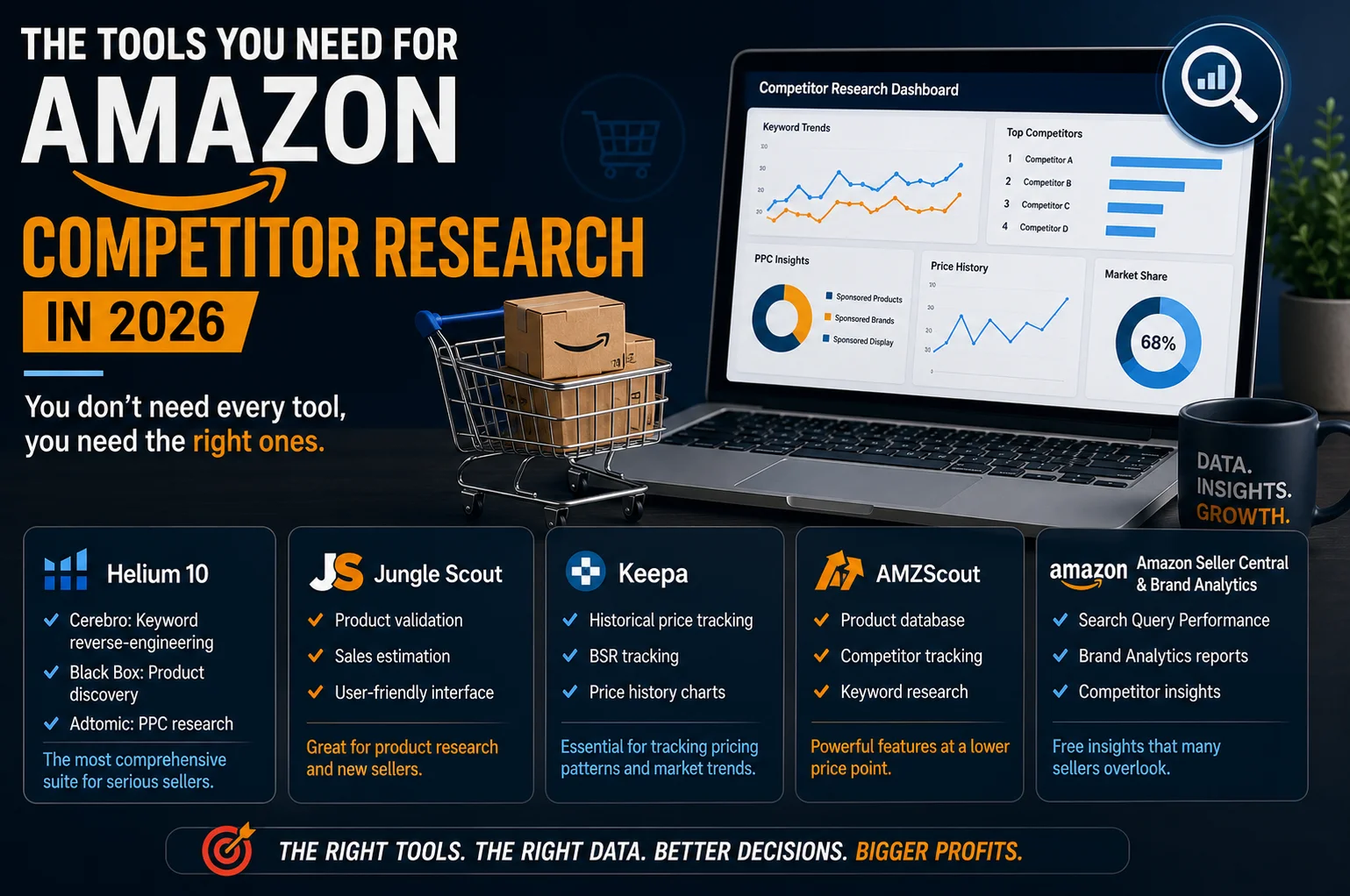
You do not need every tool, you need the right ones. Here are the most effective options available right now:
Helium 10 remains the most comprehensive suite for serious sellers. Cerebro for keyword reverse-engineering, Black Box for product discovery, and Adtomic for PPC research cover most of what you need.
Jungle Scout is strong for product validation and sales estimation, particularly useful for new sellers who want a simpler interface.
Keepa is essential for historical price and BSR tracking. It is free for basic use and invaluable for understanding competitor pricing patterns over time.
AMZScout offers a solid product database and competitor tracking features at a lower price point than Helium 10.
Seller Central’s own data: particularly the Search Query Performance report and Brand Analytics is often underused. If you have brand registry, these free reports can reveal keyword and competitor insights that no third-party tool can match.
Final Thoughts
Amazon competitor research in 2026 is not a one-time exercise. The market moves fast, new sellers enter, pricing shifts, and customer preferences evolve. The sellers who build a habit of regular competitor monitoring are the ones who stay ahead.
If you are spending time and money launching products or running ads without a clear competitor intelligence strategy, you are leaving significant revenue on the table.
At Ecommanagers, we help Amazon sellers build data-driven strategies, from product research and launch to full account management. If you want to outpace your competition without spending weeks on research, get in touch with our team today.