Amazon

Automatic vs Manual Targeting and Bid Strategies for Amazon Ads

If you’ve spent any time inside Amazon’s advertising console, you’ve hit this decision early: automatic or manual. It sounds like a simple toggle, but it’s actually two separate decisions wearing the same name, one about how your campaign finds shoppers, and another about how Amazon’s bidding algorithm adjusts what you pay for each click. Get either one wrong and you either overpay for traffic that never converts, or underbid your way out of visibility entirely.
This guide breaks down both layers of the decision, automatic vs. manual targeting, and Amazon’s automated bidding strategy options within each, so you can build a bidding approach that actually fits your goals, rather than picking whichever option happens to be pre-selected when you create a campaign.

What "Automatic" and "Manual" Actually Mean in Amazon Ads

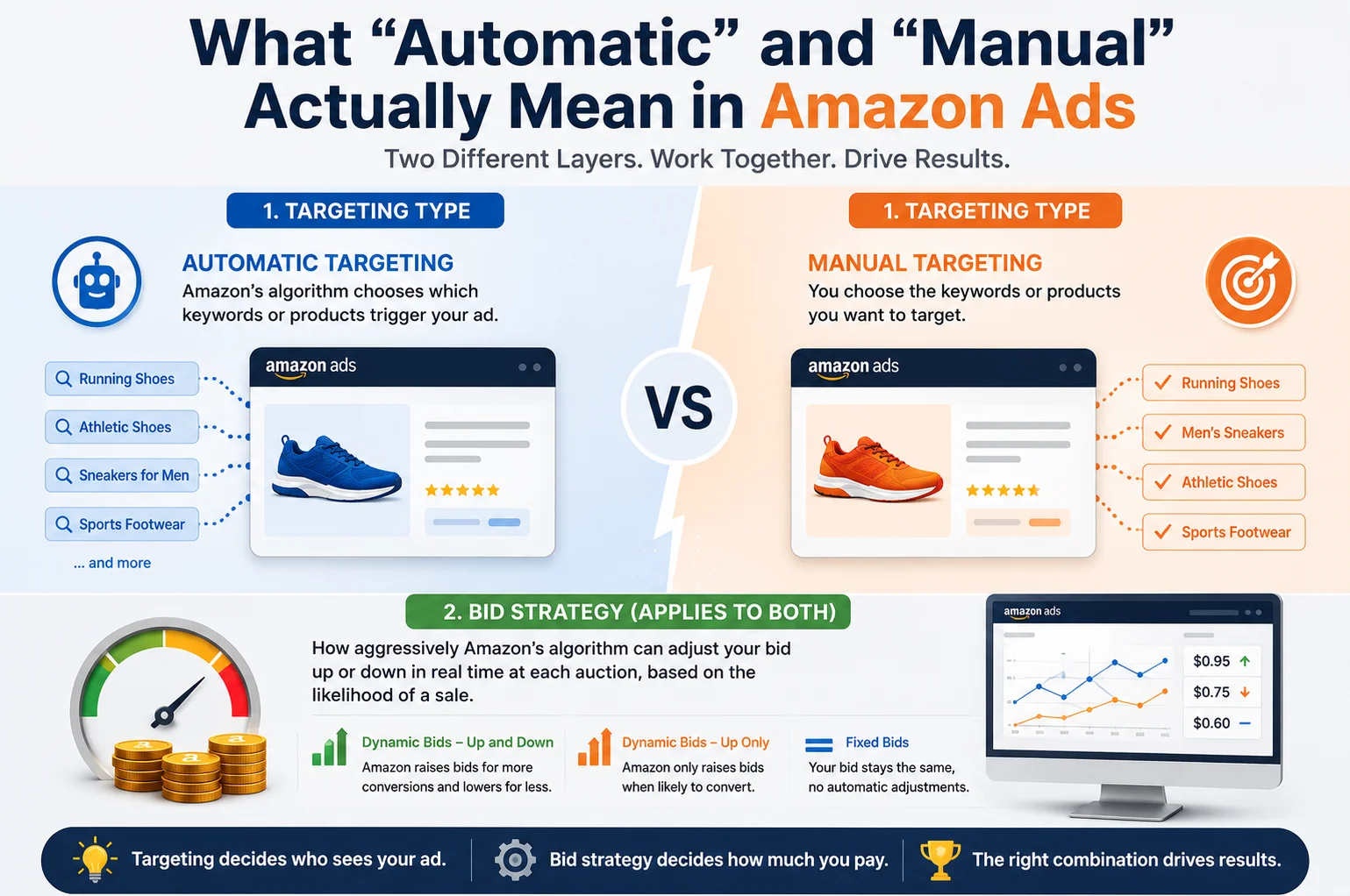
Here’s where a lot of sellers get confused: Amazon uses “automatic” and “manual” to describe two different things, and they aren’t mutually exclusive.
The first layer is targeting type, whether Amazon’s algorithm chooses which keywords or products trigger your ad (Automatic Targeting), or whether you choose them yourself (Manual Targeting).
The second layer is bid strategy, how aggressively Amazon’s real-time bidding algorithm is allowed to adjust your bid up or down at the moment of each auction, based on the likelihood of a sale. This applies whether your campaign is running on automatic or manual targeting.
Understanding this distinction matters because “should I use automatic or manual bidding” is really two questions: how should my ads find shoppers, and how much control should I hand to Amazon’s algorithm once they do. We’ll answer both.

Automatic Targeting: How It Works

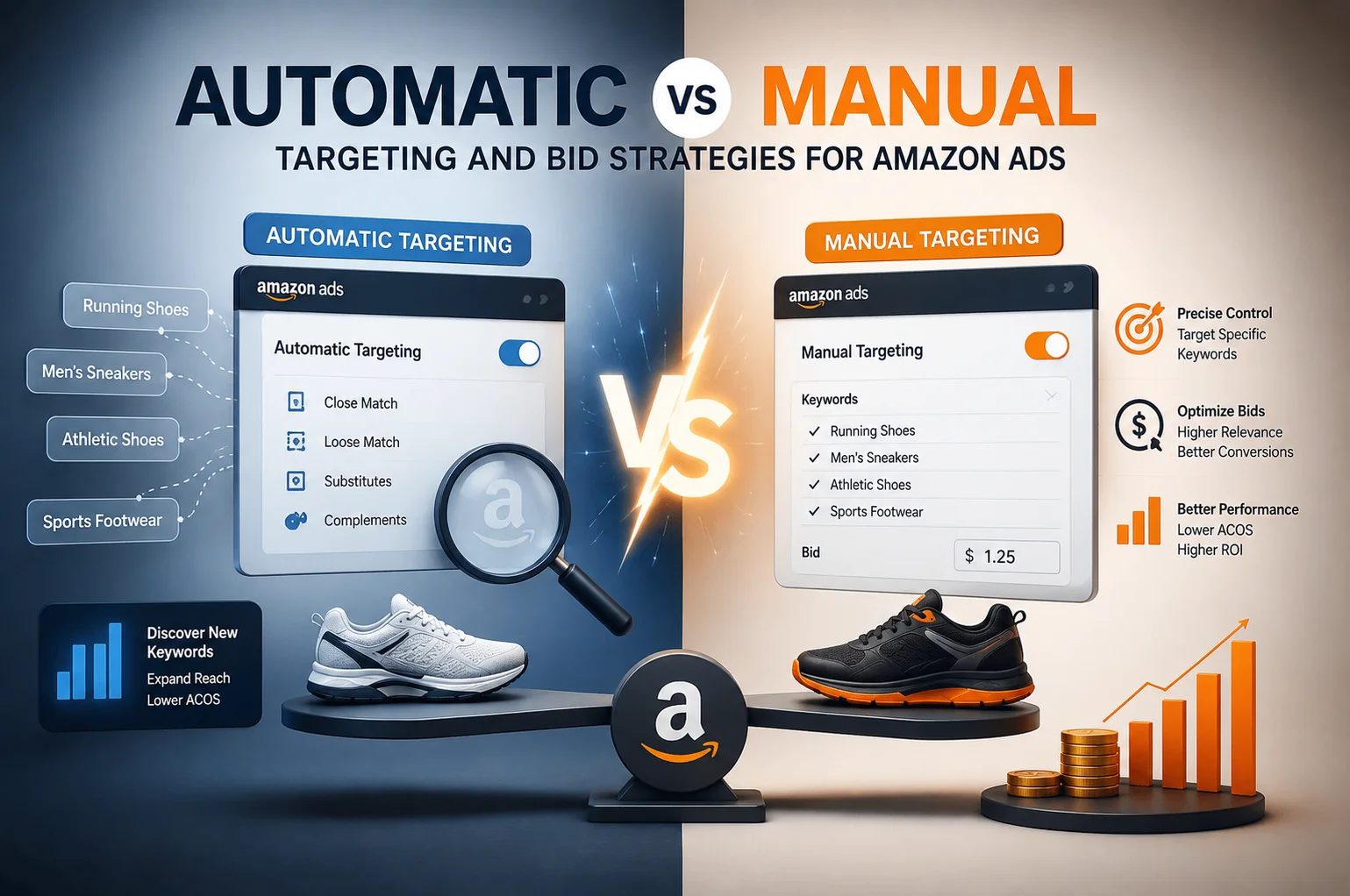
With Automatic Targeting, you write the ad and set a budget, and Amazon’s ads bidding algorithm matches your product to relevant customer searches using listing data, category information, and historical purchase behavior. You don’t select keywords, Amazon decides which searches are relevant enough to trigger your ad.


Amazon further splits automatic campaigns into four matching types behind the scenes: close match, loose match, substitutes, and complements. Close and loose match target searches similar to your product; substitutes and complements place your ad on listings that are alternatives or commonly bought alongside your product.

When Automatic Targeting Makes Sense

Automatic Targeting earns its place in a few specific situations. New listings with no search term history benefit from it because it surfaces real customer search terms you wouldn’t have thought to target manually, data you can later mine and move into manual campaigns. It’s also useful for ongoing keyword discovery even on established listings, since shopper search behavior shifts over time and automatic campaigns keep surfacing new terms passively. And for sellers who genuinely don’t have the bandwidth for granular keyword research, it provides a reasonable baseline rather than no advertising at all.


The tradeoff is control. You’re trusting Amazon’s algorithm to decide relevance, and without disciplined negative keyword management, automatic campaigns can quietly spend on searches that generate impressions but never convert.

Manual Targeting: How It Works

Manual Targeting puts keyword and product selection in your hands. You choose the exact search terms (keyword targeting) or specific ASINs and categories (product targeting) you want your ad to appear against, and you set bids at the keyword or target level rather than letting Amazon decide.


This is where match types come into play broad, phrase, and exact, each giving you a different level of control over how closely a shopper’s search needs to match your chosen keyword before your ad is triggered.

When Manual Targeting Makes Sense

Manual Targeting is the right call once you have enough performance data to know which keywords actually convert for your product, usually harvested from an automatic campaign’s Search Term Report. It’s also essential for protecting margin on your highest-value keywords, since you can bid precisely rather than accepting whatever Amazon’s automatic matching decides is relevant. Established listings, competitive categories, and any campaign where ACoS control matters more than reach are better served by manual targeting.


The tradeoff here is time. Manual campaigns require ongoing bid management, regular Search Term Report reviews, and ongoing negative keyword additions, this isn’t a “set once” strategy.

Amazon’s Bidding Algorithm: Dynamic Bids Explained

Once you’ve chosen a targeting type, the second decision is how much freedom to give Amazon’s real-time bidding algorithm to adjust your bid at the moment of auction. This is where the actual algorithmic bidding happens, and it applies to both automatic and manual campaigns.


Amazon offers three bid strategy settings:

Dynamic Bids – Down Only

Amazon’s algorithm will lower your bid in real time when a click appears less likely to convert, but it will never raise it above what you set. This is the most conservative auto bidding strategy, it protects you from overpaying, but it also means you may miss high-intent placements where a slightly higher bid would have won a valuable sale.

Dynamic Bids – Up and Down

Amazon can both raise and lower your bid, increasing it by up to 100% for top-of-search placements when a conversion looks highly likely, and lowering it when it doesn’t. This is Amazon’s most fully automated bid strategy option, and it generally performs well for sellers who trust the algorithm and are optimizing for overall sales volume rather than bid-level precision.

Fixed Bids

Your bid stays exactly where you set it regardless of Amazon’s real-time conversion prediction. This gives you complete predictability, which matters most when you’re running tightly controlled campaigns against a strict target ACoS, but it also means you’re not benefiting from any of Amazon’s algorithmic adjustments, good or bad.


None of these three is universally “correct.” Down Only tends to suit newer campaigns and tighter margins; Up and Down tends to suit campaigns chasing visibility and volume; Fixed Bids tend to suit highly optimized, data-mature campaigns where you’ve already found your winning bid through testing.

Manual Bidding vs. Automatic Bidding: Side-by-Side Comparison

Let’s put real numbers on it. Here’s what the comparison looks like for a seller spending $5,000 per month on Amazon ads:
Factor Manual Targeting + Fixed/Down-Only Bids Automatic Targeting + Up/Down Bids
Control High - you choose keywords and bid precisely Low - Amazon chooses matches and adjusts bids
Time investment High - ongoing keyword and bid management Low - largely hands-off once launched
Best for Established listings, tight ACoS targets New listings, keyword discovery, volume goals
Risk of wasted spend Lower, if negative keywords are maintained Higher, without regular Search Term Report review
Data quality generated Precise, keyword-level performance data Broader signals, useful for discovering new terms
In practice, most well-run Amazon accounts don’t pick one side of this table and stay there, they use both, deliberately, at different stages of a product’s lifecycle.

Automated Bidding Tools and Strategies Beyond Amazon's Native Options

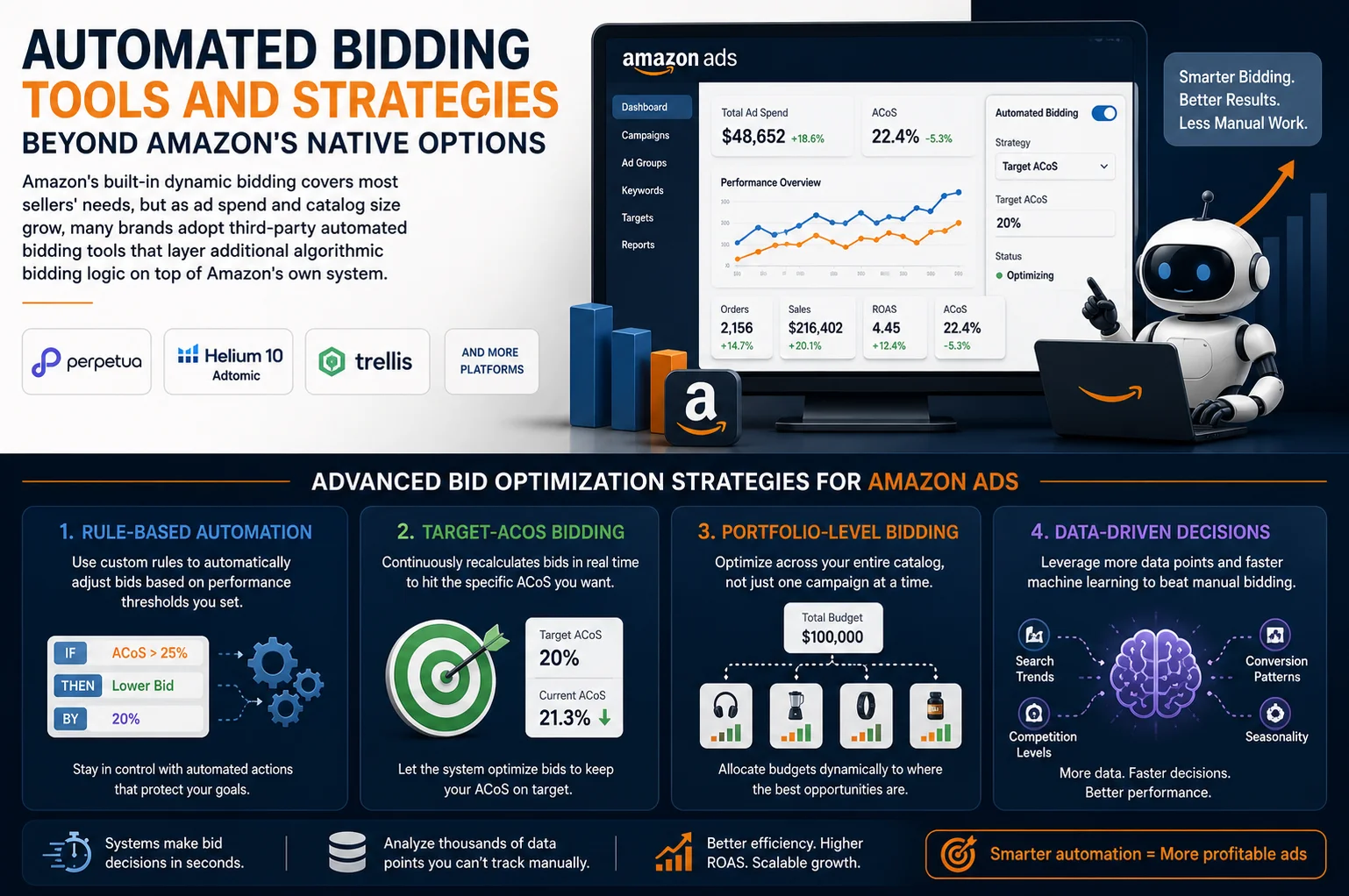
Amazon’s built-in dynamic bidding covers most sellers’ needs, but as ad spend and catalog size grow, many brands adopt third-party automated bidding tools Perpetua, Helium 10 Adtomic, Trellis, and similar platforms that layer additional algorithmic bidding logic on top of Amazon’s own system.

Advanced Bid Optimization Strategies for Amazon Ads

Beyond Amazon’s native dynamic bids, third-party tools typically offer rule-based automation (if ACoS exceeds X%, lower bid by Y%), target-ACoS bidding that continuously recalculates bids to hit a specific efficiency goal, and portfolio-level bidding that balances spend across an entire catalog rather than campaign by campaign. Each represents a different flavor of the same underlying idea: letting a system make bid decisions faster than a person could, based on more data points than a person could realistically track manually.

How This Compares to AdWords Automated Bidding

Sellers with a Google Ads background sometimes expect Amazon’s system to mirror AdWords automated bidding strategies like Target CPA or Maximize Conversions, but the two platforms work differently under the hood. Google’s Smart Bidding pulls from a much broader signal set (device, location, time of day, remarketing lists) and can set bids from scratch on your behalf. Amazon’s dynamic bidding, by contrast, only adjusts a bid you’ve already set, within the boundaries you define. The underlying goal, using an algorithm to bid more efficiently than manual adjustment allows is the same, but Amazon’s version currently gives you a narrower, more controlled band of automation.

Choosing the Best Bidding Strategy for Your Amazon Goals


There isn’t a single best bidding strategy that applies to every account, because “best” depends entirely on what you’re optimizing for.


If your priority is efficient, profitable sales on a tight margin, manual targeting with Down Only or Fixed bids gives you the control to protect ACoS. If your priority is visibility and sales velocity, during a launch, for example; automatic targeting or Up and Down bidding trades some efficiency for reach. If your priority is closer to what B2B advertisers on other platforms call lead generation efficiency maximizing qualified engagement per dollar rather than raw impressions, the Amazon equivalent is usually a tightly scoped manual campaign on high-intent, exact-match keywords with conservative bidding, since that mirrors the same “quality over volume” logic.


The best campaign bidding strategy on Amazon, in other words, isn’t a fixed setting, it’s a decision that should shift as your product moves from launch, to growth, to mature, steady-state advertising.


A Practical Framework: Auto, Manual, or Both?


For most sellers, the highest-performing approach isn’t choosing automatic or manual, it’s running both, with each doing the job it’s best suited for.


Start new listings on Automatic Targeting with Down Only bids to gather real search-term data safely. After two to three weeks, review the Search Term Report, harvest the converting keywords, and move them into a Manual campaign with more precise bids. Keep a smaller Automatic campaign running in parallel for continued keyword discovery, while your Manual campaign carries the weight of proven, profitable terms. Layer in dynamic bid adjustments Up and Down for visibility pushes, Fixed for stable, optimized keywords, as each keyword’s performance history matures.


This layered structure is the same logic behind most professionally managed Amazon accounts: automatic campaigns for discovery, manual campaigns for precision, and bid strategy adjusted deliberately rather than left on whatever default Amazon suggests at setup.


Common Mistakes When Choosing a Bidding Strategy


Leaving automatic campaigns unmanaged. Automatic doesn’t mean “ignore it.” Without regular negative keyword additions, automatic campaigns accumulate wasted spend on irrelevant matches over time.


Switching to Up and Down bidding without a target ACoS in mind. This setting can drive real sales growth, but without a ceiling in mind, it’s easy to let ACoS climb further than intended in pursuit of top-of-search placements.


Assuming manual means “set it and forget it.” Manual targeting requires more attention, not less bids need regular review against changing competition and seasonality, not a one-time setup.


Never revisiting the strategy as the product matures. A bidding approach that worked at launch often becomes inefficient six months later, once enough data exists to bid with more precision.


How eComManagers Approaches Bidding Strategy


At eComManagers, bidding strategy isn’t treated as a one-time setup decision, it’s reviewed continuously as part of ongoing campaign management across the USA, UK, UAE, and Germany. We typically launch new listings on a carefully scoped automatic strategy, transition proven keywords into manual campaigns as data matures, and apply dynamic bid adjustments based on category competitiveness and account-specific ACoS targets, rather than defaulting to whatever setting Amazon pre-selects.


If time-of-day bid scheduling is also part of your optimization plan, our guide on Hourly PPC Dayparting covers how to layer scheduling rules on top of the bidding strategy decisions covered here. For the full picture of how bidding fits into a complete PPC strategy, see our Complete Guide to Amazon PPC Management.


Not sure whether your current campaigns are set up correctly? 


Contact eComManagers for a straightforward account review, no pressure, just an honest look at whether your bidding strategy matches your actual goals.

Scroll to Top
Privacy Overview

This website uses cookies so that we can provide you with the best user experience possible. Cookie information is stored in your browser and performs functions such as recognising you when you return to our website and helping our team to understand which sections of the website you find most interesting and useful.