Amazon

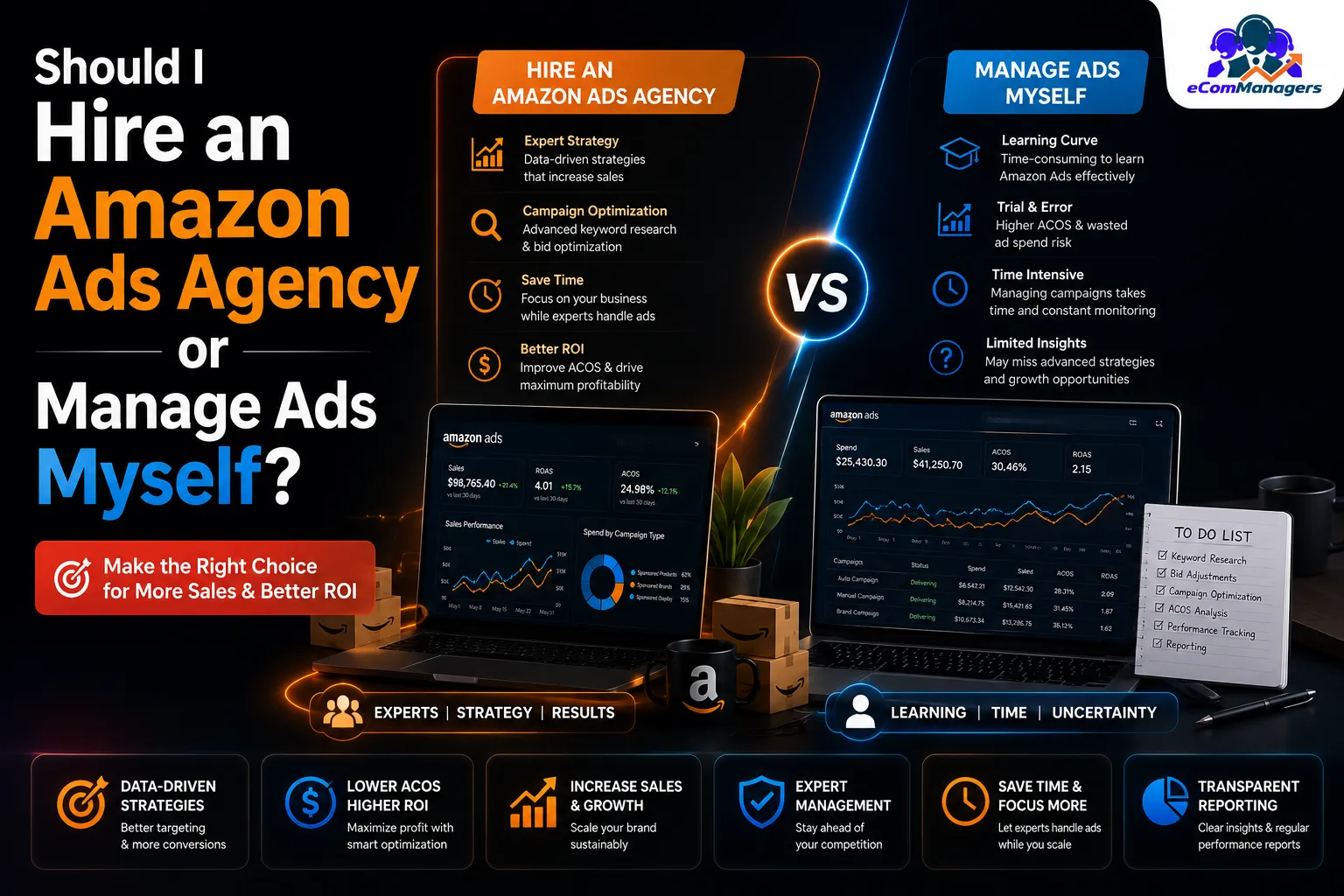
Should I Hire an Amazon Ads Agency or Manage Ads Myself?

This is one of the most common questions Amazon sellers ask, and honestly, it’s one of the most important ones too. Get it wrong and you either waste money on an agency you didn’t need, or you waste far more money running campaigns badly on your own.
There is no single correct answer. But there is a correct answer for your business, depending on where you are right now. This guide breaks down both sides honestly, whether Amazon Ads Agency vs DIY is the better choice for your business, what Amazon PPC Agency vs DIY really means, what DIY Amazon PPC and Amazon self service advertising actually involve, and how to decide which option delivers the best ROI.

What Does Amazon Self-Service Advertising Actually Look Like?

When sellers choose Amazon Ads Management vs DIY, they’re usually referring to Amazon self service advertising, where they create, manage, and optimize campaigns without hiring an agency.

Running Amazon ads properly on your own requires:

Keyword research

Finding the exact terms your buyers are searching for, not just the obvious ones, using tools and competitor analysis.

Campaign structure

Organizing ads into properly segmented groups so you can identify what's working and control bids precisely.

Bid management

Adjusting bids based on performance data, placement type, and competitive changes. This requires regular attention, not a one-time setup.

Search Term Report analysis

Reviewing which customer searches triggered your ads, identifying what converts, and adding non-converting terms to your negative keyword list.

Negative keyword management

locking irrelevant search terms before they drain budget on clicks that will never convert.

Performance tracking

Monitoring ACoS, TACoS, CTR, CVR, and impression share, and understanding what the numbers are actually telling you.

For a single product in a low-competition category, an experienced seller can manage this effectively. For a growing catalog across multiple categories or across multiple marketplaces the time requirement grows fast. Most sellers estimate 15 to 20 hours per week once their account reaches any real complexity.

The Real Costs of Amazon Self-Service Advertising

The biggest advantage of Amazon self service advertising is avoiding agency fees, but comparing Amazon Ads Agency vs DIY requires looking beyond monthly management costs.
The learning curve costs money

Amazon's advertising platform changes constantly. New ad formats, new bidding strategies, new targeting options. Learning what actually works takes months of testing and during that time, you're paying tuition in wasted ad spend.

Mistakes are expensive in competitive categories

Overbidding on the wrong keywords, running broad campaigns without negative keywords, or missing the auto-to-manual harvesting process can easily consume 30 to 40 percent of your ad budget on non-converting traffic. On a $5,000 monthly ad spend, that's $1,500 to $2,000 per month in waste.

Opportunity cost is real

Every hour you spend managing campaigns is an hour not spent on product development, supplier relationships, customer experience, or strategic growth. For most business owners, that tradeoff gets more expensive as the business grows.

You can only see your own data

An experienced agency manages accounts across dozens or hundreds of sellers, which means they see patterns in keyword performance, seasonal trends, and category dynamics that no individual seller can observe from a single account.

What Does an Amazon Ads Agency Actually Do?

If you’re comparing Amazon PPC Agency vs DIY, it’s important to understand what professional management actually includes beyond simply running campaigns.

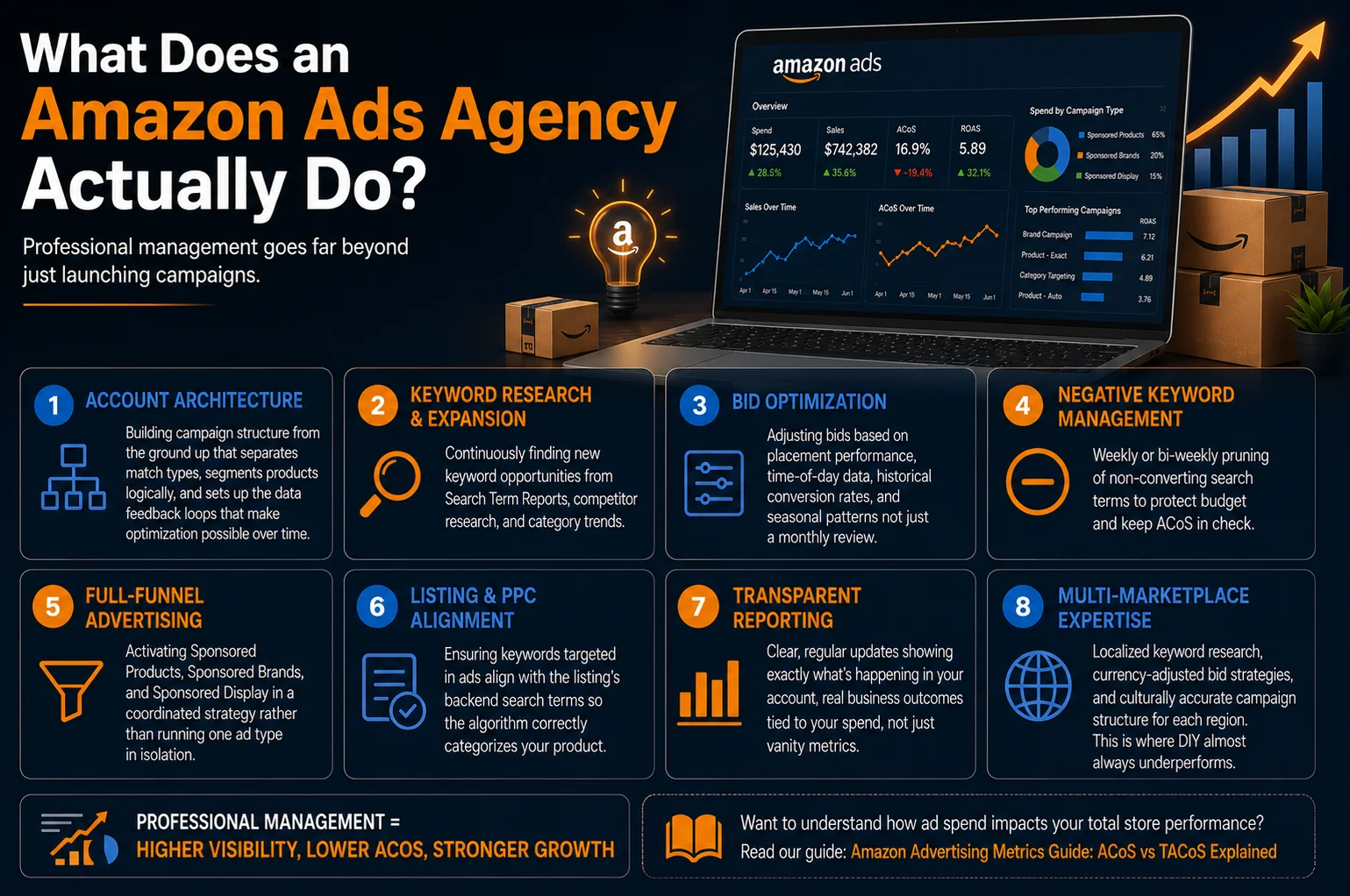
Account architecture: Building campaign structure from the ground up that separates match types, segments products logically, and sets up the data feedback loops that make optimization possible over time.

Keyword research and expansion: Continuously finding new keyword opportunities from Search Term Reports, competitor research, and category trends.

Bid optimization: Adjusting bids based on placement performance, time-of-day data, historical conversion rates, and seasonal patterns not just a monthly review.

Negative keyword management: Weekly or bi-weekly pruning of non-converting search terms to protect budget and keep ACoS in check.

Full-funnel advertising: Activating Sponsored Products, Sponsored Brands, and Sponsored Display in a coordinated strategy rather than running one ad type in isolation.

Listing and PPC alignment: Ensuring keywords targeted in ads align with the listing’s backend search terms so the algorithm correctly categorizes your product.

Transparent reporting: Clear, regular updates showing exactly what’s happening in your account, real business outcomes tied to your spend, not just vanity metrics.

Multi-marketplace expertise: Localized keyword research, currency-adjusted bid strategies, and culturally accurate campaign structure for each region. This is where DIY almost always underperforms.

To understand how ad spend connects to your total store performance, see our Amazon Advertising Metrics Guide: ACoS vs TACoS Explained.

Amazon Ads Agency vs DIY: The True Cost Comparison

Let’s put real numbers on it. Here’s what the comparison looks like for a seller spending $5,000 per month on Amazon ads:
Cost Factor DIY Management Agency Management
Monthly Ad Spend $5,000 $5,000
Management Fee $0 $1,500 – $2,500
Your Time (hrs/month) 15–20 hrs 2–3 hrs (reviews only)
Estimated Wasted Spend $1,500 – $2,000 (30–40%) $250 – $500 (5–10%)
Tools & Software $150 – $400/month Included
Average ACoS 35–45% 18–28%
Effective Total Monthly Cost $6,650 – $7,400 $6,750 – $8,000

At $5,000 monthly ad spend, the numbers are roughly comparable, which means the real differentiator at this level is your time and whether you have the bandwidth and skill to manage campaigns to agency-level quality.

At $10,000 or more per month, the efficiency gap widens considerably. The wasted spend in a DIY account at that scale typically exceeds agency fees by a meaningful margin, meaning professional management often pays for itself purely in budget savings, before counting the revenue gains from better optimization.
Amazon Self-Service Performance Advertising: When It Actually Works


Many sellers successfully use self-serve Amazon ads before moving to professional management. 

  • You have fewer than five products in a single, low-competition category
  • Your monthly ad spend is under $3,000 and you have time to learn properly
  • You enjoy data analysis and are genuinely interested in mastering the platform
  • Your campaigns are simple, primarily Sponsored Products only, no multi-marketplace complexity

If these describe your situation, investing time in learning Amazon PPC self-service advertising is a completely valid path. There are good resources, courses, and tools available that can get a dedicated seller to a reasonable level of competence.


When Hiring an Agency Is the Smarter Move


In the Amazon PPC Management vs DIY debate, agency management usually becomes the smarter investment once campaigns become more complex. 


Your monthly ad spend exceeds $5,000. At this level, the efficiency difference between good and poor campaign management becomes significant enough to justify management fees and often more than covers them.


You’re selling in more than one marketplace. Managing localized campaigns across the USA, UK, Germany, and UAE simultaneously with different keywords, different competitive landscapes, and different bidding dynamics in each is genuinely beyond what most solo sellers can execute well alongside running a business.


Your ACoS has been climbing for more than two months. This is a signal that something in your campaign structure or keyword strategy needs professional diagnosis. A PPC audit is often the fastest way to identify the source of the problem. Our Amazon PPC Audit Service is specifically designed for this.


You’re preparing for a major product launch. New product launches require an aggressive, coordinated PPC push to build sales velocity quickly, which directly influences organic ranking. Getting this wrong during a launch can set a product back months.


You’re running more than Sponsored Products. Once you’re incorporating Sponsored Brands, Sponsored Display, and competitor targeting into your strategy, the complexity increases significantly. Managing all three formats in coordination requires dedicated expertise.


Your time is genuinely better spent elsewhere. If 15 to 20 hours per week of campaign management is preventing you from growing your business in other ways, the opportunity cost of DIY is significant.


The Multi-Marketplace Factor: A Real Differentiator


One thing most DIY vs. agency comparisons miss is the multi-marketplace dimension and it’s significant for brands selling internationally.


Managing Amazon self-service performance advertising across the USA, UK, Germany, and UAE is not the same as managing one marketplace and copy-pasting campaigns. Each region requires localized keyword research in the native language, currency-adjusted bidding, region-specific negative keyword lists, and an understanding of local competitive dynamics. German campaigns run in English consistently underperform native-language targeting, a mistake that costs brands real money every day.


Sellers who manage multi-marketplace advertising without this localization almost always see significantly weaker performance in non-domestic markets. For a deeper look at this, see our blog on Negative Keyword Strategies for Multi-Language Ads.

Questions to Ask Before Hiring an Amazon Ads Agency

If you’re still deciding between Amazon Ads Agency vs DIY, these questions will help you evaluate whether hiring an agency is the right move.
Amazon advertising has its own mechanics, auction dynamics, and optimization levers. Agencies that split their attention across platforms rarely develop the deep Amazon-specific expertise that delivers consistent results.
You should receive clear, regular updates that connect campaign activity to business outcomes. Monthly PDF reports with vague summaries are not sufficient for actively managed accounts.
PPC performance is directly capped by listing conversion rate. An agency that manages ads in isolation from listing quality is solving half the problem.
If international growth is part of your roadmap, confirm this capability before committing.

Specific, verifiable outcomes, ACoS reductions, revenue growth, launch results tell you far more than service descriptions. See our Amazon PPC Case Studies: How We Doubled Seller Revenue in 100 Days for examples of what real outcomes look like.

How eComManagers Approaches This Decision

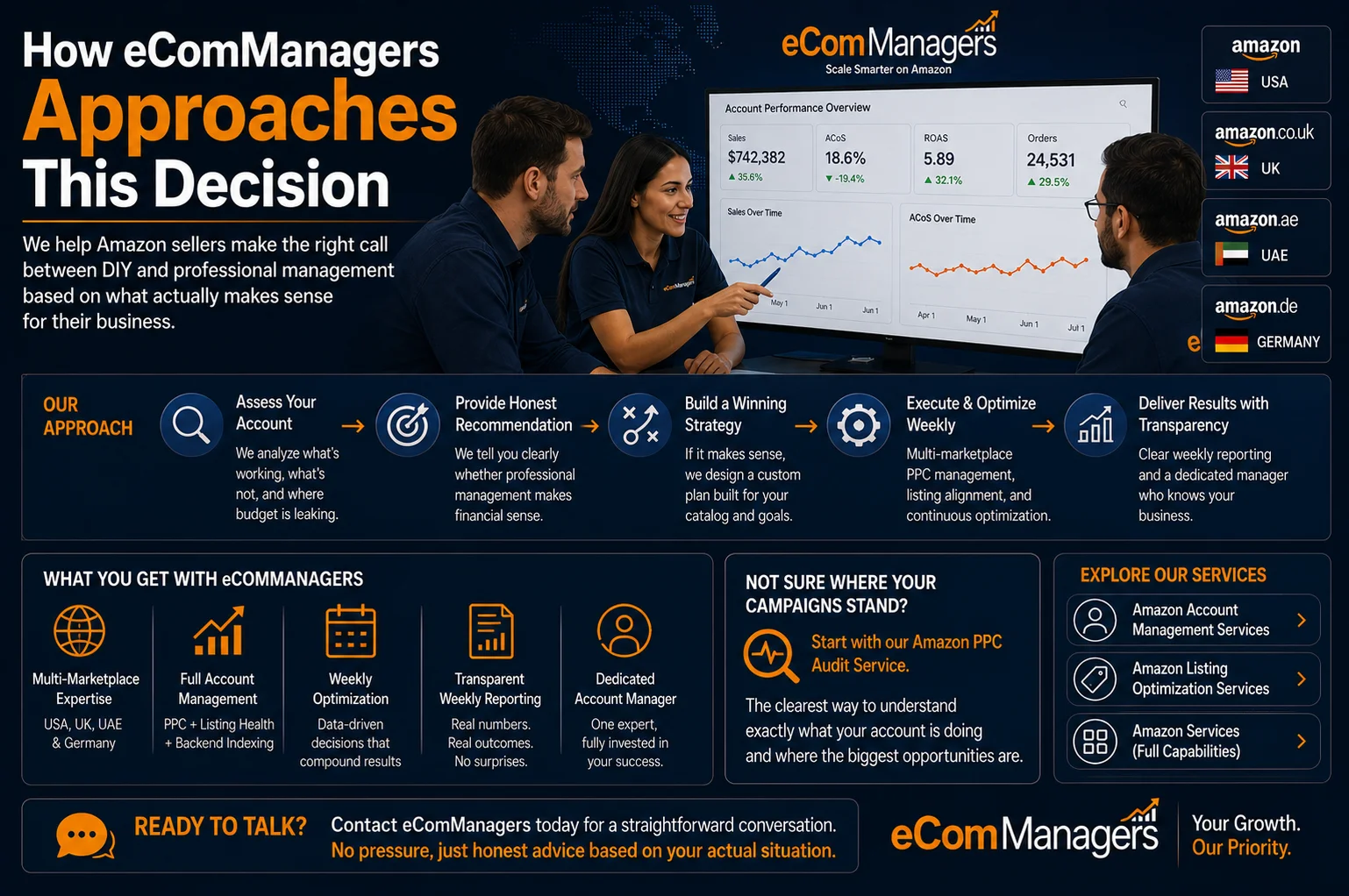
At eComManagers, we’ve worked with sellers at every stage from small businesses running their first campaigns to established multi-marketplace brands with complex catalogs. We don’t push every seller toward agency management before it makes financial sense.

We start with an honest assessment of where your account stands, what’s working, and what’s wasting budget. From there, we tell you clearly whether professional management makes financial sense and if it does, what that looks like in practice.
Our team manages Amazon PPC across the USA, UK, UAE, and Germany with dedicated multi-marketplace expertise, weekly optimization, and full account management connecting advertising performance to listing health and backend indexing. Every client gets transparent weekly reporting and a dedicated account manager who knows their business.

Explore what we offer on our Amazon Account Management Services and Amazon Listing Optimization Services pages, or visit the Amazon Services pillar page for our full capabilities.

Not sure where your campaigns stand? Start with our Amazon PPC Audit Service, the clearest way to understand exactly what your account is doing and where the biggest opportunities are.

Ready to talk? Contact eComManagers today for a straightforward conversation, no pressure, just honest advice based on your actual situation.

Scroll to Top
Privacy Overview

This website uses cookies so that we can provide you with the best user experience possible. Cookie information is stored in your browser and performs functions such as recognising you when you return to our website and helping our team to understand which sections of the website you find most interesting and useful.