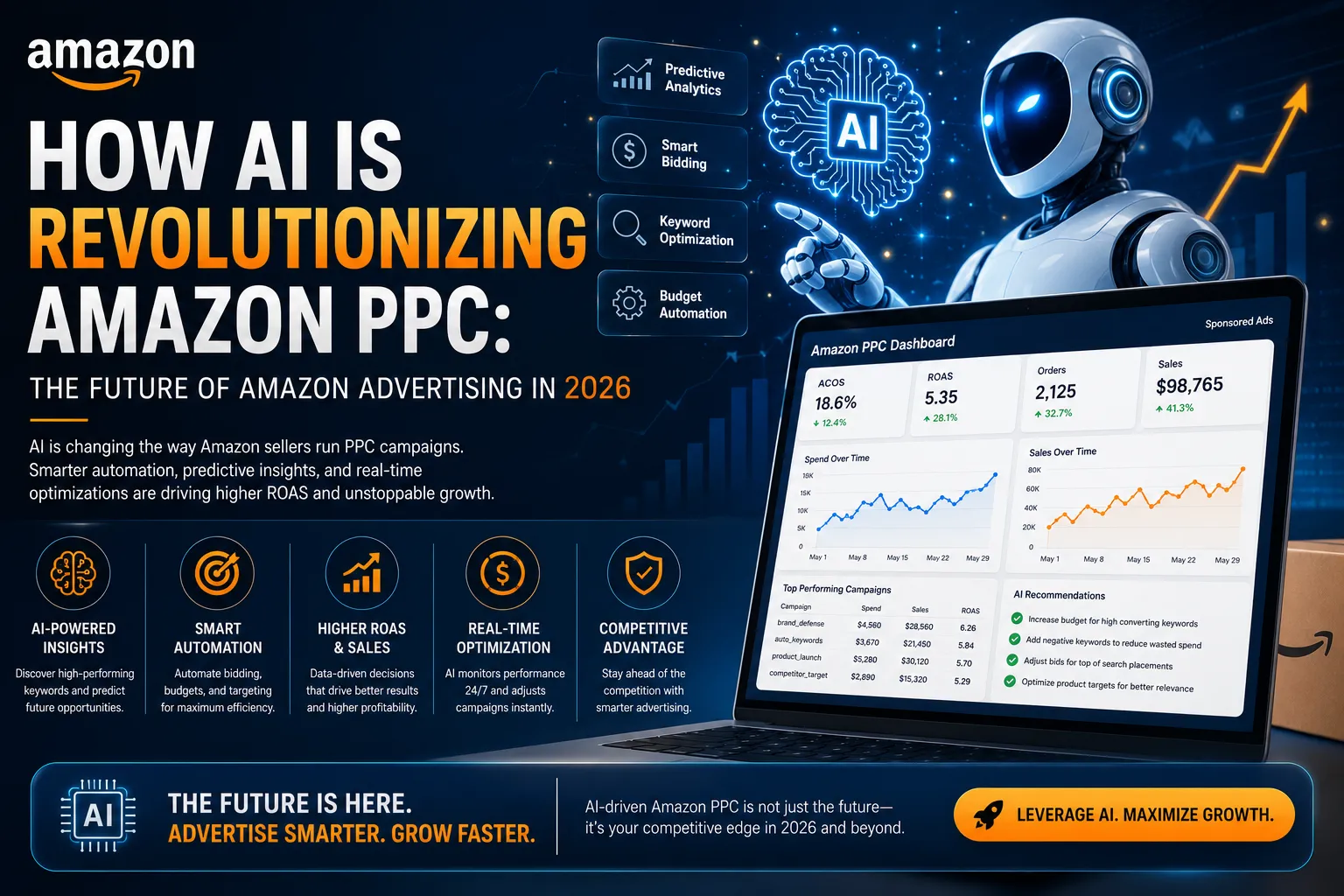
Amazon advertising has crossed a threshold. The sellers scaling profitably in 2026 are not the ones running the most ads, they are the ones using AI-powered Amazon PPC intelligently, with human expertise guiding every automation decision.
Manual bid adjustments, keyword reviews done once a week, and reactive budget changes are no longer sufficient. The competitive gap between sellers using intelligent automation and those still managing campaigns manually grows wider every month.
This guide breaks down exactly how AI is reshaping Amazon PPC, what it means for your campaigns, and how EcomManagers combines smart automation with senior-level human oversight to deliver results that pure automation alone never will.
For the full strategic foundation, start with our Complete Guide to Amazon PPC Management in 2026.
Why AI Has Become Non-Negotiable in Amazon PPC Management
The Manual Management Problem in 2026
Every manual bid adjustment, every keyword pause, every budget reallocation takes time. In a marketplace where auction dynamics shift by the hour and competitor activity changes daily, the seller reacting at the end of the week is always behind.
AI-powered Amazon PPC eliminates this lag by:
- Analyzing thousands of campaign data points in real time
- Adjusting bids and budgets based on live conversion signals
- Identifying high-ACoS keywords and reallocating spend before damage compounds
- Flagging structural problems in campaigns before they become expensive
The result is faster optimization cycles, less wasted spend, and campaigns that respond to the market instead of lagging behind it.
What Has Changed in Amazon’s Advertising Ecosystem
The Amazon advertising landscape in 2026 is fundamentally different from two years ago:
- AI-powered bidding tools are now standard for professional sellers
- Sponsored Brands Video ads deliver 30–50% higher CTRs than static image ads
- CPCs in competitive categories have risen 20–40% since 2023
- Amazon’s own algorithm weighs sales velocity, conversion rate, and ad relevance simultaneously
Sellers who are not actively adapting their Amazon PPC strategy 2026 are handing market share to competitors who are. See how this connects directly to the broader challenge of How Amazon Sellers Can Remain Competitive in 2025 and Beyond.
The Core Advantages of AI Automation for Amazon Ads
Speed, Responsiveness, and Scale
The three performance advantages of AI Amazon advertising tools over manual management are measurable and consistent:
Faster optimization, Processes that previously required hours of manual analysis now happen in minutes. Campaigns that would have bled budget over a weekend are corrected in real time.
Instant responsiveness, Bid and budget changes fire as shopper behavior shifts, not 48 hours later when someone finally reviews a spreadsheet.
Scalability, Managing hundreds of ASINs, thousands of keywords, and multiple ad formats simultaneously becomes operationally viable with the right automation infrastructure.
How AI Tools Like Teikametrics and AdBadger Work in Practice
Platforms including Teikametrics and AdBadger are automating bid management and keyword optimization at a level that would require a full-time analyst per account to replicate manually. These tools operate on rule-based logic:
- If ACoS exceeds 40% for seven consecutive days → reduce bids by 15%
- If CTR drops below threshold → pause the ad group and flag for review
- If conversion rate improves above target → increase bids to capture more volume
SellerMate.AI and similar tools allow sellers to construct these rule sets systematically, building a responsive campaign engine that adjusts faster than any manual process can.
The critical distinction: these tools provide the speed. Human expertise provides the strategy behind the rules.
How EcomManagers Combines AI With Expert Human Oversight
Why Automation Alone Still Falls Short
Pure automation without human oversight produces a predictable set of problems: over-optimization on short-term data, incorrect rule triggers, budget misallocation during algorithm shifts, and campaigns that hit local efficiency peaks while missing larger strategic opportunities.
At EcomManagers, our Amazon PPC management approach is built on a four-stage integration of AI tools and senior specialist oversight.
Stage 1: Tool Selection and Configuration
Before automation runs a single rule, our Amazon PPC specialists select and configure the right tools for each client account based on:
- Ad spend level and account size
- Product category and competitive intensity
- Existing campaign structure and historical performance data
- ACoS targets, ROAS goals, and margin requirements
Tool selection is not one-size-fits-all. An account spending $2,000 per month requires a different automation infrastructure than one spending $50,000.
Stage 2: Rule and Strategy Development
Every automation rule we deploy is mapped to a specific business objective, not a generic platform default. We convert client goals into precise automation logic:
- ACoS target → bid adjustment thresholds and trigger windows
- Conversion rate goals → keyword promotion and demotion rules
- TACoS cap → budget allocation limits across campaign types
- Seasonal patterns → scheduled rule overrides during peak periods
Why Custom Rules Outperform Black-Box AI
Generic AI tools that operate as black boxes, making bid changes without visible logic, create a fundamental accountability problem. Sellers cannot learn from decisions they cannot see, and agencies cannot explain results they do not understand.
EcomManagers builds only transparent, customizable rule engines where every change is logged, explained, and reviewable. This is non-negotiable in professional Amazon PPC campaign management. For a full breakdown of what transparent management looks like in practice, read our Amazon PPC Audit Service Deliverables overview.
Stage 3: Live Monitoring and Expert Override
Automation operates in suggest mode until campaign performance stabilizes. Our specialists review every significant suggested change before full automation takes effect, providing the speed of AI with the judgment of experienced human oversight.
When Human Override Protects Campaign Performance
AI tools make decisions based on patterns in historical data. They cannot account for:
- A competitor’s sudden price drop that changes conversion dynamics
- A product going viral on social media and driving atypical traffic
- An Amazon policy update that affects keyword eligibility
- Inventory constraints that make scaling spend counterproductive
These are judgment calls that require human expertise. This is why our senior-level Amazon PPC specialists review automation outputs daily, not weekly.
Stage 4: The Continuous Learning Loop
Automation collects performance data. Our team analyzes that data, refines the underlying rules, and tests new approaches. Over time, this process produces campaigns that become progressively more efficient, not campaigns locked into static rules that worked six months ago.
This iterative loop is what separates Amazon advertising management that compounds over time from agency management that plateaus.
What to Require From Any AI-Powered Amazon PPC Agency
Before working with any agency promising AI-powered results, verify these five requirements:
Transparent automation logs, You must be able to see what changed, when, and why. Any agency that cannot provide this is operating a black box at your expense.
Customizable rule engines, Automation should reflect your margin structure and business goals, not the agency’s default templates.
Manual review and override capability, Full automation without expert oversight is a liability. Confirmed human review at key decision points is essential.
Demonstrated results in your category, AI tools perform differently across product categories. Demand case studies from comparable accounts.
Reporting tied to business KPIs, ACoS, ROAS, and TACoS trends tied to actual profit contribution. Not impression counts or click volume. See how this accountability structure works in our Amazon PPC Case Studies.
For a complete framework before making your decision, read our How to Choose the Right Amazon PPC Agency guide and our Amazon PPC Agency FAQs.
Amazon PPC AI Strategy Across Multiple Marketplaces
AI-powered Amazon advertising performs differently across marketplaces. The automation rules, bid thresholds, and keyword strategies that work in the USA do not automatically transfer to the UK, UAE, or Germany.
EcomManagers manages AI-enhanced campaigns with market-specific configurations across all major Amazon marketplaces:
Multi-market sellers who apply identical automation settings across all regions consistently underperform compared to those using market-specific rule sets. Our regional expertise ensures that AI tools are configured for each marketplace’s specific dynamics, not just deployed globally with default settings.
Final Thoughts
AI is not replacing Amazon PPC expertise, it is multiplying what expert management can deliver. The sellers and agencies winning in 2026 are those who use intelligent automation to move faster, reduce waste, and scale with precision, while keeping experienced human judgment in control of every strategic decision.
EcomManagers brings both. If you are ready to see what AI-powered Amazon PPC management can deliver for your brand, book a free strategy consultation with our team today.
Frequently Asked Questions
What is AI-powered Amazon PPC and how does it work?
AI-powered Amazon PPC uses machine learning and rule-based automation to adjust bids, budgets, and keyword targeting based on real-time performance data, moving faster and at greater scale than manual management allows.
Does AI completely replace human management in Amazon advertising?
No. AI tools accelerate optimization and eliminate manual data processing, but human expertise remains essential for strategy development, rule configuration, override decisions, and marketplace-specific judgment calls that data alone cannot resolve.
Which AI tools does EcomManagers use for Amazon PPC?
Our specialists select tools based on each client’s account size, ad spend, and category dynamics, including platforms like Teikametrics and AdBadger alongside custom rule configurations built within Amazon’s native campaign management system.
How quickly does AI optimization improve campaign performance?
Initial efficiency improvements from AI-assisted management are typically visible within 30–60 days. Compounding performance improvements through the continuous learning loop develop over a 90–120 day optimization cycle.
Can AI-powered PPC management work across multiple Amazon marketplaces?
Yes, but only with market-specific rule configurations. EcomManagers manages AI-enhanced campaigns across the USA, UK, UAE, and Germany with distinct automation settings for each marketplace’s buyer behavior and CPC dynamics.
Conclusion
In 2026, successful Amazon PPC management is no longer about manual optimization alone, it is about combining AI-driven automation with expert human strategy. Sellers who adapt to intelligent, data-driven advertising gain faster optimization, better scalability, and higher profitability. With the right balance of AI tools and experienced oversight, brands can stay competitive, reduce wasted ad spend, and achieve long-term growth across Amazon marketplaces worldwide.