Most online sellers hit the same wall. Sales grow, to-do lists multiply, and suddenly the business that was exciting to build becomes exhausting to run. The product is right. The demand is there. But the operation behind it cannot keep up, and that gap is exactly what eCommerce store management is designed to close.
This is not about delegating tasks. It is about building a structured operational system that keeps your store running efficiently, your customers satisfied, and your revenue growing, without requiring your constant attention on every moving part.
If you want to understand how store management fits into a complete growth framework, our eCommerce Management: Complete Guide to Running & Scaling Your Online Business covers the full picture. This blog focuses specifically on why structured store management is the operational foundation that makes everything else work.
What eCommerce Store Management Actually Means
eCommerce store management is the day-to-day operational system that keeps an online store functional, accurate, and performing. It covers every routine process that determines whether your store delivers a reliable customer experience or a frustrating one.
Core Operations Under Store Management
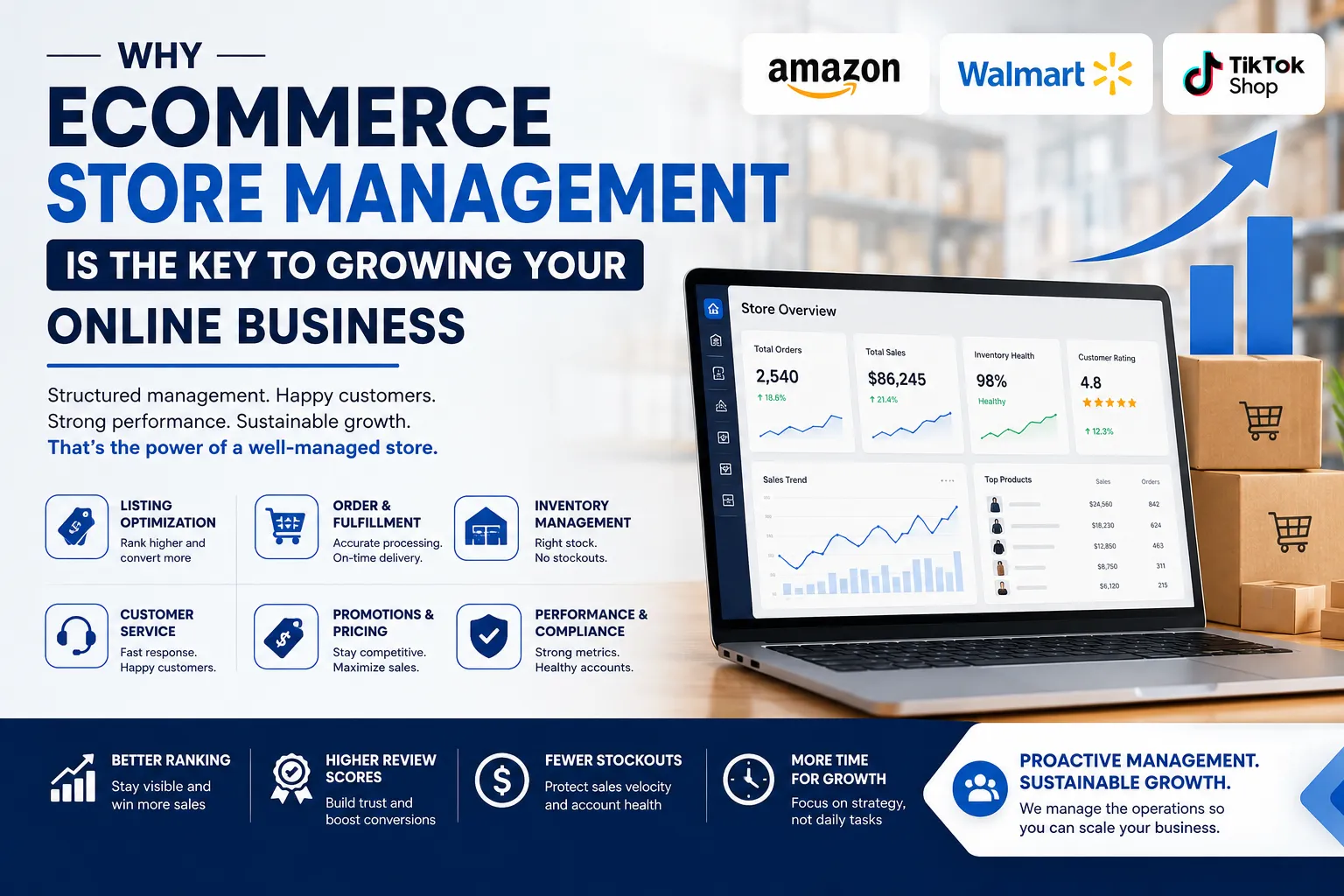
A properly managed eCommerce store runs consistent processes across six areas:
- Product listing management, creating, updating, and optimizing listings for search visibility and conversion performance
- Order processing and fulfillment tracking, ensuring orders move from placement to delivery without errors or delays
- Inventory accuracy, maintaining correct stock levels across every sales channel to prevent oversells and stockouts
- Customer service and inquiry management, responding to questions, resolving complaints, and protecting review scores
- Promotions and pricing updates, managing deals, coupons, and competitive pricing in real time
- Performance and compliance monitoring, tracking platform metrics and maintaining account health on Amazon, Walmart, and TikTok
When each of these operates on a defined schedule with a clear owner, the store runs predictably. When any one of them is managed reactively, handled only when something breaks, it creates problems that cost revenue and ranking.
Why Structured Store Management Drives Growth in 2026
The eCommerce environment in 2026 is faster-moving and less forgiving than it was three years ago. Platform algorithms reward consistency. Customers expect faster resolution times. Account health enforcement has become more automated and less lenient. In this environment, reactive management is a structural disadvantage.
Listings That Are Maintained Convert Better
A product listing is not a one-time asset. Keyword rankings shift. Competitor listings improve. Platform search algorithms update. A listing that ranked and converted well six months ago may underperform today if it has not been reviewed and refreshed against current search data.
eCommerce store management treats listing optimization as an ongoing process, not a launch task. Titles, bullet points, A+ Content, backend keywords, and images are reviewed regularly against conversion data, ensuring the listing continues to work as hard as the product deserves.
Inventory Accuracy Protects Ranking and Margin
Inventory errors are not just operational problems, they are ranking problems. On Amazon and Walmart, consistent sales velocity is one of the primary signals that earns and maintains organic position. A stockout breaks that velocity. Recovering the ranking position lost during a stockout takes significantly longer than the stockout itself.
Structured store management prevents this. Reorder points are set based on actual sales velocity and supplier lead times. Inbound shipments are tracked. Stock levels are monitored before they reach critical thresholds, not after the stockout has already occurred.
Customer Service Quality Protects Review Scores
Review scores are one of the most durable competitive advantages in eCommerce, and one of the easiest to damage through poor service. A single period of slow response times or unresolved complaints can generate negative reviews that suppress conversion rates for months.
Managed customer service maintains consistent response times, follows platform-compliant resolution processes, and monitors feedback proactively, protecting the review score that your product quality earned.
The Signs Your Store Needs Structured Management
Most sellers do not identify the need for structured eCommerce store management until the gaps are already costing them revenue. These are the operational signals that indicate your current approach is not keeping pace with your business:
- Listings have not been reviewed or updated in more than 90 days, your ranking and conversion performance is likely declining
- Inventory has stocked out in the past 60 days, you lost sales velocity and ranking momentum that takes weeks to rebuild
- Customer response times exceed 24 hours regularly, you are accumulating account health risk and likely losing reviews
- You are spending more than 15 hours per week on operational tasks, your time is being consumed by execution instead of growth decisions
- Account health metrics have dropped below green, you are operating in the zone where platform enforcement becomes a real risk
If two or more of these apply, the structure is the problem, not the effort. More hours spent managing reactively will not produce a different result. A managed system will.
What Professional eCommerce Store Management Delivers
From Reactive to Proactive Operations
The most significant difference between self-managed and professionally managed stores is not the quality of individual tasks, it is the shift from reactive to proactive operations. Problems are identified before they become crises. Restock orders are placed before stock runs out. Listing issues are resolved before they suppress ranking. Account metrics are monitored before they approach threshold violations.
This shift produces compounding results. A store that avoids one stockout per quarter maintains ranking momentum that a reactive operation loses and must rebuild. A store with consistently fast customer response times earns better review scores over time. Each proactive process improvement compounds across months.
Platform-Specific Management Expertise
Amazon, Walmart, and TikTok Shop each operate different rules, different performance metrics, and different content requirements. eCommerce store management that works on Amazon does not automatically translate to Walmart, the fulfillment standards, listing requirements, and account health metrics are different in meaningful ways.
EcomManagers provides platform-specific management teams for Amazon Services, Walmart Services, and TikTok Services, with regional specialist teams across the USA, UK, UAE, and Germany.
How Store Management Connects to Full eCommerce Growth
eCommerce store management is the operational layer that makes every other growth investment work properly. Strong advertising campaigns require accurate inventory to fulfil the demand they generate. Listing optimization requires ongoing maintenance to sustain the ranking it earns. Multi-platform expansion requires operational discipline on each platform before adding the next.
For sellers evaluating whether to bring in professional management, the question is not whether you can continue managing without structure, it is whether your current structure is the ceiling on your growth. If operational management is consuming more of your capacity than strategic decisions, that is the answer.
To understand how to evaluate and choose the right management partner for your business stage, read our guide on choosing the right eCommerce management service. For a broader view of how professional agency management drives multi-platform scaling, explore the smart way to scale online sales with an eCommerce agency in 2026.
Frequently Asked Questions
What does eCommerce store management include?
It covers product listing creation and optimization, order processing, inventory tracking, customer service, promotions management, and account health monitoring across platforms like Amazon, Walmart, and TikTok Shop.
When should I start using a store management service?
The right time is before operational problems begin limiting your growth, typically when you are spending more than 15 hours per week on routine operational tasks, experiencing recurring inventory issues, or noticing declining account health metrics.
Does EcomManagers manage stores on Amazon, Walmart, and TikTok?
Yes. EcomManagers provides full-service eCommerce store management across Amazon, Walmart, and TikTok, with platform-specific teams and regional specialists for the USA, UK, UAE, and Germany.
How does store management improve profitability?
By replacing reactive problem-solving with proactive systems. Inventory is managed before stockouts happen. Listings are updated based on performance data. Customer service response times are maintained consistently. Each improvement compounds over time, producing better margins, stronger organic rank, and faster scaling velocity than self-managed operations can sustain.
Conclusion
As eCommerce competition continues to evolve in 2026, structured store management has become essential for sustainable growth. From maintaining inventory accuracy to protecting account health and improving customer experience, proactive management creates the operational foundation every successful online business needs. Sellers who build reliable systems today are better positioned to scale efficiently, protect profitability, and compete consistently across Amazon, Walmart, and TikTok Shop.