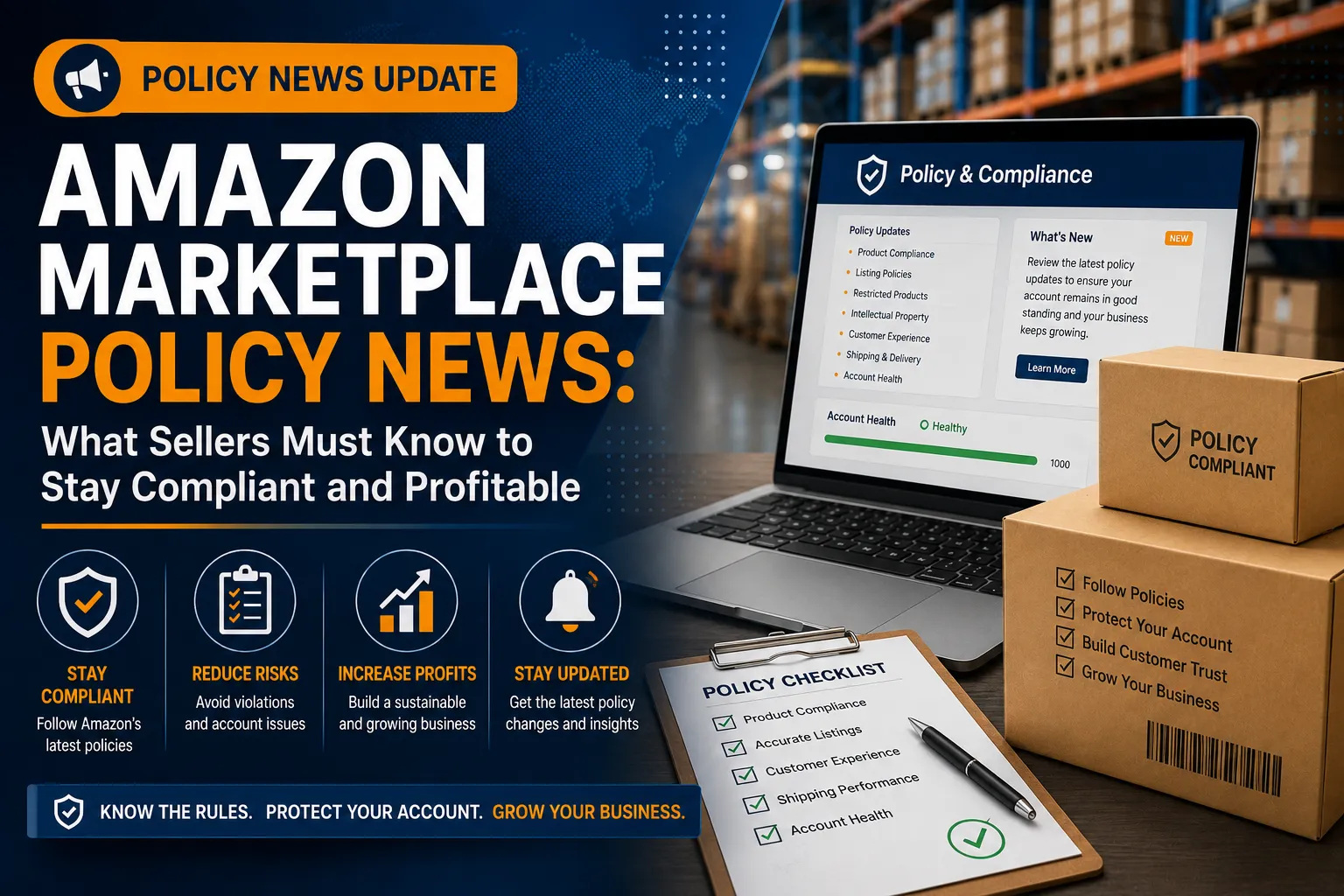
Amazon’s policy enforcement in 2026 is faster, more automated, and less forgiving than at any previous point in the platform’s history. A single policy update, missed or ignored, can remove a listing, suspend an ad campaign, or close an account without prior warning.
For sellers who monitor Amazon marketplace policy news proactively, policy changes are manageable. For sellers who discover them after enforcement has already acted, they are expensive and often avoidable crises.
This guide covers the most significant Amazon marketplace policy updates sellers need to understand in 2026, the enforcement patterns that accompany them, and the compliance practices that protect accounts from automated action.
For sellers already facing suspension due to a policy violation, read our Amazon Account Suspension: Complete Guide to Prevention, Appeal & Reinstatement in 2026.
Why Amazon Marketplace Policy Updates Matter More in 2026
How Amazon’s Enforcement Has Changed
Amazon has always maintained and enforced seller policies, but the mechanism of enforcement has shifted fundamentally. In 2026, the majority of policy enforcement is automated. AI-driven compliance systems scan listings, seller behaviour, advertising content, and account metrics continuously. When a violation is detected, enforcement acts immediately, often before a human reviewer has seen the case.
This means the traditional pattern of receiving a warning, correcting the issue, and avoiding suspension no longer applies reliably. Sellers who wait for Amazon to notify them of a problem are operating on a timeline that Amazon’s systems no longer guarantee.
The sellers who protect their accounts in 2026 treat Amazon marketplace policy news as a proactive business input, not a reactive compliance task.
Key Amazon Marketplace Policy Updates Sellers Must Know
The Policy Areas With the Most Active Enforcement in 2026
Product Compliance and Safety Standards
Amazon has significantly tightened its product compliance requirements across multiple categories. Certifications that were previously optional or loosely enforced, FDA registration for health products, CE marking for electronics, FCC compliance for wireless devices, are now subject to automated document verification at the listing level.
Sellers in affected categories who cannot provide current, accurate compliance documentation face listing removal without prior notice. The enforcement is category-wide, not triggered by individual complaints, which means listings that have been active for years are being reviewed and removed under updated standards.
What sellers must do: Audit every active listing in regulated categories against Amazon’s current compliance documentation requirements. Maintain up-to-date certificates and make them accessible for rapid submission when Amazon requests them.
Seller Code of Conduct Enforcement
The Amazon marketplace policy update most consistently generating account-level enforcement in 2026 relates to seller conduct violations. Amazon’s systems now detect and act on:
- Review solicitation outside Amazon’s permitted channels
- Invoice manipulation or falsification in authenticity appeals
- Black-hat ranking tactics including search term manipulation and click farming
- Coordinated competitor attack campaigns using IP complaints or fake negative feedback
Each of these violations carries account-level consequence, not listing-level. A single confirmed conduct violation can trigger immediate account closure. For sellers whose accounts have already been closed due to a conduct violation, read our guide on why Amazon closes seller accounts without warning.
Account Health Rating as an Enforcement Signal
Amazon’s Account Health Rating (AHR) has evolved from an informational dashboard metric into an active enforcement trigger in 2026. Accounts with AHR scores in the “At Risk” range now face faster suspension timelines than in previous years, and limited appeal attempts before Amazon moves toward permanent deactivation.
What sellers must do: Check Account Health weekly, not when a notification arrives. Build internal alert thresholds at 50% of Amazon’s published metric limits so that deterioration is caught and corrected before the AHR score moves into risk territory. For a full breakdown of the performance metrics that drive AHR, read our guide on why Amazon seller accounts get suspended for performance.
Amazon Advertising Policy Updates
Amazon marketplace policy news in 2026 includes significant updates to PPC and sponsored content compliance. The most impactful changes for sellers:
- Prohibited claims in ad copy are now enforced at the campaign level, a single non-compliant ad can pause an entire campaign
- Restricted keywords vary by category and are updated regularly; campaigns using restricted terms face automatic rejection
- Category-based ad approval requirements have expanded, certain health, beauty, and supplement categories now require pre-approval before sponsored content can run
Agencies and in-house teams managing Amazon PPC now conduct compliance audits of ad copy, landing page claims, and imagery as a standard pre-launch step. For sellers using EcomManagers for PPC management, this compliance layer is built into every campaign setup and ongoing audit process. Explore our Amazon PPC Management Services for details.
Brand Registry and IP Policy Changes
Amazon’s Brand Registry has been strengthened in 2026 with tighter authentication requirements and faster IP enforcement response times. For brand-registered sellers, this is largely positive, complaints from verified brand owners are processed more quickly, and unauthorised resellers face faster removal.
The documentation requirements have increased alongside the enforcement speed. Brand owners must maintain active, accurate trademark registrations. Sellers managing authorised reseller relationships must ensure those relationships are documented and that reseller listings comply with brand owner specifications, because brand owners now have more tools to enforce listing standards across their entire catalogue.
FBA Storage and Fulfilment Policy Shifts
Amazon FBA policy news in 2026 includes ongoing adjustments to storage limits, restock fees, and aged inventory penalties. The consistent direction of these changes is toward higher inventory turnover expectations and faster removal of slow-moving stock.
Sellers with large FBA footprints who are not actively managing storage utilisation and inventory age are accumulating fees that erode margin without triggering a formal policy alert. This is one of the most common hidden compliance costs in 2026, not a suspension risk, but a profitability risk that compounds monthly when unmanaged.
How to Stay Ahead of Amazon Marketplace Policy Changes
The Four Compliance Practices That Protect Seller Accounts
Check Seller Central Announcements Weekly
Amazon publishes policy updates through Seller Central announcements, not always through direct seller emails. Checking the announcements section weekly is the most reliable way to catch updates before they become enforcement events. Do not rely on email notifications alone, they are not comprehensive and filter settings can cause them to be missed.
Conduct Quarterly Listing Compliance Audits
Every active listing should be reviewed against Amazon’s current policy standards at least once per quarter. The audit should cover product claims, image compliance, keyword usage, backend search term content, and category-specific documentation requirements. Listings that were compliant 12 months ago may not be compliant today, Amazon’s category standards are updated continuously.
Maintain Complete Supplier Documentation
Invoices, supplier authorisation letters, product safety certificates, and brand ownership documentation should be maintained and updated proactively, not assembled in response to a suspension notice. Complete, organised documentation is the single most effective tool for shortening suspension resolution timelines when policy enforcement does occur. For guidance on what documentation Amazon requires in reinstatement appeals, read our step-by-step guide to creating an Amazon suspension Plan of Action.
Work With Compliance-Aware Partners
The agencies and service providers that protect seller accounts in 2026 monitor Amazon seller policy updates as a standing operational process, not reactively. EcomManagers integrates policy compliance monitoring into every managed account, ensuring that enforcement changes are identified and addressed before they affect account standing or listing visibility.
How EcomManagers Keeps Seller Accounts Policy-Compliant
EcomManagers monitors Amazon marketplace policy news on a continuous basis and applies policy updates directly to client account management processes. Our compliance support includes:
- Weekly Account Health monitoring with proactive metric alerts
- Quarterly listing compliance audits against current Amazon policy standards
- PPC campaign compliance review for ad copy, claims, and restricted keyword exposure
- Supplier documentation management and verification
- Suspension risk assessment and proactive corrective action before enforcement occurs
We manage policy compliance and account health for sellers across Amazon Services USA, Amazon Services UK, Amazon Services UAE, and Amazon Services Germany.
Explore our Amazon Account Management Services and speak with a compliance specialist today.
Frequently Asked Questions
What is Amazon marketplace policy news?
Amazon marketplace policy news refers to official updates, enforcement changes, and new compliance requirements that Amazon introduces for sellers. These cover product safety, seller conduct, advertising standards, fulfilment requirements, and account health policies, and are published through Seller Central announcements and Amazon’s policy documentation pages.
How often does Amazon update its seller policies?
Amazon updates policies regularly throughout the year, in some categories, multiple times per quarter. There is no fixed schedule. The most reliable way to stay current is weekly review of Seller Central announcements combined with quarterly listing compliance audits.
Can a single policy violation suspend my Amazon account?
Yes. Certain policy violations, particularly those related to seller conduct, review manipulation, and serious product safety breaches, can trigger immediate account-level suspension without prior warning. For a complete guide to suspension recovery, read our Amazon Account Suspension guide.
Where can I find the latest Amazon marketplace policy updates?
The primary source is Seller Central announcements. Amazon’s policy pages within Seller Central are updated when changes are made, checking these directly is more reliable than waiting for email notifications, which are not always sent for every policy change.
Conclusion
Amazon’s marketplace policies in 2026 are evolving faster than ever, with automated enforcement systems leaving little room for error. Sellers who proactively monitor policy updates, maintain accurate documentation, and conduct regular compliance audits are far better positioned to protect their accounts and profitability. Long-term success on Amazon now depends not only on strong sales performance, but also on consistent policy awareness, operational discipline, and proactive account management.