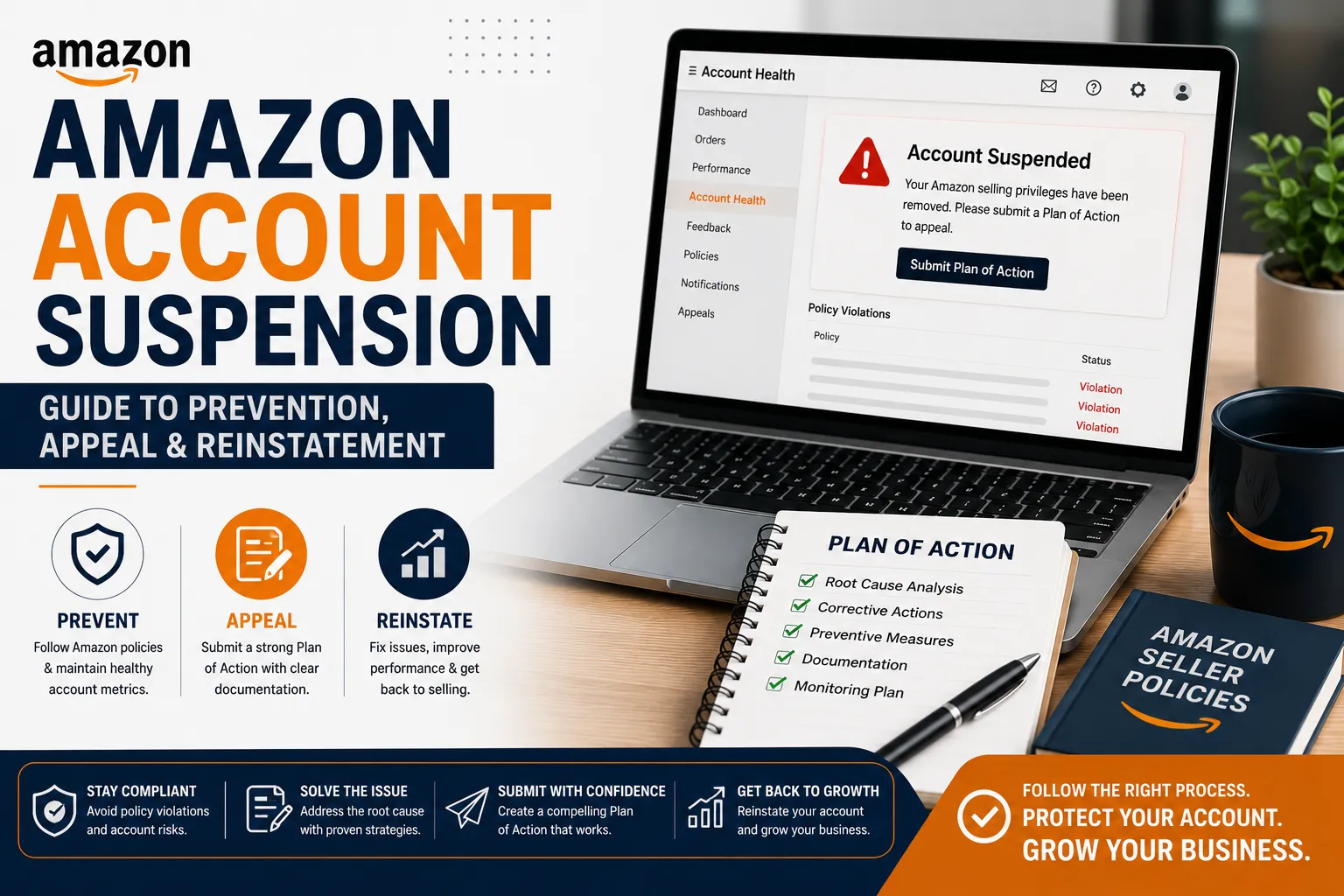
An Amazon account suspension can stop your business overnight. No warning email prepares you for the moment your seller dashboard goes dark, and no amount of panic reverses it. What reverses it is a structured, policy-compliant response delivered at the right time in the right format.
This guide covers everything an Amazon seller needs to know in 2026: why suspensions happen, what Amazon actually expects from your appeal, how to write a Plan of Action that works, and how to protect your account from future risk.
If your account is already suspended and you need professional reinstatement support, explore our Amazon Account Management Services and speak with a specialist today.
Why Amazon Suspends Seller Accounts in 2026
The Three Categories of Amazon Seller Account Suspension
Amazon does not suspend accounts randomly. Every suspension falls into one of three enforceable categories, each with its own appeal path and resolution timeline.
Performance-Based Suspensions
Performance suspensions are triggered when your account metrics fall below Amazon’s minimum thresholds. The three metrics that most commonly trigger suspension are:
- Order Defect Rate (ODR) above 1%
- Late Shipment Rate above 4%
- Pre-Fulfilment Cancellation Rate above 2.5%
These are not soft guidelines. When your account crosses these thresholds, Amazon’s automated systems flag it, and suspension follows quickly. For a detailed breakdown of performance-based triggers and what causes them, read our guide on why Amazon seller accounts get suspended for performance.
Policy Violation Suspensions
Policy violations cover a broad range of infractions, from intellectual property complaints and listing policy breaches to review manipulation and inauthentic product claims. In 2026, Amazon’s enforcement of policy violations has become increasingly automated, meaning suspensions can arrive without prior warning or direct human review. If your account was closed without any apparent trigger, read our analysis of why Amazon closes seller accounts without warning.
Inauthentic or Restricted Product Suspensions
Selling products Amazon considers inauthentic, or items in restricted categories without prior approval, generates some of the most difficult suspensions to appeal. These require documentation of your supply chain, invoices from verifiable suppliers, and in some cases, third-party testing certificates. The bar for reinstatement is high, and the appeal documentation must be thorough.
How Long Does an Amazon Account Suspension Take to Resolve?
What Sellers Should Realistically Expect
Timeline is one of the first questions every suspended seller asks, and the honest answer is that it depends entirely on the suspension type and the quality of your appeal.
For a complete breakdown of realistic timelines by suspension type, read our dedicated guide on how long Amazon suspensions take to resolve.
Typical Resolution Windows in 2026
Performance suspensions with a strong first appeal: 7–14 business days is achievable when the Plan of Action is complete, factual, and addresses each metric violation with specific corrective actions.
Policy violation suspensions: These typically run 14–30 days even with a well-structured appeal, because they often require manual review by an Amazon Seller Performance team member rather than automated processing.
Inauthentic product suspensions: These are the longest, 30–60+ days is common when documentation requests go back and forth. Incomplete invoice documentation is the most frequent cause of extended timelines.
Accounts closed without explanation: These require a formal escalation through Amazon’s appeals process and sometimes a direct submission to the Executive Seller Relations team. Timeline is unpredictable, weeks to months.
The Cost of a Slow Appeal
Every day your account remains suspended is revenue your business is not generating. A seller doing $30,000 per month loses approximately $1,000 per day during suspension. Getting the appeal right on the first submission, rather than submitting weak appeals that trigger multiple rejection cycles, is the single most valuable thing a suspended seller can do. Our Amazon Account Management Services are built specifically around this principle.
How to Write an Amazon Account Suspension Plan of Action
What Amazon Actually Wants to See
The Plan of Action (POA) is the document Amazon uses to decide whether your account deserves reinstatement. It is not a place to argue your case, express frustration, or insist the suspension was unfair. It is a structured business document with one job: convince Amazon that the root cause of the suspension has been identified, corrected, and will not recur.
For a full step-by-step guide to creating an effective POA, read our dedicated resource on how to create an Amazon account suspension Plan of Action.
The Three-Part POA Structure Amazon Expects
Part 1 – Root Cause Identification State clearly and specifically what caused the suspension. Not “we had some issues with our metrics”, but “our Order Defect Rate exceeded 1% between [date] and [date] due to [specific supplier/fulfilment/process failure].” Vague root causes tell Amazon you have not genuinely diagnosed the problem.
Part 2 – Corrective Actions Already Taken List the specific, concrete steps you have already completed to address the root cause. Past tense. Not plans, actions. “We have terminated our relationship with supplier X and sourced an alternative with documented quality controls” is a corrective action. “We plan to improve our quality” is not.
Part 3 – Preventive Measures Going Forward Describe the permanent changes you have made to your business processes, monitoring systems, and supplier relationships that will prevent recurrence. Be specific about timelines, monitoring frequency, and accountability mechanisms.
What Destroys POA Credibility
Amazon’s Seller Performance team reads hundreds of POAs. These elements immediately undermine yours:
- Blaming Amazon’s systems or other sellers
- Claiming the suspension was an error without evidence
- Promising future changes without evidence of current corrective action
- Generic language that could apply to any account
- Emotional language or appeals to fairness
Amazon Appeal Letter: What to Include and What to Avoid
The Difference Between an Appeal That Works and One That Fails
The appeal letter is the cover document that accompanies your Plan of Action. Its job is not to repeat the POA, it is to frame the POA, acknowledge the violation clearly, and signal that your business is ready to return to full compliance.
For a complete sample with annotations, read our guide on appeal letter samples for suspended Amazon accounts.
Appeal Letter Structure That Amazon Responds To
Opening: Acknowledge the suspension without argument. Reference the specific ASIN, performance metric, or policy violation cited in Amazon’s notification.
Body: Reference your attached Plan of Action. Briefly summarise the root cause and the corrective actions taken. Keep this section factual and short, the detail is in the POA.
Closing: Express your commitment to Amazon’s policies and your readiness to operate in full compliance. Do not include emotional appeals or promises you cannot document.
Length: The most effective appeal letters are 200–350 words. Longer letters dilute the signal. Shorter letters appear dismissive of the severity.
Amazon Marketplace Policy Compliance: Staying Suspension-Free in 2026
The Policy Changes Every Seller Must Understand
Amazon’s policy enforcement in 2026 is more automated and more comprehensive than it has ever been. Sellers who were compliant two years ago may now be at risk due to policy updates they are unaware of. For the latest enforcement developments, read our Amazon marketplace policy news update for 2026.
The Six Account Health Metrics to Monitor Weekly
- Order Defect Rate (ODR): Keep below 0.5% as a working target, not Amazon’s 1% threshold. The buffer is your early warning system.
- Late Shipment Rate: Keep below 2%. Carrier delays outside your control still count against your metrics, build lead time buffers accordingly.
- Pre-Fulfilment Cancellation Rate: Any cancellation triggered on your end counts. Inventory management and demand forecasting directly protect this metric.
- Valid Tracking Rate: For FBM sellers, tracking must be uploaded before the expected ship date. Missing tracking is a compliance risk that compounds quickly.
- Invoice Defect Rate: For sellers in the Business Seller program, missing or incorrect invoices generate defects that affect account health.
- Intellectual Property Complaints: A single unresolved IP complaint can trigger suspension. Monitor your listings for keyword or image misuse that could attract a brand complaint.
FBA-Specific Compliance: LPN Barcodes and Inventory Management
FBA sellers face an additional layer of compliance risk through inventory management errors. LPN barcode issues, incorrect prep requirements, and receiving discrepancies can generate account-level flags that accumulate into suspension triggers. For everything FBA sellers need to know about barcode compliance, read our detailed guide on LPN barcodes on Amazon and how to avoid FBA errors.
Amazon Account Suspension Prevention: Building a Compliant Business
Proactive Account Health Management in 2026
The most effective suspension strategy is never needing to appeal one. EcomManagers builds account health monitoring into every managed account, because a suspended account costs far more in lost revenue than any prevention system.
The Prevention Framework Every Seller Should Implement
Supplier documentation: Maintain invoice records for every product you sell. In the event of an inauthentic complaint, invoices from a verifiable supplier within Amazon’s chain-of-custody requirements are your primary defence.
Weekly metric review: Do not wait for Amazon to notify you that a metric is approaching threshold. Build a weekly review process that tracks ODR, late shipment rate, and cancellation rate before they become problems.
Policy update monitoring: Amazon updates its policies regularly and does not always send direct seller notifications. Subscribe to Amazon’s seller news and review the Seller Central policy pages on a monthly basis.
IP compliance review: Before launching any new listing, conduct a basic trademark and patent check. A single IP complaint from a brand owner can trigger suspension and requires a formal counter-notification to resolve.
Listing quality standards: Listings that violate style guides, contain prohibited claims, or use restricted keywords are suspension risks in 2026. Our Amazon Account Management Services include ongoing listing compliance monitoring as a core deliverable.
Why EcomManagers Handles Amazon Suspensions Differently
Account suspensions at EcomManagers are handled by specialists who understand both Amazon’s policy framework and the specific appeal language that Seller Performance teams respond to. Our approach integrates:
- Root cause analysis that identifies the actual trigger, not the surface symptom
- POA drafting that follows Amazon’s documented structure precisely
- Appeal letter formatting that signals professionalism and compliance commitment
- Post-reinstatement account health monitoring to prevent recurrence
We manage suspension resolution and ongoing account health for sellers operating across Amazon Services USA, Amazon Services UK, Amazon Services UAE, and Amazon Services Germany, with marketplace-specific appeal strategies for each region’s Seller Performance team.
Explore our Amazon Account Management Services and speak with a suspension specialist today.
Frequently Asked Questions
What is the first thing I should do when my Amazon seller account is suspended?
Read the suspension notice in full before taking any action. Identify whether it is a performance suspension, policy violation, or account closure. Do not submit an appeal until you have identified the specific root cause and drafted a complete Plan of Action, a weak first appeal reduces your chances of reinstatement significantly.
Can I sell on Amazon while my account is suspended?
No. A suspended account has all active listings deactivated. You cannot process orders, receive disbursements, or access your account balance during suspension. Attempting to open a second account to continue selling violates Amazon’s policies and can result in permanent closure of both accounts.
How many times can I appeal an Amazon suspension?
Amazon does not set a formal limit on appeals, but each rejected appeal makes reinstatement progressively harder. After two or three rejections, Amazon often stops responding entirely. Getting the appeal right on the first submission is critical, which is why professional POA drafting is worth the investment for high-revenue accounts.
What happens to my FBA inventory during suspension?
Your FBA inventory remains in Amazon’s fulfilment centres during suspension. You can request a removal order to have inventory returned to you or disposed of, but you cannot sell it through Amazon until your account is reinstated.
Does EcomManagers help with Amazon account suspension appeals?
Yes. Our Amazon Account Management Services include full suspension appeal support, root cause analysis, POA drafting, appeal submission, and follow-up management, for sellers across the USA, UK, UAE, and Germany.
Final Thoughts
In 2026, Amazon account suspension prevention is no longer optional, it is essential for long-term seller success. Understanding Amazon’s policies, monitoring account health metrics, and submitting a structured, professional Plan of Action can significantly improve reinstatement chances. Sellers who focus on compliance, proactive management, and quick corrective action are far more likely to protect their business and maintain stable growth on Amazon.