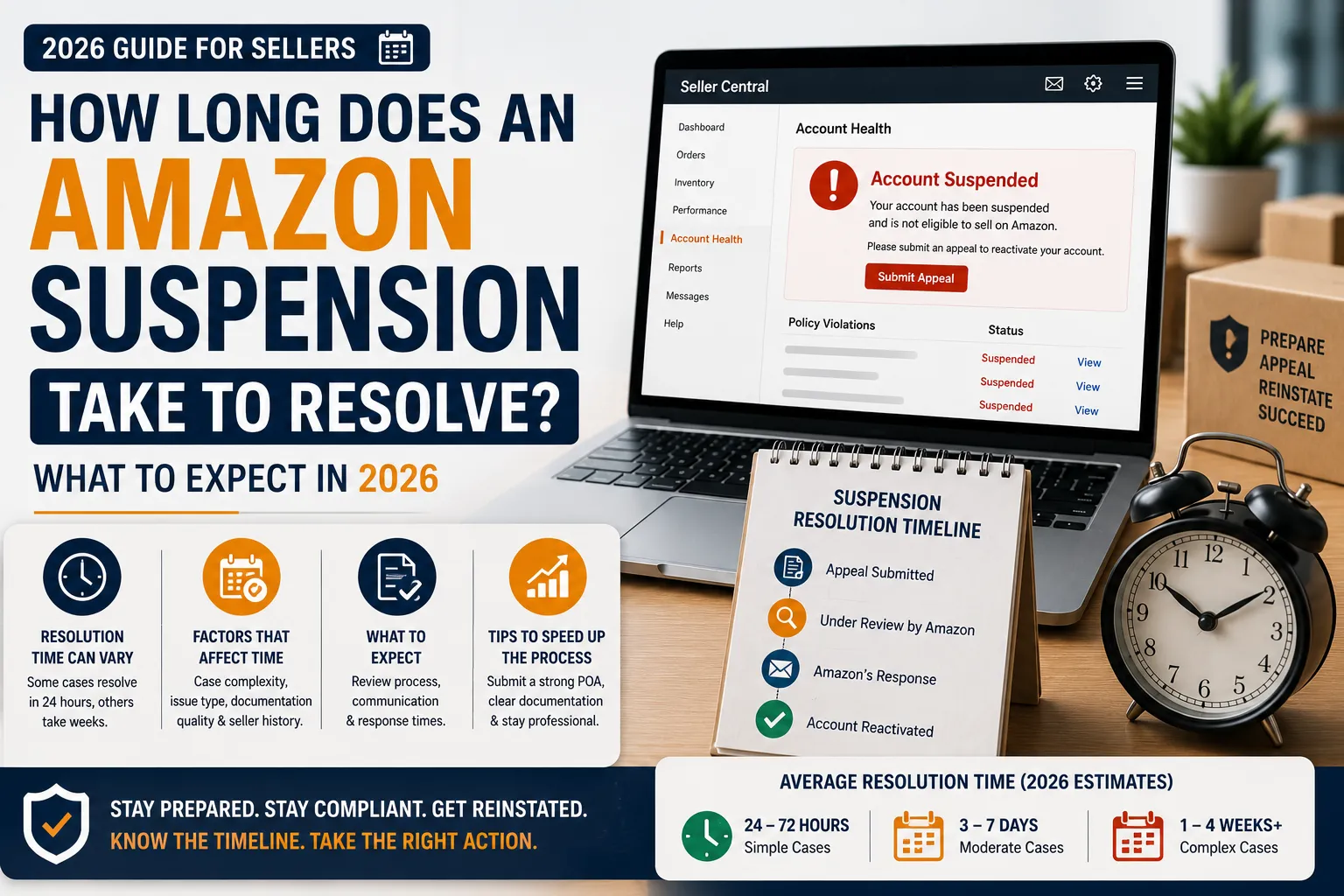
When your Amazon account is suspended, the first question is always the same: how long is this going to take?
The honest answer is that there is no fixed timeline. Amazon does not guarantee resolution windows, and the range is wide, from 3 business days for a clean performance appeal to 60-plus days for a counterfeit or linked account case. What determines where your suspension falls in that range is the suspension type, the quality of your first appeal, and whether your documentation is complete.
This guide gives you realistic timelines for every major suspension category, explains what causes delays, and outlines the specific steps that shorten resolution time.
For the complete reinstatement framework, including Plan of Action structure and appeal letter format, read our Amazon Account Suspension: Complete Guide to Prevention, Appeal & Reinstatement in 2026.
Does Amazon Have a Fixed Timeline for Resolving Suspensions?
Why Amazon Does Not Commit to Resolution Deadlines
Amazon evaluates every suspension case based on risk to customers, not urgency to the seller. There is no published SLA, no escalation clock, and no guaranteed response window. Cases are prioritised by the type of violation, the risk profile of the account, and the quality and completeness of the appeal submitted.
This means two sellers suspended on the same day for similar reasons can have vastly different resolution timelines depending entirely on how their appeals are structured and what documentation they provide.
Amazon Suspension Resolution Timelines by Type
What to Realistically Expect for Each Suspension Category
Performance-Based Suspensions: 3 to 14 Business Days
Performance suspensions, triggered by Order Defect Rate, Late Shipment Rate, or Pre-Fulfilment Cancellation Rate breaching Amazon’s thresholds, are typically the fastest to resolve when the appeal is strong.
A seller who submits a clear, specific Plan of Action with documented root cause analysis and corrective actions already completed can realistically expect an initial response within 3–7 business days. Accounts with clean histories prior to the metric failure tend to receive faster responses than accounts with prior warnings on record.
Weak or generic appeals for performance suspensions extend this timeline significantly, a rejected first appeal adds 7–14 days to the process, and repeated rejections can push a straightforward performance case into a month-long ordeal.
For a complete breakdown of every performance metric that triggers suspension, read our guide on why Amazon seller accounts get suspended for performance.
Policy Violation Suspensions: 7 to 30 Days
Policy-based suspensions, covering listing violations, restricted product sales, prohibited keyword use, and messaging policy breaches, require a more thorough review than performance cases. Amazon needs to confirm that the seller understands the specific policy that was violated and has made changes that eliminate future risk.
Resolution in this category typically falls between 7 and 30 days. The factors that push toward the longer end of this range include the severity of the violation, whether multiple ASINs were affected, and whether the seller’s appeal language demonstrates a clear understanding of Amazon’s policy framework rather than a generic acknowledgement.
Intellectual Property Complaint Suspensions: Variable
IP suspensions are among the least predictable in terms of timeline because resolution often depends on a third party, the rights holder who filed the complaint.
If the rights holder agrees to retract the complaint, resolution can happen within a few days of the retraction being processed.
If Amazon requires documentation, authorisation letters, brand ownership evidence, supply chain invoices, the review cycle extends to 2–4 weeks. Cases where the documentation submitted is incomplete or where Amazon requests multiple rounds of additional information can stretch to 6–8 weeks.
Product Authenticity and Counterfeit Claims: 2 to 6 Weeks
Authenticity suspensions are the most documentation-intensive category. Amazon typically requests supplier invoices, brand authorisation letters, certificates of authenticity, and a detailed explanation of the supply chain from manufacturer to fulfilment.
Even when full documentation is provided promptly, review times in this category run 2–6 weeks. Incomplete invoices, missing supplier contact information, showing purchase quantities that do not align with sales volume, or originating from suppliers Amazon does not recognise, are the most common cause of extended timelines and repeated rejection cycles.
Linked Account and Severe Policy Violations: 30 Days or More
Suspensions involving linked accounts, repeated policy infractions, or fraud-related closures are the most complex and carry the longest timelines. Reinstatement in these cases is not guaranteed, and the appeal process often requires escalation beyond the standard Seller Performance channel to reach a senior reviewer.
For sellers whose accounts were closed suddenly with no prior warning, the closure often falls into this category. Read our full guide on why Amazon closes seller accounts without warning for the specific triggers and appeal pathways that apply.
What Slows Down Amazon Suspension Resolution
The Six Factors That Extend Reinstatement Timelines
Understanding what causes delays is as important as knowing the typical timelines. These are the most consistent causes of extended resolution in 2026:
Weak or generic Plan of Action: A POA that uses template language, fails to identify a specific root cause, or promises future changes without documenting current corrective actions is rejected at a significantly higher rate. Each rejection adds days or weeks to the timeline.
Incorrect root cause identification: Appealing against the wrong trigger, addressing listing quality when the suspension was caused by a metric violation, for example, signals to Amazon that you have not understood the problem. This is one of the most common reasons structurally sound appeals fail.
Incomplete documentation: Missing invoices, incomplete supplier information, or authorisation letters that do not meet Amazon’s format requirements generate documentation requests that add review cycles to the process.
Multiple appeals without revision: Resubmitting a rejected appeal without substantively changing the root cause analysis or corrective actions tells Amazon’s system that the seller is not engaging with the feedback. This can result in the case being deprioritised entirely.
Emotional or defensive language: Appeals that express frustration, argue that the suspension was unfair, or assign blame to customers or competitors are dismissed quickly. Amazon’s review process is not a dispute resolution, it is a compliance assessment.
Ignoring Amazon’s specific response instructions: When Amazon requests additional information or specific documentation, failing to provide exactly what was requested in the format specified delays the case and signals poor compliance awareness.
How to Shorten Your Amazon Suspension Resolution Time
The Steps That Accelerate Reinstatement
Get the First Appeal Right
The single highest-leverage action a suspended seller can take is submitting a complete, well-structured Plan of Action on the first attempt. A strong first appeal avoids the rejection cycles that multiply timelines. For a step-by-step guide to building a POA that Amazon responds to, read our dedicated resource on how to create an Amazon suspension Plan of Action.
Fix the Problem Before Appealing
Amazon evaluates whether the issue has been corrected, not whether it will be corrected. Sellers who appeal before completing their corrective actions are submitting a weaker document than sellers who fix first and document the fix in the appeal. This applies to every suspension type: resolve the operational failure, update the affected listings, or replace the non-compliant supplier before the POA is drafted.
Use Amazon’s Policy Language
Appeals written in Amazon’s own terminology, referencing customer trust, buying experience, and Amazon’s published policy language, perform better than appeals written in general business language. This is not about flattery, it signals to the reviewer that the seller understands the policy framework they are operating within.
Provide Complete Documentation on the First Submission
For authenticity and IP suspensions, submit every piece of requested documentation with the first appeal, do not wait for Amazon to ask for it. Invoices should show supplier contact information, purchase quantities, and product descriptions that match the suspended ASINs. Incomplete documentation triggers a document request cycle that adds weeks to the timeline.
For a complete appeal letter structure and sample, read our guide on appeal letters for suspended Amazon seller accounts.
What to Do While Waiting for Amazon’s Response
Using the Waiting Period Productively
The period between submitting an appeal and receiving Amazon’s response is not dead time. Sellers who use it well are in a stronger position regardless of whether the first appeal is accepted or requires revision:
- Organise and verify all supplier invoices and compliance documentation
- Conduct a full audit of remaining active listings for policy compliance
- Review Account Health metrics for any secondary issues that could complicate reinstatement
- Prepare cash flow and inventory contingency plans for an extended suspension timeline
- Stay compliant with all Amazon marketplace policy updates, read our Amazon marketplace policy compliance guide for the latest 2026 enforcement changes
Do not submit follow-up messages or additional appeals while a case is under active review. Multiple submissions on the same case disrupt the review queue and signal impatience rather than compliance readiness.
How EcomManagers Reduces Suspension Resolution Time
EcomManagers structures every suspension appeal around the factors that shorten resolution timelines, accurate root cause identification, complete documentation on first submission, and POA language that aligns precisely with Amazon’s review criteria.
Our suspension recovery process covers:
- Identifying the exact root cause and suspension category before drafting any appeal
- Writing a complete, Amazon-compliant Plan of Action and appeal letter
- Validating all documentation before submission to eliminate document request cycles
- Managing follow-up communication with Amazon’s Seller Performance team
- Post-reinstatement account health monitoring to prevent recurrence
We manage suspension recovery for sellers across Amazon Services USA, Amazon Services UK, Amazon Services UAE, and Amazon Services Germany.
Explore our Amazon Account Management Services and speak with a suspension specialist today.
Frequently Asked Questions
How long does an Amazon suspension take to resolve on average? Performance suspensions with strong first appeals typically resolve in 3–14 business days. Policy violations run 7–30 days. Authenticity and counterfeit cases take 2–6 weeks. Linked account and severe violation cases run 30 days or more with no guaranteed reinstatement.
Does submitting multiple appeals speed up resolution? No, multiple submissions on the same case disrupt the review queue and can deprioritise your case. Submit one complete, well-structured appeal and wait for Amazon’s response before making any revision or resubmission.
What is the most common reason Amazon suspensions take longer than expected? Incorrect root cause identification and incomplete documentation are the two most consistent causes of extended timelines. Both result in rejection cycles that add weeks to the process, which is why getting the first appeal right is the highest-priority action a suspended seller can take.
Can EcomManagers help speed up my Amazon suspension resolution? Yes. Our Amazon Account Management Services include full suspension appeal support, from root cause analysis and POA drafting to documentation validation and follow-up management, for sellers across the USA, UK, UAE, and Germany.
Conclusion
Amazon suspension timelines vary based on the type of violation, the quality of the first appeal, and the completeness of the supporting documentation. Sellers who identify the correct root cause, submit a structured Plan of Action, and resolve operational issues before appealing significantly improve their chances of faster reinstatement. In 2026, successful suspension recovery depends not on speed alone, but on accuracy, compliance, and a well-prepared response from the very first submission