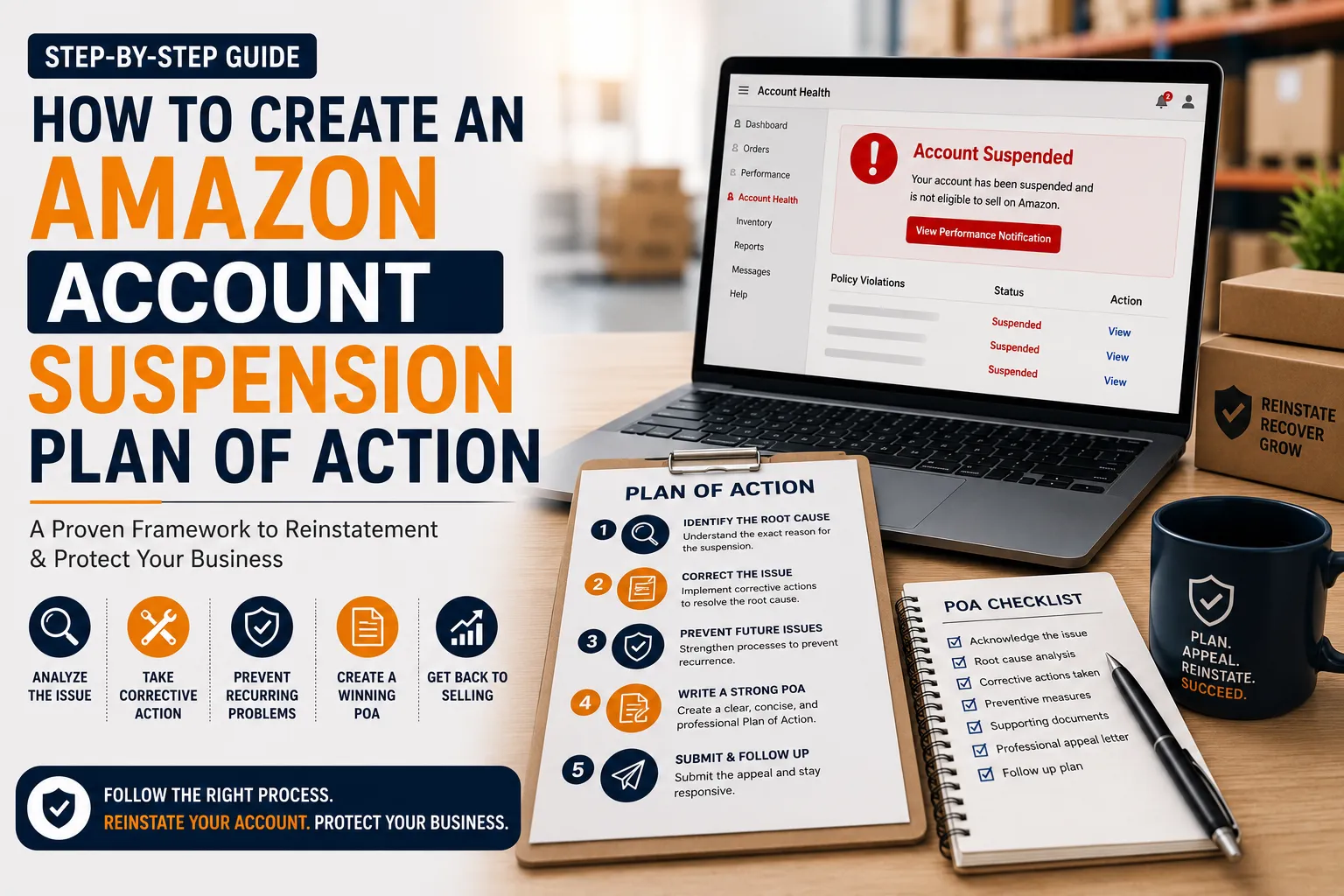
The Plan of Action is the single document that determines whether your suspended Amazon seller account gets reinstated or stays closed. It is not a letter of apology. It is not an explanation of how hard you have worked. It is a structured business document with one job: prove to Amazon that the root cause of your suspension has been identified, corrected, and permanently prevented.
Most Plans of Action get rejected, not because the seller’s situation is hopeless, but because the document is structured incorrectly, addresses the wrong root cause, or uses language that signals the seller still does not understand what went wrong.
This guide shows you exactly how to build an Amazon suspension Plan of Action that Amazon’s Seller Performance team approves.
For the complete suspension recovery framework, including appeal timelines and reinstatement strategy, read our Amazon Account Suspension: Complete Guide to Prevention, Appeal & Reinstatement in 2026.
What Is an Amazon Plan of Action?
Why Amazon Requires a POA Before Reinstating Your Account
An Amazon Plan of Action is the formal response document Amazon requires before considering reinstatement of a suspended seller account. It tells Amazon three things in sequence:
- What specifically caused the suspension
- What you have already done to fix it
- What permanent changes you have made to prevent it from happening again
Amazon uses this document to assess one thing: whether your account poses a continuing risk to customers. Every element of your POA should be written with that evaluation in mind, not with the goal of explaining your situation, but with the goal of demonstrating that the risk has been eliminated.
Why Most Amazon Plans of Action Get Rejected
The Patterns That Amazon’s Review Team Sees Every Day
Understanding why POAs fail is as important as understanding how to write one. Amazon’s Seller Performance team reviews a high volume of appeals. These are the patterns that result in immediate rejection:
Blaming external parties: Attributing the suspension to customers, competitors, Amazon’s systems, or a supplier without taking operational responsibility signals that you have not identified the actual process failure within your business.
Vague root cause statements: “We experienced some issues with our operations” tells Amazon nothing. A root cause statement must identify the specific metric, listing, or process that failed, with enough detail that Amazon can evaluate whether your corrective actions actually address it.
Future-tense corrective actions: Describing what you plan to do rather than what you have already done is one of the most common structural errors. Amazon wants evidence of completed action, not promises.
Generic preventive measures: Statements like “we will follow Amazon’s policies more carefully” or “we will improve our operations” are dismissed immediately. Preventive measures must describe specific, auditable process changes.
Emotional or defensive language: Appeals that express frustration, argue the suspension was unfair, or describe the impact on your business are rejected. Amazon is assessing compliance risk, not evaluating your circumstances.
Copy-pasted policy language: Repeating Amazon’s own policies back to them without demonstrating how your specific business practices now align with those policies shows no genuine understanding of the violation.
The Three-Part Structure of an Effective Amazon Plan of Action
The Exact Format Amazon Expects
Every successful Amazon suspended account Plan of Action follows the same three-part structure. Missing any section, or merging sections together, reduces the document’s credibility with Amazon’s reviewers.
Part 1: Root Cause – What Caused the Suspension
The root cause section is the foundation of your entire POA. If you identify the wrong root cause, every corrective action and preventive measure that follows addresses the wrong problem, and the appeal fails regardless of how well the rest of the document is written.
What Amazon wants to see in the root cause section:
- The specific metric, listing, or policy that triggered the suspension
- The precise operational failure within your business that caused it
- An honest acceptance of responsibility, no deflection, no argument
Weak root cause example: “Our account was suspended due to unforeseen circumstances beyond our control.”
Strong root cause example: “Our Order Defect Rate exceeded Amazon’s 1% threshold between [date] and [date] as a result of our third-party supplier shipping units with inadequate packaging, which generated a pattern of negative feedback and A-to-Z claims from customers who received damaged items.”
The difference is specificity. The strong example tells Amazon exactly what failed, when it failed, and why, which makes the corrective actions that follow credible.
For sellers whose suspension was triggered by performance metrics, read our detailed guide on why Amazon seller accounts get suspended for performance to identify the precise metric at issue before drafting your root cause.
Part 2: Corrective Actions – What You Have Already Fixed
This section documents the specific steps you have completed since the suspension was issued. Every action in this section must be past tense, Amazon evaluates what has been done, not what will be done.
Examples of strong corrective actions:
- Removed all affected ASINs from active listings pending quality review
- Issued full refunds to all customers who submitted A-to-Z claims or negative feedback related to the identified issue
- Terminated the relationship with the supplier whose packaging failures generated the defect rate breach
- Sourced a replacement supplier with documented quality control standards and provided a sample invoice
- Updated internal order management processes to include pre-shipment quality checks
What does not belong in this section: Any action you have not yet completed. If you write “we are in the process of updating our supplier agreements,” you are telling Amazon the problem is not yet fixed. Complete the corrective action first, then document it.
Part 3: Preventive Measures – How You Will Stop This From Recurring
The preventive measures section demonstrates that the operational change is permanent, not a one-time correction that reverts once the account is reinstated. Amazon evaluates whether your preventive measures are specific, scalable, and auditable.
Examples of strong preventive measures:
- Weekly Account Health dashboard review with a designated team member responsible for flagging any metric approaching 50% of Amazon’s published threshold
- Mandatory pre-shipment quality inspection protocol for all inbound inventory from new and existing suppliers
- Automated shipment tracking with same-day escalation if a carrier scan is not recorded within the expected handling window
- Quarterly supplier performance review process with documented criteria for continuation or replacement
- Dedicated customer message response system with a maximum 12-hour internal response target, inside Amazon’s 24-hour requirement
What does not meet the standard: “We will be more careful in the future.” This is not a preventive measure. It is a statement. Amazon needs to see a process, a system, or a structural change, something that operates independently of individual attentiveness.
Writing Style and Format Amazon Responds To
How to Structure the Document for Maximum Clarity
Format Guidelines for Your POA
Use clear section headings: Label each section explicitly, “Root Cause,” “Corrective Actions Taken,” “Preventive Measures.” Amazon’s reviewers process high volumes of appeals and evaluate structured documents faster and more favourably than narrative prose.
Use bullet points within each section: Each corrective action and preventive measure should be a separate bullet point, not a paragraph. Bullet format makes each action distinct and auditable.
Keep language professional and objective: Write in the third person or neutral first-person plural. Avoid “I” statements that personalise the appeal. Avoid any language that implies emotional distress or frustration.
Keep the document focused: A complete POA for most suspension types should be 300–500 words. Longer documents do not demonstrate more effort, they dilute the signal of the key corrective and preventive actions.
What Must Never Appear in a Plan of Action
- Emotional language describing the impact of the suspension on your business or family
- Threats of legal action or escalation
- Arguments that Amazon’s enforcement was an error
- Apologies without accompanying solutions
- Detailed descriptions of your business history or years of compliance prior to the suspension
Amazon is not evaluating your circumstances. It is evaluating your compliance risk going forward. Every word in your POA should address that evaluation, nothing else.
Amazon Plan of Action for Reinstatement: Specific Scenarios
Adjusting Your POA Structure by Suspension Type
POA for Performance Metric Suspensions
Root cause must identify the specific metric (ODR, Late Shipment Rate, or Cancellation Rate), the date range of the breach, and the operational failure that caused it. Corrective actions must include resolution of all affected orders. Preventive measures must include a weekly monitoring process with specific threshold targets below Amazon’s published limits.
POA for Policy Violation Suspensions
Root cause must reference the specific policy violated and the specific listing or practice that triggered the violation. Corrective actions must include removal or correction of all affected listings. Preventive measures must include a listing compliance review process that checks new and existing listings against Amazon’s current policy standards.
POA for Intellectual Property Complaints
Root cause must address the specific IP complaint, the rights holder, the ASIN, and the nature of the infringement allegation. Corrective actions must include removal of the affected listing and, where applicable, communication with the rights holder. Supporting documentation, invoices, authorisation letters, or supply chain records, should accompany the POA as attachments.
For the complete appeal letter structure that accompanies your POA submission, read our guide on appeal letters for suspended Amazon accounts.
How EcomManagers Writes Plans of Action That Get Approved
EcomManagers specialises in building Amazon suspension Plans of Action that follow Amazon’s documented review criteria precisely. Our process covers:
- Accurate root cause identification, including the operational failure behind the metric or policy trigger
- POA drafting in the exact structure and language Amazon’s Seller Performance team evaluates
- Documentation review and validation before submission to eliminate rejection cycles
- Full appeal management including follow-up communication with Amazon
We handle POA preparation and suspension recovery for sellers across Amazon Services USA, Amazon Services UK, Amazon Services UAE, and Amazon Services Germany.
Explore our Amazon Account Management Services and speak with a suspension specialist today.
Frequently Asked Questions
What is the correct format for an Amazon suspension Plan of Action?
A compliant Amazon suspension Plan of Action has three clearly labelled sections: Root Cause, Corrective Actions Taken, and Preventive Measures. Each section uses bullet points. The document is 300–500 words, written in professional objective language, with no emotional content or blame directed at external parties.
How long should an Amazon Plan of Action be?
300–500 words is the effective range for most suspension types. Longer documents dilute the key corrective and preventive actions. Shorter documents appear to underestimate the severity of the violation. Every word should serve the compliance assessment, nothing else.
Can I use a template for my Amazon Plan of Action?
Template structure is fine, the three-part format is consistent across suspension types. Template language is not. Your root cause, corrective actions, and preventive measures must be specific to your account, your metrics, and your operational processes. Generic language that could apply to any account is one of the most consistent causes of rejection.
What happens if my Plan of Action is rejected?
A rejected POA means Amazon found the root cause identification, corrective actions, or preventive measures insufficient. Review Amazon’s rejection response carefully, it typically indicates which section failed. Revise that section with greater specificity before resubmitting. Do not resubmit the same document. For realistic timelines after a rejected appeal, read our guide on how long Amazon suspensions take to resolve.
Does EcomManagers write Plans of Action for suspended sellers?
Yes. Our Amazon Account Management Services include full POA drafting, documentation review, and appeal submission management for sellers across the USA, UK, UAE, and Germany.
Conclusion
A successful Amazon Plan of Action is built on clarity, accountability, and specific corrective measures, not emotion or generic promises. Sellers who accurately identify the root cause, document completed actions, and implement long-term preventive systems have the strongest chance of reinstatement. In 2026, Amazon’s review process is more compliance-focused than ever, making a well-structured, evidence-based POA essential for protecting and restoring your seller account.