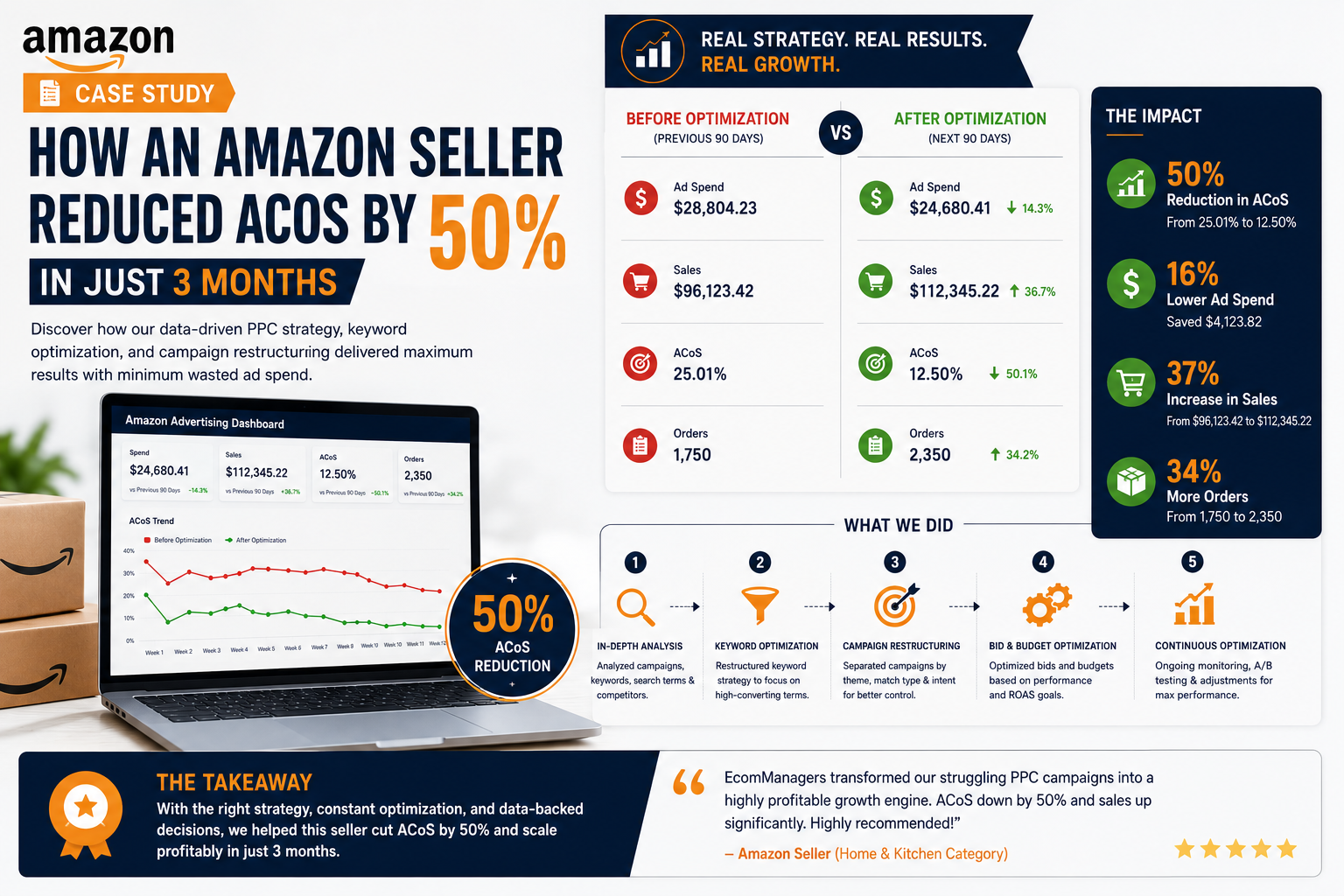
High ACoS is not just a metric problem, it is a margin problem. For every dollar your campaigns overspend on irrelevant clicks and underperforming keywords, your growth slows and your profit shrinks. And in 2026, with CPCs running 20–40% higher than just two years ago, the cost of an unoptimized Amazon ad account is higher than ever.
This case study documents exactly how EcomManagers helped a growing home and lifestyle brand cut its average ACoS from 42% to 21% in under 90 days, a 50% reduction, while simultaneously increasing total revenue and improving long-term campaign efficiency.
If you want to understand the full strategic framework behind our work, start with our Complete Guide to Amazon PPC Management in 2026.
Why ACoS Gets Out of Control – And Why It Stays That Way
Most sellers do not arrive at a 40%+ ACoS overnight. It builds slowly, campaign by campaign, as structure erodes and spend scales without strategy.
The Silent Margin Killers Most Sellers Ignore
The three patterns we see most consistently in high-ACoS accounts are:
Broad match keyword dependency, When auto and broad match campaigns run without a disciplined negative keyword strategy, budget flows to search terms that generate clicks but not conversions. The impressions look healthy. The spend does not match the return.
No campaign segmentation, Bundling high-performing and low-performing products into the same campaigns makes it impossible to control where budget goes. Strong products subsidize weak ones, and neither gets the optimization it needs.
Bid set-and-forget, Bids placed at launch and left unchanged will drift out of alignment as competition, seasonality, and conversion data evolve. A bid that made sense in Q1 may be actively wasteful by Q3.
These are the patterns EcomManagers found, and fixed, for this client. For a structured look at what a proper account audit reveals, read our Amazon PPC Audit Service Deliverables Overview.
Client Background: A Strong Brand With a Leaking Ad Account
The client was a mid-size home and lifestyle brand selling across multiple Amazon categories. Their products carried strong reviews and consistent organic traffic. By every product metric, this was a healthy brand.
But their ad account told a different story.
What the Numbers Looked Like Before Engagement
Metric | Pre-Optimization |
Average ACoS | 42% |
Budget Utilization | Top campaigns exhausted by midday |
Negative Keyword Coverage | None |
Campaign Segmentation | Minimal |
ROAS | Below breakeven threshold |
The brand had scaled ad spend without scaling the structure to support it. The result was a 42% ACoS that was eroding margins on even their best-selling products.
They came to EcomManagers with one clear objective: get ACoS under control, rebuild the account architecture, and establish a foundation for profitable scaling.
The EcomManagers Optimization Process: Step by Step
Our Amazon PPC management process follows a structured sequence. For this account, the 90-day engagement unfolded across five distinct phases.
Phase 1: Full PPC Account Audit
Before touching a single bid, our Amazon PPC specialists reviewed the entire account: campaign structure, historical keyword performance, search term reports, bidding behavior, and budget allocation patterns.
The audit revealed what we suspected, budget was flowing freely into broad match terms with low purchase intent, and there was no mechanism in place to redirect spend toward high-converting queries.
This audit is the foundation of every optimization decision that follows. See exactly what our audit process covers in our Amazon PPC Audit Service Deliverables Overview.
Phase 2: Campaign Restructuring and Segmentation
The existing campaign architecture was rebuilt from the ground up. Products were segmented by performance tier and category, creating the separation needed to control spend at the individual product level.
How Proper Campaign Structure Unlocks Optimization
When campaigns contain mixed-performance products, every bid adjustment is a compromise. Increase a bid and you overspend on weak products. Decrease it and you starve the strong ones.
Segmentation solves this. By creating dedicated campaigns for top-performing ASINs, our team could allocate budget with precision, directing the majority of spend toward the 20% of products driving 80% of revenue.
This structural foundation is what makes every subsequent optimization decision meaningful. Read more about our campaign architecture approach in our guide on Inside a Top Amazon PPC Agency.
Phase 3: Keyword Strategy and Negative Keyword Implementation
High-intent purchase keywords were moved into exact match campaigns. Broad and phrase match terms were retained only where conversion data supported them, and monitored weekly.
The Negative Keyword Process That Cut Wasted Spend Immediately
Negative keyword implementation was the fastest-impact action in the first 30 days. Our weekly process:
- Pull complete search term reports for every active campaign
- Identify terms generating impressions and clicks with zero conversions
- Add as negative exact or negative phrase at the appropriate level
- Document all additions to prevent blocking high-value keyword variations
This single discipline reduced wasted spend by over 20% within the first 30 days, before any bid changes were made. For a deeper look at our keyword methodology, read our guide on Data-Driven Amazon Keyword Research.
Phase 4: Bid Management and Dynamic Bidding Strategy
With the structural and keyword foundations in place, the team implemented dynamic bidding on campaigns with strong conversion data, increasing bids on top-converting search terms and reducing them on underperformers.
Placement multipliers were applied to top-of-search positions for high-intent exact match campaigns, where conversion rates consistently outperform product page and rest-of-search placements.
Why Bid Strategy Depends on Campaign Stage
Bid strategy is not one-size-fits-all. Our Amazon advertising management approach uses three distinct bidding modes depending on campaign maturity:
- Down-Only, For new campaigns and products without conversion history
- Dynamic Up and Down, For established campaigns with proven conversion data
- Fixed Bids, For brand defense and exact match campaigns where stability matters more than efficiency optimization
The wrong bidding strategy applied to the wrong campaign stage is one of the most common ways agencies accelerate ACoS problems rather than solve them.
Phase 5: Amazon DSP Retargeting and Budget Reallocation
To capture warm audiences, shoppers who had viewed products but not purchased, the team introduced Amazon DSP retargeting alongside traditional PPC. This allowed the brand to re-engage high-intent browsers at a lower cost per conversion than cold traffic acquisition.
Budget reallocation directed the majority of spend toward the top 20% of products by revenue contribution, ensuring every incremental dollar of ad spend produced measurable return.
For guidance on when DSP makes sense alongside PPC, see our analysis in Best Amazon PPC Agency Services.
The Results: 90 Days of Structured Optimization
Metric | Before | After | Change |
Average ACoS | 42% | 21% | ↓ 50% |
ROAS | Below breakeven | 2× improvement | ↑ 100% |
Total Revenue | Baseline | +47% | ↑ 47% |
Wasted Spend (irrelevant clicks) | Untracked | Reduced by ~25% | Significant |
Budget Efficiency | Campaigns exhausted early | Full-day pacing | Resolved |
The brand was no longer fighting to stay profitable. With ACoS at 21% and a scalable campaign structure in place, they could reinvest in winning campaigns with confidence, knowing every dollar spent was producing documented return.
What a 50% ACoS Reduction Actually Means for Margins
At a 42% ACoS, a brand spending $10,000/month on ads generates $23,810 in attributed sales, barely breaking even after margins. At 21% ACoS on the same spend, attributed sales reach $47,619. The same budget, the same products, and 2× the revenue. That is the compounding impact of structural Amazon PPC campaign optimization applied consistently over 90 days.
Key Takeaways From This Amazon PPC Case Study
Campaign segmentation creates control. Separating products by performance tier is the prerequisite for every subsequent optimization decision. Without it, bid changes are guesses.
Negative keywords deliver the fastest ROI. Implementing a weekly negative keyword process consistently reduces wasted spend by 15–30% before any other optimization is applied.
Bid strategy must match campaign stage. Dynamic bidding on campaigns without conversion data accelerates spend without improving efficiency. Structure comes first.
Retargeting recaptures lost revenue. DSP campaigns targeting product page visitors who did not purchase add a lower-CPA conversion layer on top of traditional PPC.
The 90-day timeline is realistic. Meaningful ACoS reduction requires structure, then keywords, then bids, then scale, in that sequence. Shortcuts to the scaling phase skip the foundation that makes scaling work.
Frequently Asked Questions
What is a realistic ACoS reduction timeline with professional management?
Initial improvements are typically visible within 30–60 days. Meaningful, sustainable reduction, like the 50% we achieved here, follows a 90-day optimization cycle applied in the correct sequence.
Does campaign restructuring require pausing existing ads?
Not necessarily. Our approach restructures iteratively, maintaining spend continuity while migrating keywords and products into the new architecture.
What ACoS should I be targeting?
Target ACoS depends on your product margin and business stage. Generally, 15–30% ACoS is considered healthy for established products. New product launches may run higher temporarily to build ranking velocity. Read more in our Amazon PPC Agency FAQs.
Do you manage PPC across multiple marketplaces?
Yes. EcomManagers manages campaigns across USA, UK, UAE, and Germany with market-specific keyword strategies and bid approaches for each.
How do I get started with EcomManagers?
Book a free strategy call through our Amazon PPC Management Services page. We begin every engagement with a full account audit, no commitments, no guesswork.
Ready to reduce your ACoS and scale profitably? Explore our Amazon PPC Management Services and book your free strategy consultation today.
Final Thoughts
Within three months, eCom Manager assisted a lagging brand in changing its advertising from unprofitable to profitable. Through the union of data-driven insights and rigorous campaign management, the brand not only attained a 50% ACoS decrease but also freed up growth opportunities.