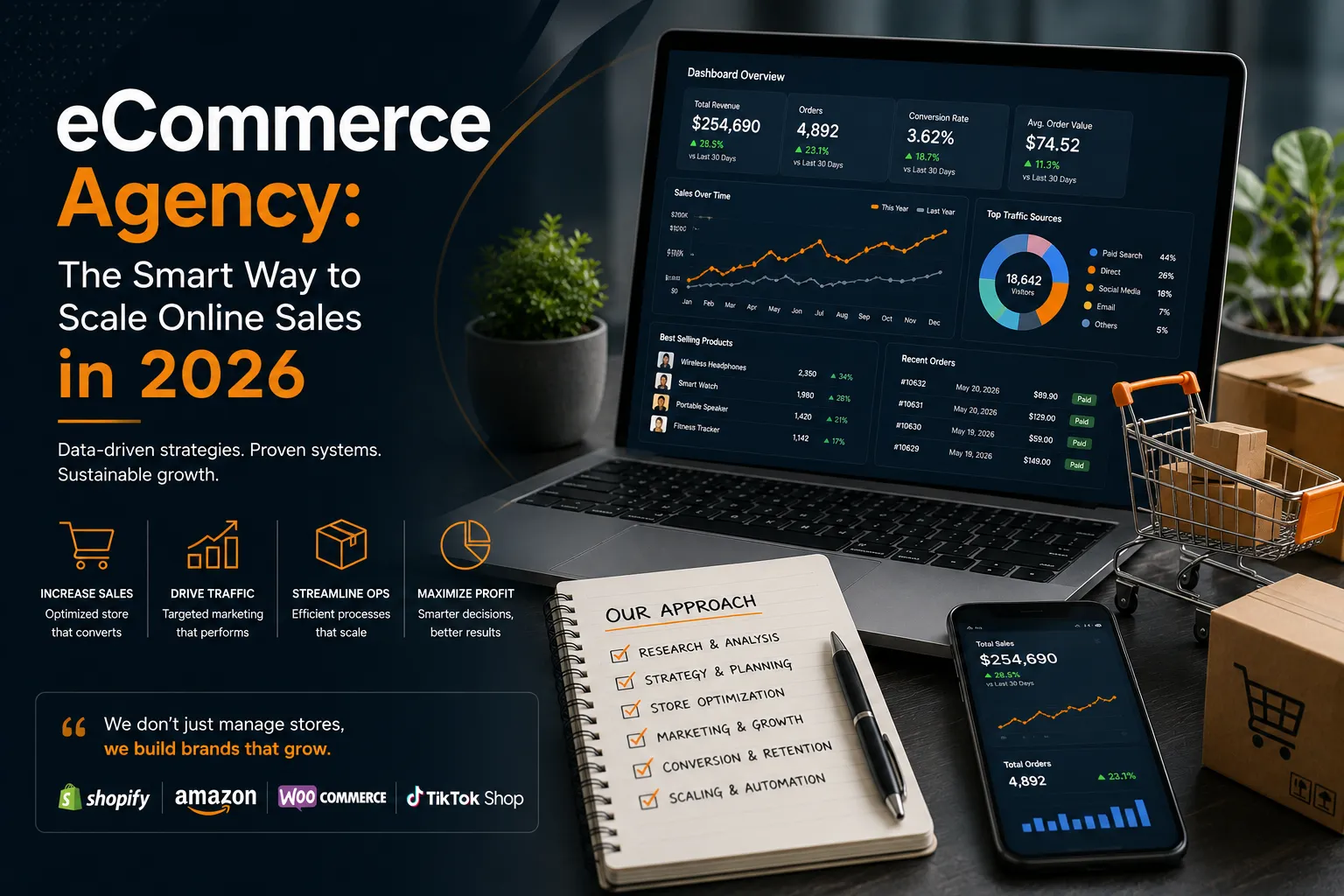
Great products do not sell themselves. In 2026, the online marketplace is more competitive, more algorithm-dependent, and less forgiving of operational gaps than it has ever been. Thousands of eCommerce businesses launch every year with strong products and real demand, and still fail to grow, because the execution behind the product is not structured for scale.
This is the problem a professional eCommerce agency solves. Not by replacing your effort, but by bringing the systems, platform expertise, and integrated strategy that turns a product with potential into a business with compounding revenue.
For a complete view of how agency management fits within a full operational framework, our eCommerce Management: Complete Guide to Running & Scaling Your Online Business covers every pillar in detail. This blog focuses specifically on what a professional eCommerce agency delivers, and why it is the structural unlock for brands that are ready to scale.
Why Scaling eCommerce in 2026 Requires More Than Effort
The sellers who struggle to grow in 2026 are not struggling because they lack effort. They are struggling because the execution model they are running was built for a simpler environment, and the environment has changed materially.
What Has Made eCommerce Harder to Scale Alone
Three compounding shifts have raised the baseline requirements for competitive eCommerce management:
Platform algorithms have become more sophisticated. Amazon, Walmart, and TikTok Shop now evaluate sellers across a broader set of performance signals, conversion rate, inventory consistency, customer response times, policy compliance, and reward or penalize accordingly. Optimizing for one signal while neglecting others produces diminishing returns.
Paid advertising costs have increased. Rising competition across Google Shopping, Amazon PPC, Walmart Connect, and TikTok Ads has driven up CPCs across most product categories. Profitable advertising in this environment requires strategic bid management, aggressive negative keyword discipline, and TACoS-focused optimization, not just campaign setup.
Multi-platform presence is now a competitive necessity. A business that sells only on Amazon is structurally fragile in 2026. Algorithm changes, policy updates, or category saturation on a single platform can eliminate revenue that took years to build. The sellers building durable businesses are managing coordinated presence across Amazon, Walmart, and TikTok, each with a platform-native strategy.
Running all of this competently as a solo operator or with a small internal team is not impossible, it is just structurally slower than working with a team that manages these systems at scale every day.
What a Professional eCommerce Agency Actually Does
An eCommerce agency is not a freelancer who handles one function. It is a cross-functional team that manages every operational layer of your online business as an integrated system, where each pillar supports the others rather than operating in isolation.
Strategy and Platform Selection
Before any execution begins, a professional agency builds a growth roadmap specific to your business stage, product catalog, and target markets. This includes platform selection, not every product belongs on every platform, and channel prioritization based on margin structure and competitive dynamics.
Most sellers expand to new platforms too early, before the primary platform is generating stable returns. A good agency sequences the expansion correctly: establish operational efficiency and profitable advertising on the primary platform first, then build coordinated multi-platform presence from a position of strength.
Listing Optimization and Content Management
Your product listing is your storefront, your SEO asset, and your sales pitch simultaneously. An eCommerce agency manages listing creation and ongoing optimization as a continuous process, not a one-time launch task.
This covers title architecture, bullet point structure, A+ Content, backend keyword mapping, main image CTR performance, secondary images, and video. Each element is tracked against conversion data and updated when performance data indicates an opportunity. A listing that is not actively maintained loses ranking and conversion performance to competitors who are actively optimizing.
EcomManagers manages this across Amazon Services, Walmart Services, and TikTok Services, with platform-specific content standards applied to each.
PPC Management and Paid Advertising
Paid advertising on Amazon, Walmart, and TikTok serves two functions: it generates immediate sales, and those sales generate the ranking signals that earn organic position. This dual function is what makes PPC management a strategic lever, not a marketing line item.
Professional agencies run advertising on weekly optimization cycles, search term analysis, exact match expansion, aggressive negative keyword implementation, and bid adjustments based on conversion data. TACoS (Total Advertising Cost of Sales) is tracked as the primary efficiency metric, because it captures the relationship between ad spend and total revenue including organic, not just the ad-attributed sales that ACoS measures in isolation.
Our Amazon PPC Management, Walmart PPC Management, and TikTok PPC Management services operate on this active management model.
Account Health and Compliance Management
Platform enforcement in 2026 is faster and more automated than it was two years ago. Listings that violate updated policy guidelines are suppressed within hours. Account health thresholds are enforced more strictly. The margin for error that sellers enjoyed in 2023 and 2024 has narrowed considerably.
A professional eCommerce agency monitors account health metrics proactively, identifying risks before they reach threshold violations, not after a suppression or suspension has already occurred. This includes performance metric monitoring, policy compliance review across all active listings, and resolution management when issues do arise.
Multi-Platform Growth Strategy
Single-platform businesses are structurally fragile. The sellers building durable revenue in 2026 are the ones managing coordinated presence across Amazon, Walmart, and TikTok, with a platform-native strategy on each, not a copy-paste approach.
EcomManagers manages multi-platform scaling for clients across the USA, UK, UAE, and Germany, with regional market expertise applied to platform selection, listing localization, and advertising strategy.
Freelancers vs a Full-Service eCommerce Agency
Why the Comparison Matters for Scaling Brands
Freelancers solve specific problems. A copywriter improves a listing. A PPC specialist optimizes a campaign. A designer produces better images. Each delivers value within their function, but none of them manages the integrated system that determines whether your eCommerce business grows.
An eCommerce agency manages the integrated system. The listing optimization informs the PPC strategy. The PPC data informs which listings need conversion improvement. The inventory data informs the advertising budget allocation. Each function feeds the others, and a cross-functional team can manage those connections in ways that individual specialists working independently cannot.
For brands that are scaling past the point where DIY management is viable, the relevant question is not whether a freelancer is cheaper, it is whether the integrated management model produces better compounding results. For sellers operating at meaningful revenue, it consistently does.
How to Evaluate an eCommerce Agency Before You Hire
Not every agency that calls itself full-service delivers full-service results. Before committing to a partner, evaluate on four criteria:
Platform-specific experience, ask for evidence of results on the specific platforms you operate on. General digital marketing experience does not translate directly to Amazon or Walmart marketplace management.
Transparent reporting, a professional agency reports on the metrics that matter: TACoS, organic rank movement, account health scores, and conversion rate trends. If an agency’s reporting focuses only on ad spend and clicks, the strategic layer is missing.
Case studies with real numbers, revenue growth, ACoS improvement, and ranking gains from comparable sellers in comparable categories are the evidence that matters.
Clear communication structure, know who manages your account, how often you receive updates, and what the escalation process is when issues arise.
For a detailed framework on evaluating management partners for your specific business stage, read our guide on choosing the right eCommerce management service.
The Outcome of Working with the Right eCommerce Agency
Sellers who partner with a professional eCommerce agency stop spending their capacity on operational firefighting and start spending it on decisions that actually grow the business, new products, new markets, new revenue streams.
The operational layer runs without requiring their constant involvement. Problems are caught before they become crises. Advertising is optimized weekly. Listings maintain their performance. Account health stays green. And the compounding effect of each proactive improvement builds month over month.
For a complete view of how structured eCommerce management across every operational pillar produces this outcome, read our guide on why eCommerce store management is key to growing your online business.
Explore EcomManagers’ full service range and book a free strategy consultation to discuss your scaling goals.
Frequently Asked Questions
What does an eCommerce agency do?
A professional eCommerce agency manages the integrated operational and marketing system of an online business, including listing optimization, PPC advertising, inventory management, account health, and multi-platform growth strategy. It is a cross-functional team managing every layer, not a freelancer handling one function.
Is an eCommerce agency better than hiring freelancers?
For brands that are scaling, yes. Freelancers deliver value within individual functions. An agency manages the integrated system where each function supports the others, producing compounding results that siloed specialists cannot.
How quickly do results come from an eCommerce agency?
Initial improvements in advertising efficiency and listing performance are typically visible within the first 30 to 60 days. Organic ranking gains and revenue compounding build over three to six months as the integrated system operates consistently.
Does EcomManagers manage Amazon, Walmart, and TikTok?
Yes. EcomManagers provides full-service management across Amazon, Walmart, and TikTok, with regional specialist teams for the USA, UK, UAE, and Germany.
What metrics should an eCommerce agency report on?
TACoS (Total Advertising Cost of Sales), organic rank movement, conversion rate, account health scores, and revenue growth. If reporting focuses only on ad spend and clicks, the strategic management layer is not present.
Conclusion
As competition across Amazon, Walmart, and TikTok continues to intensify in 2026, scaling an eCommerce business requires more than effort alone. A professional eCommerce agency provides the structure, platform expertise, and integrated strategy needed to manage growth efficiently and sustainably. Businesses that invest in proactive management, optimized advertising, and multi-platform expansion are better positioned to build long-term revenue, stronger brand stability, and scalable online success.