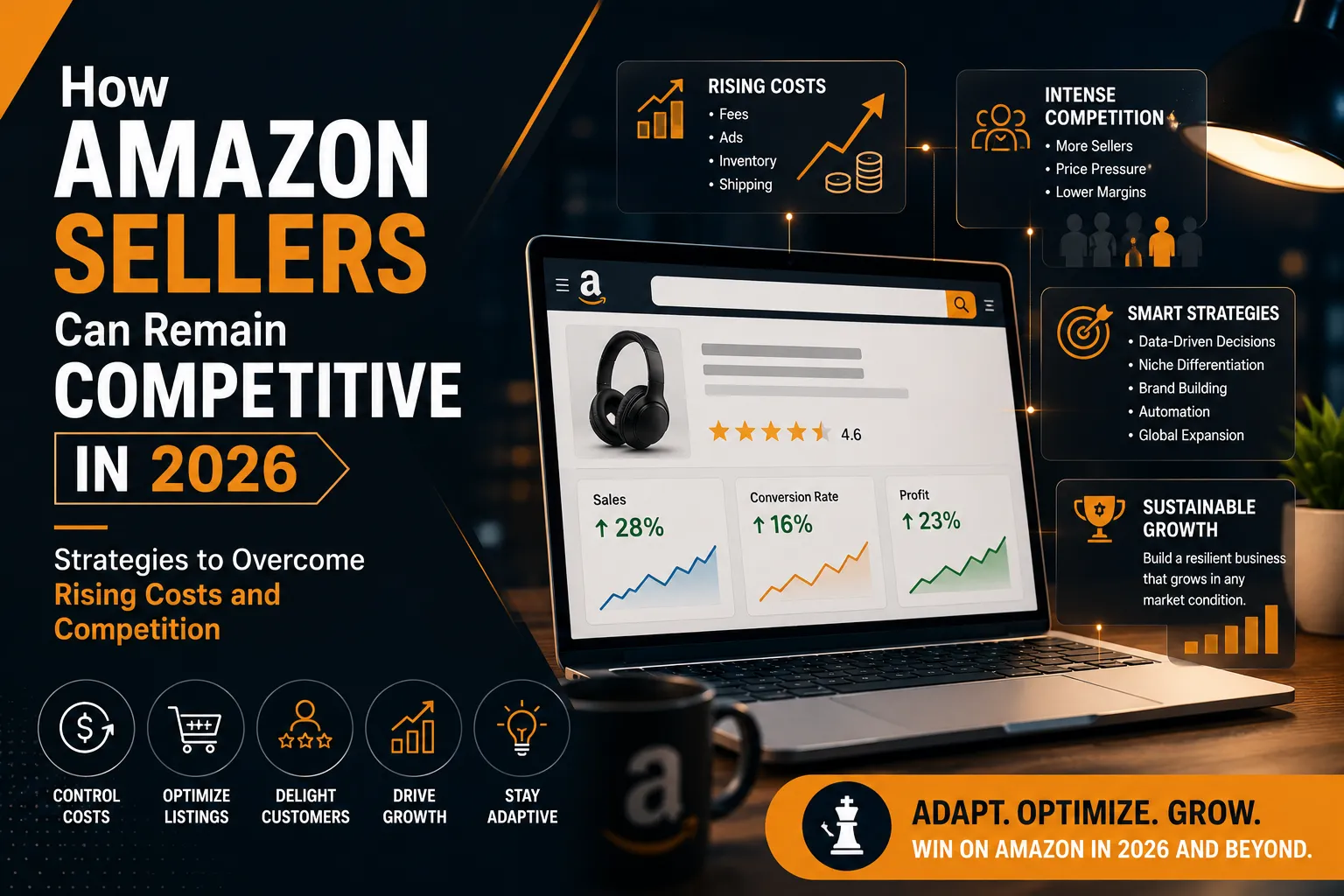
The Amazon marketplace in 2026 is not broken, it is simply less forgiving of the habits that worked three years ago. PPC costs are higher. Niches that were accessible in 2022 now have entrenched competitors with thousands of reviews. Amazon’s policy enforcement is more active than it has ever been.
And yet, sellers are building profitable, scalable Amazon businesses every month.
The difference between sellers who are growing and sellers who are struggling is not luck or timing, it is whether their operating strategy matches the competitive environment the platform has become. This guide breaks down exactly what that strategy looks like in 2026, across every major lever that determines whether an Amazon account grows or stalls.
This blog is part of our cluster supporting the Amazon Product Launch Strategy: The Ultimate Step-by-Step Guide for 2026. For sellers building a launch or scaling an existing account, read both together.
Why Staying Competitive on Amazon in 2026 Requires a Different Approach
What Has Changed – And What It Means for Your Strategy
Three structural shifts define the Amazon competitive landscape in 2026:
PPC auction prices have increased across most categories. More sellers competing for the same top-of-search placements means higher cost-per-click. Categories that supported a 30% ACoS in 2023 often require tighter campaign architecture and more disciplined keyword management to hit the same efficiency targets today.
Product saturation has raised the entry bar in popular niches. Categories that appear attractive on the surface, high search volume, healthy price points, frequently have top-10 organic positions held by listings with 2,000–10,000 reviews backed by established brands. Entering these niches without a clear differentiation strategy and sufficient launch budget is not difficult, it is structurally impossible to win.
Amazon’s algorithm rewards engagement signals more heavily. Click-through rate, conversion rate, and review velocity are weighted more strongly in 2026 than keyword density alone. A listing that converts well from day one builds ranking momentum faster than a keyword-stuffed listing that generates clicks but not purchases.
Understanding these shifts is the foundation of every competitive strategy that actually works in 2026.
Strategy 1: Fix Listing Quality Before Increasing Ad Spend
Conversion Rate Is the Multiplier on Every Dollar You Spend
The most common response to flat sales is increasing PPC budget. It is also the most expensive mistake a seller can make when the underlying listing does not convert.
A listing converting at 9% generates 9 sales from every 100 clicks. The same budget driving traffic to a listing converting at 15% generates 15 sales from those same 100 clicks, at identical cost. No bid adjustment, keyword expansion, or campaign restructure produces that outcome. Only listing quality does.
The Four Listing Elements With the Greatest Conversion Impact in 2026
Main image: The single highest-leverage creative decision in any Amazon account. It determines click-through rate on the search results page before a buyer reads the title. It must outperform competitor thumbnails in a direct visual comparison, not simply look professional in isolation.
A+ Content: For brand-registered sellers, A+ Content with lifestyle imagery and comparison modules consistently lifts conversion rates 10–25% over standard product descriptions. In 2026, listings without A+ Content are at a measurable disadvantage in most competitive categories.
Bullet points: Benefit-driven, objection-handling copy that addresses specific buyer concerns rather than restating product specifications. Buyers decide in seconds. Bullets that speak to outcomes convert; bullets that list features do not.
Product video: Listings with video in the image stack show measurably higher add-to-cart rates, particularly on mobile where the majority of Amazon sessions now originate. In competitive categories, video is no longer a differentiator, it is a baseline expectation.
Our Amazon Listing Optimization Services rebuild every one of these elements before a single dollar of additional ad spend is committed.
Strategy 2: Build Smarter PPC – Not Just Bigger Budgets
How Competitive Amazon Sellers Manage Rising PPC Costs in 2026
Higher CPC does not make Amazon PPC unworkable, it makes unstructured PPC unworkable. Sellers running auto campaigns without negative keywords, without exact match build-out, and without weekly data review are competing in a more expensive auction with the least efficient possible setup.
The PPC Principles That Separate Profitable Accounts From Draining Ones
Negative keywords are not optional. Every irrelevant search term that generates a click without converting is money transferred from your margin to Amazon’s revenue. In a higher-CPC environment, negative keyword management is the fastest lever to improve campaign efficiency without reducing spend on converting terms.
Exact match campaigns are built from data, not assumptions. The search terms that actually convert for your specific product, not the terms you think should convert, are identified through auto and broad match campaigns and then moved into exact match with aggressive bids. This is how you dominate placements on proven terms rather than bidding broadly across unvalidated keywords.
TACoS is the metric that reveals whether PPC is working. ACoS measures advertising efficiency within paid campaigns. TACoS, ad spend as a percentage of total revenue including organic, measures whether your PPC investment is building organic rank or simply subsidizing sales that would not otherwise exist. A declining TACoS over a 60–90 day window is the signal that a launch strategy is working. Flat or rising TACoS is the signal that PPC is compensating for an organic ranking problem that budget alone cannot solve.
For a detailed look at the four-level PPC architecture EcomManagers deploys across client accounts, read our Amazon PPC agency guide.
Strategy 3: Compete on Niche Depth, Not Category Breadth
Why Sub-Niche Specificity Beats Broad Category Entry Every Time
The sellers losing to competition in 2026 are almost always competing in the wrong place, broad, high-volume categories where the top positions are owned by brands with years of review velocity and ranking history. The sellers winning are competing in specific sub-niches where demand is proven, competition has not consolidated, and differentiation is achievable.
How to Identify the Sub-Niches Worth Entering
A competitive sub-niche in 2026 shows three signals simultaneously: top-10 organic results averaging fewer than 500 reviews, primary keyword volume above 5,000 monthly searches with year-round consistency, and a margin structure that delivers 25%+ net after FBA fees and launch-phase PPC.
Finding these niches requires a layered research approach, not a single tool set to default filters. Our complete framework for this process is covered in our guide on finding profitable Amazon FBA niches in 2026, and the tools that support each research stage are covered in our best Amazon product research tools guide.
Strategy 4: Protect Ranking With Inventory Discipline
Stockouts Are a Competitive Advantage for Your Competitors
Every stockout on a growing Amazon account is a transfer of ranking momentum to competitors. The organic rank built through 60 days of structured PPC and consistent sales velocity does not pause when inventory runs out, it resets. Recovering that rank requires relaunch spend at full launch-phase ACoS, compressing the margin on every unit sold during the recovery period.
The Inventory Planning Standard That Prevents Ranking Loss
Reorder planning mapped 60 days ahead of projected stockout, based on current sell-through rate adjusted for PPC-driven growth trajectory, not historical averages. Backup supplier relationships identified before they are needed. Safety stock calculated against inbound lead time variability rather than best-case shipping scenarios.
This is not inventory management, it is ranking protection. For sellers building consistent month-over-month revenue growth, inventory discipline is as strategically important as PPC structure.
Strategy 5: Expand Across Amazon Marketplaces to Reduce Risk
Why Multi-Marketplace Presence Is a Competitive Advantage in 2026
Amazon USA is the largest marketplace, and the most competitive. Sellers who validate a product in the US and expand to the UK, UAE, or Germany access markets with lower average CPC, less review-saturated top positions, and growing buyer bases that the same validated product can serve profitably.
A product that faces 800-review competitors on Amazon USA may face 150-review competitors in the same sub-niche on Amazon UK or Germany, with proportionally lower advertising costs and a faster path to organic rank.
EcomManagers manages marketplace expansion across Amazon Services USA, Amazon Services UK, Amazon Services UAE, and Amazon Services Germany, with market-specific listing localization, keyword strategies, and bid structures for each marketplace environment.
How EcomManagers Builds Competitive Amazon Accounts in 2026
Remaining competitive on Amazon in 2026 is not about working harder on the same approach that is not producing results. It is about applying the right strategy to the right lever, listing quality, PPC structure, niche selection, inventory discipline, and marketplace expansion, in a coordinated way that compounds over time.
EcomManagers brings this coordinated approach to every client engagement through our Amazon Account Management Services, covering listing optimization, PPC management, product research, and scaling strategy across all major Amazon marketplaces.
Explore our full Amazon Services and book a free strategy consultation to assess where your account has the most room to grow.
Frequently Asked Questions
How do small Amazon sellers compete with large established brands in 2026?
Through sub-niche specificity. Large brands dominate broad categories, they rarely dominate every sub-niche within those categories. Sellers who identify sub-niches with proven demand and manageable review counts can build page-one positions that established brands are not actively defending.
How do Amazon sellers reduce PPC costs without reducing sales?
By improving listing conversion rate and building exact match campaigns from proven converting search terms. Higher conversion rate means more sales from identical traffic, which reduces the effective cost per sale without requiring lower bids or reduced spend.
What is the most important metric for Amazon competitiveness in 2026?
TACoS, Total Advertising Cost of Sale. It reveals whether PPC investment is building organic rank or permanently subsidizing sales. A declining TACoS over 60–90 days confirms that a amazon competitive strategy is working.
Can EcomManagers help me compete in a saturated Amazon niche?
Yes, through a combination of sub-niche identification, listing differentiation, and structured PPC that targets winnable positions rather than broadly competing in saturated keyword landscapes. Contact us for a free strategy consultation.
Conslusion
Staying competitive on Amazon in 2026 requires more than increasing ad spend or chasing trends. Sellers who succeed focus on conversion-driven listings, structured PPC, smart niche positioning, inventory discipline, and marketplace expansion to build long-term momentum. As competition rises, the advantage belongs to brands that operate strategically, adapt quickly, and treat Amazon as a scalable business rather than a short-term opportunity.