Running an online business in 2026 is not complicated because the opportunity is small. It is complicated because the opportunity is enormous, and capturing it requires managing more moving parts, across more platforms, with more precision than most sellers are prepared for on their own.
eCommerce management is the operational and strategic framework that determines whether an online business runs efficiently or bleeds revenue through avoidable mistakes. Inventory errors, listing suppression, wasted ad spend, unmanaged account health, these are not bad luck. They are the predictable result of running a growing business without a structured management system behind it.
This guide covers the complete picture: what eCommerce management actually involves, why it determines your growth ceiling, how professional management differs from doing it yourself, and what a fully managed online business looks like when every operational layer is working together.
If you are ready to hand your eCommerce operation to a team that manages this at scale every day, explore our Amazon Services, Walmart Services, and TikTok Services, and book a free strategy consultation.
What Is eCommerce Management – and Why Does It Determine Your Growth Ceiling?
The Definition Most Sellers Miss
eCommerce management is not a single task. It is not just listing products, or just running ads, or just responding to customer messages. It is the integrated system of processes, operational, strategic, and technical, that keeps an online business functional, competitive, and growing simultaneously.
The reason this distinction matters is that most sellers manage their businesses reactively. They respond to problems after they occur: a listing gets suppressed and they scramble to fix it, an ad campaign runs out of budget on a peak sales day and they miss the window, inventory runs out two weeks before a restock arrives and they lose ranking momentum they spent months building.
Professional eCommerce management replaces reactive firefighting with proactive systems. Every process has an owner, a timeline, and a performance metric. Problems are identified before they become crises. Opportunities are captured before the window closes.
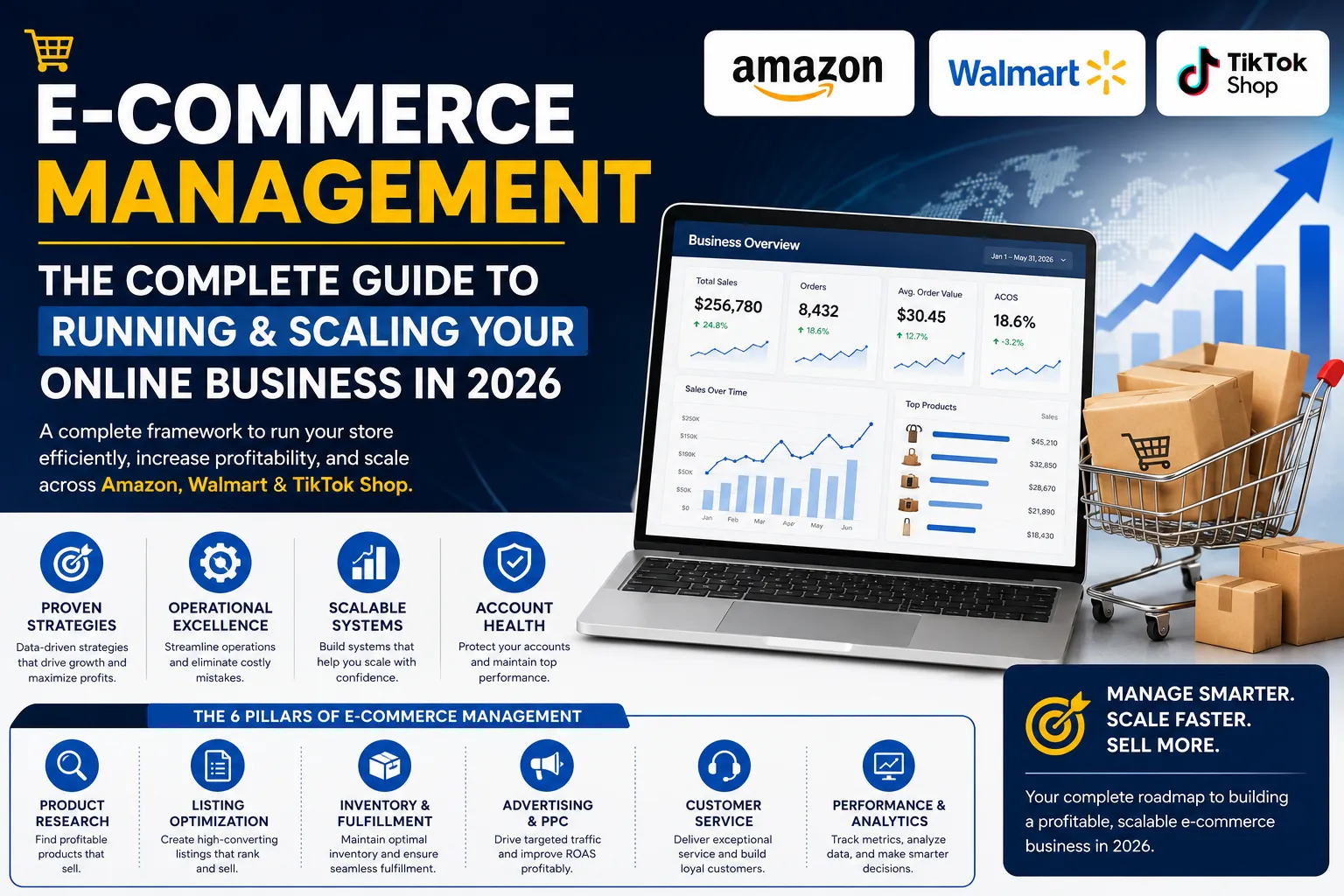
The Six Pillars of eCommerce Management
A fully functioning eCommerce management system operates across six integrated pillars. Each one contributes to revenue independently, and each one damages revenue when it fails.
Pillar 1: Product Research and Catalog Strategy
Every eCommerce business begins with product decisions, and those decisions compound over time. The right product in the right niche with the right margin structure makes every subsequent management task easier. The wrong product makes every subsequent task a cost recovery exercise.
Professional product research evaluates demand volume, competitive intensity, and margin viability as a system, not in isolation. A product with strong demand and weak margin is not a good product. A product with strong margin in a structurally inaccessible niche is not a good product. Both need to be right simultaneously.
Our Amazon Product Research Services and Walmart Product Research Services are built around this integrated evaluation framework.
Pillar 2: Listing Optimization and Content Management
Your product listing is your storefront, your sales pitch, and your SEO asset simultaneously. An underoptimized listing loses on all three dimensions: it ranks lower in search, it converts at a lower rate when shoppers do find it, and it fails to communicate the product’s value clearly enough to justify the purchase.
Listing optimization in 2026 covers title architecture, bullet point structure, product description and A+ Content, backend keyword mapping, main image CTR performance, secondary images, and video. Each element has a specific function in the ranking-and-conversion system. Missing any one of them creates a gap that your competitors will exploit.
Pillar 3: Inventory Management and Fulfillment Operations
Inventory management is the silent killer of eCommerce businesses that appear to be performing well on the surface. A business can have excellent listings, strong ad campaigns, and growing review counts, and still lose ranking momentum, customer trust, and margin to inventory mismanagement.
The specific risks: stockouts that push organic rank down on platforms that reward consistent sales velocity, overstock that generates storage fees and ties up working capital, inbound shipment errors that delay restocks, and fulfillment performance metrics that fall below platform thresholds when operations are not managed proactively.
Whether your fulfillment runs through Amazon FBA, Walmart Fulfillment Services (WFS), or a third-party logistics provider, the management requirements are the same: accurate demand forecasting, timely reorder points, and performance monitoring against platform SLAs.
Pillar 4: Advertising and PPC Management
Paid advertising on Amazon, Walmart, and TikTok serves two functions simultaneously, it generates immediate sales, and those sales generate the ranking signals that earn organic position. This dual function is what makes PPC management a strategic lever, not just a marketing expense.
The common failure mode is treating advertising as a set-it-and-forget-it operation. Campaigns are launched, budgets are set, and results are checked monthly. Meanwhile, wasted spend accumulates on non-converting keywords, profitable keywords are underbid, and the ad-to-organic revenue ratio stays unfavorable indefinitely.
Professional PPC management runs on weekly optimization cycles: search term data mined for exact match expansion, negative keywords implemented aggressively, bids adjusted based on conversion data, and TACoS (Total Advertising Cost of Sales) tracked as the primary efficiency metric rather than ACoS alone.
Our Amazon PPC Management Services, Walmart PPC Management Services, and TikTok PPC Management Services operate on this active management model.
Pillar 5: Account Health and Compliance Management
Every major eCommerce platform, Amazon, Walmart, TikTok Shop, operates a performance monitoring system that evaluates sellers against defined thresholds. Fall below those thresholds and the consequences are immediate: listing suppression, Buy Box removal, account suspension.
Account health management is the operational discipline of monitoring performance metrics proactively, resolving issues before they escalate, and maintaining policy compliance across every listing and every order. It is not glamorous work, but it is the foundation that everything else depends on. A suspended account generates zero revenue regardless of how good the products or listings are.
Pillar 6: Growth Strategy and Multi-Platform Scaling
The sixth pillar is where eCommerce management transitions from operations to strategy. Single-platform businesses are structurally fragile, algorithm changes, policy updates, or category saturation on one platform can eliminate revenue that took years to build. Multi-platform growth distributes that risk while compounding total revenue.
The sequence matters. Most sellers should establish operational excellence on their primary platform before expanding. A business that is losing margin to poorly managed Amazon PPC is not ready to launch on Walmart. But a business with stable organic rank, healthy account metrics, and a proven product catalog is in a strong position to expand to Walmart, TikTok Shop, or both simultaneously.
Why DIY eCommerce Management Has a Ceiling
The Compounding Cost of Divided Attention
The majority of eCommerce sellers who manage their own businesses are not failing, they are performing below their potential. The reason is structural, not personal. Running a growing eCommerce business requires simultaneous expertise in product research, copywriting, photography direction, keyword strategy, PPC bid management, inventory forecasting, fulfillment operations, customer service, and account compliance.
No single person is expert in all of these. And even sellers who are competent across multiple areas face the fundamental constraint of time: every hour spent managing ad campaigns is an hour not spent on product development, and every hour spent on customer service is an hour not spent on listing optimization.
The growth ceiling that self-managed sellers hit is not a reflection of their effort. It is a reflection of the finite capacity of one person to manage a system that requires specialist expertise across multiple disciplines simultaneously.
For a detailed look at why professional eCommerce store management is the structural unlock that removes this ceiling, read our guide on why eCommerce store management is key to growing your online business.
What a Professional eCommerce Management Agency Actually Delivers
The Difference Between Outsourcing Tasks and Gaining a Growth Partner
The distinction between a task-based freelancer and a professional eCommerce management agency is the difference between replacing one hour of your work with someone else’s hour, and building a system that generates compounding results without your constant involvement.
A task-based approach produces individual outputs: a listing written, a campaign launched, an appeal filed. A professional agency approach produces integrated outcomes: a listing that ranks and converts, a campaign that builds organic momentum, an account that stays healthy without crisis management.
What EcomManagers Manages End-to-End
EcomManagers operates as a full-service eCommerce management agency across Amazon, Walmart, and TikTok platforms. Our managed service covers every pillar of the six-pillar framework:
- Product research and niche validation, demand, competition, and margin evaluated as a system
- Listing creation and ongoing optimization, titles, bullets, A+ Content, images, backend keywords
- Inventory planning and fulfillment management, FBA, WFS, and 3PL operations
- PPC architecture and weekly optimization, Amazon, Walmart Connect, and TikTok ads
- Account health monitoring and compliance, proactive metric management across all platforms
- Multi-platform expansion strategy, growth across marketplaces
For a detailed framework on how to evaluate and choose the right eCommerce management partner for your specific business stage, read our guide on choosing the right eCommerce management service.
eCommerce Management in 2026 – What Has Changed
Platform Evolution That Impacts Every Managed Seller
The eCommerce management landscape in 2026 looks materially different from three years ago. Three shifts have changed what professional management requires:
AI-Powered Platform Tools Require Strategic Oversight
Amazon, Walmart, and TikTok have all integrated AI-powered automation into their advertising and listing tools. These tools offer real benefits, faster campaign setup, automated bid adjustments, content suggestions. They also introduce new risks: AI systems optimize for the metrics they are trained on, which are not always the metrics that matter for your specific margin structure and growth goals.
Professional management uses AI tools as accelerators, deploying them where they generate efficiency without replacing the strategic judgment that determines whether a campaign builds long-term organic rank or burns budget on short-term clicks.
Multi-Platform Presence Is Now a Competitive Necessity
Three years ago, a seller could build a sustainable business on Amazon alone. In 2026, single-platform dependence is a structural risk. The sellers building durable revenue are the ones managing coordinated presence across Amazon, Walmart, and TikTok, each platform with a platform-native strategy, not a copy-paste approach.
For a full picture of how a professional eCommerce agency structures multi-platform growth, read our guide on the smart way to scale online sales with an eCommerce agency in 2026.
Account Health Enforcement Has Tightened Significantly
Platform enforcement has become faster, more automated, and less forgiving. Listings that violate updated policy guidelines are suppressed within hours, not days. Account health thresholds are enforced more strictly. The margin for error that sellers enjoyed three years ago has narrowed considerably.
This shift makes proactive account health management, monitoring metrics before they reach threshold violations, not reacting after, a baseline requirement for any business that depends on marketplace revenue.
EcomManagers: Full-Service eCommerce Management Across Every Platform
Why Structure Beats Effort Every Time
EcomManagers manages eCommerce operations for sellers across the USA, UK, UAE, and Germany, on Amazon, Walmart, and TikTok simultaneously. Our model is not built around completing tasks. It is built around producing compounding results through integrated management of every operational layer.
The sellers who work with EcomManagers stop spending their time firefighting operational problems and start spending it on the decisions that actually grow their business: new products, new markets, new revenue streams.
Whether you are operating through Amazon Services USA, Walmart Services UK, TikTok Services UAE, or building a coordinated multi-platform presence, our regional specialists manage every layer of the operation with market-specific expertise.
The Outcome of Structured eCommerce Management
Sellers who manage without structure spend their energy on problems. Sellers who manage with structure spend their energy on growth. The difference is not effort, it is the system behind the effort.
EcomManagers builds that system. Consistently.
Explore our full service range and book a free strategy consultation to discuss your eCommerce management needs.
Frequently Asked Questions
What does an eCommerce management service include?
A full-service eCommerce management operation covers product research, listing optimization, inventory management, PPC advertising, account health monitoring, and multi-platform growth strategy. EcomManagers manages all six pillars across Amazon, Walmart, and TikTok for clients across the USA, UK, UAE, and Germany.
Why is eCommerce store management important for growth?
Without structured management, growth creates operational problems rather than compounding returns. Inventory errors, listing suppression, and wasted ad spend scale with the business if not managed proactively. Read our full guide on why eCommerce store management is key to growing your online business.
When should I hire an eCommerce management agency?
The right time is before your current management capacity becomes your growth ceiling, not after. Most sellers benefit from professional management when they are spending more than 20 hours per week on operational tasks, when account health issues are recurring, or when advertising spend is growing without a proportional improvement in organic rank.
What is the difference between an eCommerce manager and an eCommerce agency?
An eCommerce manager handles individual tasks, typically one function like advertising or customer service. An eCommerce agency manages the integrated system: every operational pillar working together toward the same growth outcome. For guidance on how to evaluate which model fits your needs, read our guide on choosing the right eCommerce management service.
Does EcomManagers manage stores on Amazon, Walmart, and TikTok?
Yes. EcomManagers provides full-service management across all three platforms, Amazon Services, Walmart Services, and TikTok Services, with regional specialist teams for the USA, UK, UAE, and Germany.
How does professional eCommerce management improve profitability?
By replacing reactive problem-solving with proactive systems. Inventory is managed before stockouts happen. Ad spend is optimized weekly rather than monthly. Listings are updated based on conversion data rather than intuition. Each improvement compounds, producing better margins, higher organic rank, and faster scaling velocity than self-managed operations can sustain.
Conclusion
In 2026, successful eCommerce businesses are built on structured management, not guesswork or reactive problem-solving. From product research and listing optimization to PPC, inventory, and account health, every operational layer directly impacts growth and profitability. Sellers who implement proactive systems and platform-specific strategies across Amazon, Walmart, and TikTok position themselves for scalable, long-term success in an increasingly competitive digital marketplace.